
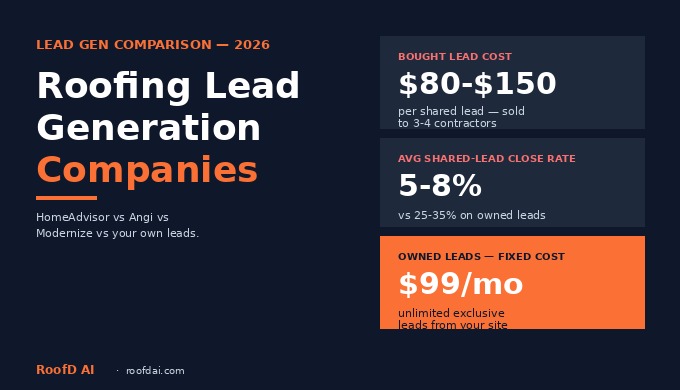
Roofing lead generation companies have been the default fallback for contractors who need leads fast. You sign up, your phone starts ringing, and the leads cost $80 to $150 each. The math seems to work, until you realize the same lead was sold to three other contractors, your close rate is 6%, and you are spending $1,200 a month for two jobs that barely cover the bill.
This is the math nobody runs before signing the contract.
At RoofD AI, we work with contractors who have used every major lead aggregator in the industry, and contractors who have walked away from all of them. The difference between the two groups is rarely the lead source. It is the math they ran before signing up. In this guide, we break down exactly how the major roofing lead generation companies compare, what they actually cost, and when it makes more sense to own your leads instead of buying them.
What Roofing Lead Generation Companies Actually Sell
Before comparing the major players, it helps to understand what these companies actually do. Most contractors sign up assuming the leads are exclusive and qualified. They are usually neither.
The Shared-Lead Model
The dominant model in roofing lead generation is the shared lead. A homeowner fills out a form on the aggregator’s website. The aggregator sells that same lead to three or four contractors simultaneously. You and your competitors all call the same homeowner within minutes of each other.
The homeowner is not happy about this. They expected one contractor to follow up. Instead, their phone rings four times in 30 minutes. They pick whoever sounds least pushy and ignore the rest. You paid $100 for that lead whether you closed it or not.
The Exclusive-Lead Model
A smaller subset of lead aggregators sell exclusive leads, meaning only one contractor receives each lead. Exclusive leads typically cost two to three times more than shared leads ($200 to $400 each) and convert at significantly higher rates because the homeowner is not being bombarded.
Exclusive leads are better economics, but the volume is dramatically lower. Most aggregators that promise exclusivity actually deliver it inconsistently. The lead may be “exclusive” in one ZIP code while being sold elsewhere as a shared lead.
HomeAdvisor (Now Angi): The Industry Default
HomeAdvisor merged with Angi (formerly Angie’s List) in 2017, and the combined platform is the largest roofing lead aggregator in the United States. Most contractors have used it at some point, and most have complaints.
How HomeAdvisor / Angi Pricing Works
Costs vary by ZIP code, service type, and demand, but roofing leads on HomeAdvisor typically run $80 to $150 per shared lead. Some markets charge higher for storm-related categories. There is also a monthly membership fee on top of per-lead charges.
Leads are sold to up to four contractors. The platform claims to “match” homeowners with the best contractors, but in practice the matching algorithm prioritizes contractors who pay more. This means even a contractor with strong reviews competes against newer paying contractors for the same leads.
Where HomeAdvisor / Angi Falls Short
The most consistent complaint from roofing contractors is lead quality. A significant percentage of HomeAdvisor leads turn out to be window shoppers, tire kickers, or homeowners who filled out the form months ago and have already hired someone. The platform’s refund process exists but is widely reported as slow and inconsistent.
Volume is real. Quality is the problem. Contractors who succeed on HomeAdvisor typically have a dedicated inside sales rep working leads within minutes of arrival, and even then, close rates rarely exceed 8% on shared leads.
Modernize: The Solar and Home Improvement Specialist
Modernize is the second-largest competitor in the home improvement lead generation space, with a strong focus on roofing, solar, and exterior services. The platform is privately held and has been acquired by EverCommerce.
How Modernize Pricing Works
Modernize uses a hybrid model: shared leads start at $50 to $100 in lower-competition markets and rise to $150+ in storm-prone or high-demand areas. Exclusive leads are available at premium pricing. The platform offers a self-service portal where contractors can adjust their lead volume and target ZIP codes.
Where Modernize Wins
Lead intent on Modernize is generally higher than HomeAdvisor because the platform attracts homeowners specifically researching home improvement projects rather than browsing a general directory. Forms ask more qualifying questions before the lead is sold, which improves the average lead quality.
Where Modernize Falls Short
Volume is significantly lower than HomeAdvisor. In smaller markets, contractors may receive only a handful of leads per month even on aggressive settings. The geographic coverage is uneven. Major metros are well-served, but rural and secondary markets often have minimal lead flow.
EverConnect, Networx, and the Long Tail
Below the top three (HomeAdvisor/Angi, Modernize, and exclusive providers), dozens of smaller lead aggregators compete for contractor budgets. EverConnect, Networx, Porch, and CraftJack each have specific strengths and weaknesses, but the patterns are consistent.
Lead Quality Decreases As You Go Down the List
Smaller aggregators source leads from a thinner pool, often from generic landing pages rather than branded consumer destinations. Lead quality reflects this. Many smaller platforms sell leads that have already been sold by larger platforms, layering markup without adding qualified buyers.
Pricing Becomes a Race to the Bottom
The smaller the platform, the more aggressive the pricing. Some niche aggregators advertise leads as low as $30 to $50 each, but lead-to-close ratios are correspondingly poor. Cost per acquired job is typically higher than the major platforms despite the lower per-lead price.
When Smaller Aggregators Make Sense
For very specific use cases (secondary markets, niche service categories like commercial flat roofing, or contractors looking to fill capacity gaps), smaller aggregators can supplement a primary lead source. They are rarely a sustainable primary channel.
The Real Cost Math Nobody Runs
This is the section most contractors skip. Comparing lead aggregator pricing on a per-lead basis is misleading. The real comparison is cost per closed job, and that number changes everything.
Shared-Lead Math
Assume HomeAdvisor at $100 per lead, 6% close rate, $12,000 average job value. Closing one job requires roughly 17 leads, a $1,700 acquisition cost per job. Margin on a $12,000 job after materials, labor, and overhead averages 15% to 20%, or $1,800 to $2,400. The lead cost consumes most of the profit.
Exclusive-Lead Math
Exclusive leads at $300 each with a 20% close rate require 5 leads per closed job, a $1,500 acquisition cost. Better than shared leads, but still consuming a significant portion of margin.
Owned-Lead Math
A website chatbot like RoofD AI at $99 per month captures every visitor your existing traffic delivers. Assume 200 monthly visitors, 8% chatbot conversion, 25% close rate. That produces 16 leads and 4 closed jobs per month, at a fixed cost of $99. Cost per closed job: under $25.
The economics are not close. Owned leads from your own website traffic outperform every paid aggregator on cost per closed job by an order of magnitude. For more on the conversion math behind this, read: The Real Cost of Not Having a Chatbot on Your Roofing Website
When Bought Leads Still Make Sense
Owned leads beat bought leads on every economic metric, but bought leads still have a role in some scenarios. Being honest about when each approach fits matters.
Scenario 1: You Are New and Have No Website Traffic
A new roofing company with no SEO, no Google reviews, and a website nobody visits cannot generate organic leads. Buying leads from HomeAdvisor or Modernize gets the phone ringing while you build the long-term assets. The mistake is staying on bought leads after the long-term assets are producing.
Scenario 2: You Have Capacity Gaps
A profitable roofing operation occasionally has a slow week: an installer crew finishing early, a sales rep with open availability. Buying leads to fill specific capacity gaps can make economic sense even when bought leads are not your primary channel.
Scenario 3: You Are Entering a New Market
Expanding into a new geographic area before your local SEO and reviews catch up justifies short-term lead buying. Treat it as a market entry cost, not a permanent strategy. For a deeper look at building a local lead foundation, read: Roofing Google Business Profile: Rank Higher and Get More Calls
How to Replace Bought Leads With Owned Leads
The transition from buying leads to owning leads takes 60 to 90 days for most roofing contractors. Here is the order of operations that works.
Step 1: Fix Your Website Lead Capture
Most roofing websites lose 95%+ of their visitors without converting them. Adding an AI chatbot that engages every visitor 24 hours a day captures the leads your website is currently losing. RoofD AI handles this layer specifically. Every visitor becomes a qualified lead in your CRM with no manual effort. For more on the website conversion side, read: Roofing Website Conversion: What Homeowners Actually Want in 2026
Step 2: Build Storm and Seasonal Lead Capture
Storm season events generate massive surges in homeowner inquiries. A website with 24/7 lead capture turns those surges into booked jobs while your competitors are still sleeping. For a complete framework on capturing storm-driven leads, read: How Roofing Contractors Can Win More Storm Season Jobs With AI
Step 3: Add a Referral System
Referred leads close at three to four times the rate of any paid lead source. Building a referral program that triggers automatically after every closed job creates lead flow that costs you nothing. For a complete referral system framework, read: Roofing Referral Program: Turn Every Job Into 3 More
Step 4: Layer Paid Channels Strategically
Once owned leads are flowing consistently, paid channels can supplement rather than replace your primary lead source. Targeted Facebook campaigns work particularly well for roofing. Read: Roofing Facebook Ads: Get More Leads Without Wasting Budget
Step 5: Phase Out Aggregator Spend
After 60 to 90 days of owned-lead flow, cut aggregator spend by 50%. Track the impact. If owned leads are producing the volume you need, cut the rest. Most contractors who follow this sequence end up cutting bought leads entirely within six months.
For a complete marketing framework that ties owned leads, paid channels, and referral systems together, read: Roofing Marketing Strategy: The Complete Contractor Guide for 2026
What to Demand Before Signing With Any Lead Generation Company
If you decide bought leads still fit your situation, the contract terms matter enormously. Most contractors sign whatever the aggregator puts in front of them and regret it within 60 days.
Demand 1: Refund Policy Clarity
Get the refund process in writing before signing. How quickly do invalid leads get refunded? What qualifies as invalid? Who decides? A vague refund policy means you have no real refund policy.
Demand 2: Lead Volume Caps
Without volume caps, aggregators can flood your account with leads at the start of the month and bill you accordingly. Set a monthly maximum in the contract.
Demand 3: Geographic and Service Limits
Specify exactly which ZIP codes and service categories you accept leads for. Aggregators routinely send leads outside your stated service area unless this is contractually limited.
Demand 4: Cancellation Terms
Most aggregator contracts auto-renew. Confirm the cancellation window and document it. Many contractors discover they are locked in for an additional 12 months because they missed a 30-day cancellation window buried in the contract.
Frequently Asked Questions About Roofing Lead Generation Companies
Q: Are roofing lead generation companies worth it in 2026? For new roofing contractors with no website traffic, bought leads can be a useful starting point. For established contractors with traffic, reviews, and brand presence, the economics rarely justify continued spend. Cost per closed job on shared leads typically runs $1,200 to $1,800, while owned leads from a website chatbot run under $50.
Q: What is the average cost per lead for roofing companies? HomeAdvisor and Angi shared leads run $80 to $150 each. Modernize runs $50 to $150. Smaller aggregators range from $30 to $100. Exclusive leads cost 2 to 3 times more, typically $200 to $400 each. The right comparison metric is cost per closed job, not cost per lead.
Q: Why do bought leads have such low close rates? Shared leads are sold to multiple contractors simultaneously. By the time you reach the homeowner, they have been called by 3 to 4 other contractors. They are frustrated, defensive, and looking for any reason to disqualify the next caller. Speed-to-lead matters enormously, but even with perfect speed, shared-lead close rates rarely exceed 8%. For more on speed-to-lead and follow-up, read: How to Never Miss a Roofing Lead Again (Even at 2am)
More Questions About Roofing Lead Generation
Q: Can RoofD AI replace HomeAdvisor or Angi for my roofing company? For most established contractors, yes. RoofD AI captures leads from your existing website traffic 24 hours a day at a fixed monthly cost: no per-lead charges, no shared leads, no sold-to-three-other-contractors problem. Every lead is exclusive and pushes directly to your CRM. For new contractors with minimal website traffic, RoofD AI is best paired with paid traffic or referral programs while organic traffic builds.
Q: How long does it take to replace bought leads with owned leads? 60 to 90 days for most roofing contractors. Adding a website chatbot produces immediate lead capture from existing traffic. Building referral systems and SEO-driven traffic takes longer but creates compounding flow. Most contractors who follow a structured transition plan cut aggregator spend by 50% within 90 days and eliminate it entirely within six months. For a deeper look at the without-ads conversion strategy, read: How to Get More Roofing Leads From Your Website Without Paying More for Ads
Q: Are exclusive leads worth the higher price? Exclusive leads typically convert at 2 to 3 times the rate of shared leads, which justifies the higher per-lead cost in many cases. However, exclusive lead volume is significantly lower, and “exclusive” claims are not always honored consistently. The economics still favor owned leads over exclusive bought leads in most scenarios, but exclusive leads are a meaningful upgrade over shared leads for contractors who choose to stay on aggregators.
Q: What contract terms should I negotiate with a roofing lead generation company? Refund policy clarity, monthly volume caps, geographic and service category limits, and cancellation terms. Most aggregator contracts auto-renew and include broad language that allows leads outside your stated service area. Document specific limits in the contract before signing. Verbal commitments do not survive contract disputes.
Stop Renting Leads. Start Owning Them.
The roofing contractors who consistently scale revenue in 2026 are not the ones spending the most on lead aggregators. They are the ones who built systems that capture leads from their own traffic, their own reviews, and their own referral networks, at a fraction of the cost per closed job.
RoofD AI handles the website lead capture layer of that system, making sure every visitor becomes a qualified lead in your CRM, exclusive to your business, at a fixed cost.
Before committing to paying per shared lead, run the math against capturing exclusive leads from your own website. Lead capture software runs a flat rate, and RoofD AI’s plans start free.
Or start your 7-day free trial. No charge until day 8, cancel any time.
