
Why Referrals Are the Highest-Value Lead Source in Roofing
Understanding why referred leads convert so much better than cold leads is the foundation of building a referral program worth investing in. The psychology behind referral conversions is straightforward, and it changes how you think about every completed job.The Trust Transfer Effect
When a homeowner refers your company to a neighbor, they transfer their trust to you. The referred homeowner arrives with a pre-built positive impression that no ad, no cold call, and no SEO content can replicate. As a result, they need significantly less convincing to book an inspection, accept an estimate, and sign a contract.Why Referrals Stop Without a System
Most roofing companies receive some natural referrals, but far fewer than they could with a formal program in place. Research from Nielsen confirms that 92% of consumers trust recommendations from people they know above all other forms of advertising. However, satisfied customers rarely refer proactively unless they are asked directly and given a clear, frictionless way to do it.The Timing Factor That Most Contractors Miss
The single biggest factor in referral generation is timing. A homeowner asked to refer within 24 to 48 hours of a completed job, when the experience is fresh and emotional, refers at dramatically higher rates than one asked weeks later. Without an automated system that fires within that window, most referral opportunities disappear permanently. For a full look at how automation handles post-job communication without manual effort, read: Roofing CRM Automation: Follow Up Every Lead on AutopilotThe 4 Components of a Formal Roofing Referral Program
Building a referral program that runs consistently requires four components working together. Each one addresses a different stage of the referral journey, from triggering the ask to capturing the new lead.Component 1: The Post-Job Trigger
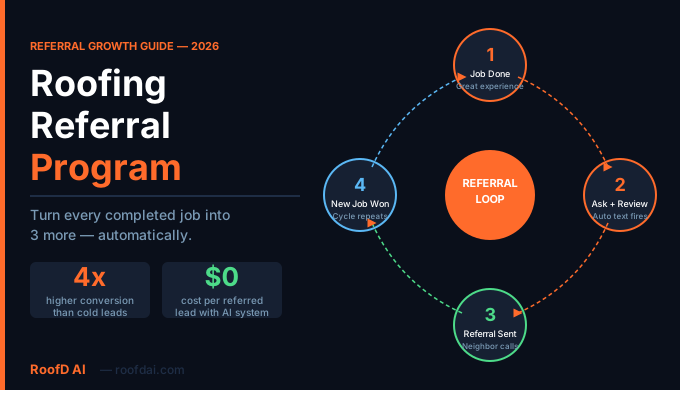
The referral program starts the moment a job moves to the Completed stage in your CRM. Within 24 hours, an automated thank-you text fires to the homeowner, expressing genuine appreciation for their business and planting the seed for the referral ask. Furthermore, a follow-up text fires 48 hours later with the formal referral request and a clear, simple way to act on it. This trigger needs to be automatic, not dependent on a team member remembering to send it. Consequently, every closed job activates the sequence regardless of how busy the team is or what else is happening that week.Component 2: The Incentive Structure
A clear incentive removes the hesitation that prevents otherwise willing referrers from acting. The most effective referral incentives in the roofing industry fall into three categories: gift cards, account credits, and charitable donations in the customer’s name. Gift cards in the $50 to $150 range work particularly well because they feel like a genuine thank-you rather than a commission. Account credits, applied toward future maintenance or repair work, have the added benefit of keeping the customer in your pipeline for repeat business. Additionally, charitable donations appeal to homeowners who prefer not to receive cash but still want to help your business grow.Component 3: The Frictionless Referral Process
The easier you make it to refer, the more referrals you receive. A referral ask that requires the customer to explain your services, remember your number, or navigate a complicated process gets ignored. In contrast, a referral ask that provides a pre-written text the customer can forward to a neighbor, or a direct link they can share in a neighborhood Facebook group, converts at significantly higher rates. The referral text message should do three things: tell the recipient what problem you solved, establish the trust transfer (“we just had our roof replaced by them and the experience was great”), and provide one clear action step, such as a phone number or website link.Component 4: The Lead Capture System That Converts the Referral
The final component, and the one most roofing companies miss entirely, is an active lead capture system on your website that converts referred traffic into qualified leads automatically. A neighbor who receives a referral text and visits your website at 10pm needs to find an engaged, responsive experience that captures their information before they move on. RoofD AI handles this automatically. The chatbot engages every referred visitor the moment they land, delivering an instant satellite-based estimate, answering their questions, and capturing their contact details before they leave. As a result, referred visitors who arrive motivated and trust-primed become qualified leads in your CRM within seconds. For a full breakdown of how AI lead capture works on your website, read: The Real Cost of Not Having a Chatbot on Your Roofing WebsiteThe Referral Text Templates That Get Results
The message you send matters as much as the timing. These templates are designed specifically for roofing referral programs: clear, warm, and easy for the customer to act on immediately.Template 1: The Referral Ask (Send 48 Hours After Job Completion)
“Hi [First Name], [Your Name] from [Company] here. We loved working on your home and hope you are enjoying the new roof! If you know any neighbors or friends who might need roofing work, we would really appreciate the introduction. Here is a message you can forward to them: ‘[Company] just replaced my roof and did a great job. Call [Phone Number] or visit [Website] if you need a roofer.’ We will send you a [gift card amount] Amazon gift card as a thank-you for any job we book from your referral. Thank you again!”Template 2: The Neighborhood Outreach Version
“Hi [First Name], quick favor to ask. We are doing work on several roofs in your neighborhood right now and would love to help more of your neighbors. If you know anyone on [Street Name] or nearby who might need a roof inspection or replacement, please share our info: [Phone Number] or [Website]. We will take great care of them, and we will send you [incentive] as our thanks. You are the best!”Template 3: The Review Plus Referral Combination
“Hi [First Name], [Your Name] from [Company]. Thank you for trusting us with your home. Two small favors, if you do not mind. First, a quick Google review would help other homeowners find a trustworthy roofer: [Review Link]. Second, if you know anyone needing roof work, please send them our way: [Website] or [Phone Number]. We are grateful for every introduction. Thank you!” For a complete library of follow-up and referral text templates for every stage of your sales process, read: Roofing Follow Up Text Templates That Close More JobsHow to Build a Neighborhood Referral Strategy
Individual referrals are powerful. However, a neighborhood-level referral strategy amplifies the effect by systematically activating everyone within viewing distance of every job you complete.The Yard Sign and Door Hanger Approach
Every completed job should result in a yard sign placed at the property, with your company name, phone number, and a QR code linking to your website. Neighbors who walk or drive past the job site see the sign for days or weeks after the crew leaves. Furthermore, door hangers placed on the five closest properties on each side of the job site (“We just completed your neighbor’s roof at [address]. Call us for a free inspection”) consistently generate same-neighborhood inquiries that cost almost nothing to produce.The Neighborhood Digital Outreach
After completing a job, post a before-and-after photo to the neighborhood’s Facebook group or Nextdoor page, with permission from the homeowner. These posts consistently generate inquiries because they combine social proof with hyper-local relevance. A homeowner who sees a before-and-after of a house two streets away is far more engaged than one who sees a generic ad. Additionally, encouraging the homeowner to tag your company in their own post on Nextdoor or a neighborhood Facebook group activates their personal network in a way that feels authentic rather than promotional.How AI Captures the Neighborhood Traffic
Every yard sign, door hanger, and neighborhood social post drives traffic to your website. RoofD AI ensures that traffic converts into leads automatically, engaging every visitor instantly, delivering an estimate, and pushing a qualified lead to your CRM regardless of the time. Consequently, the neighborhood marketing that generates awareness connects directly to a lead capture system that closes the loop without any manual intervention. For a complete look at the AI tools that power this kind of compounding system, read: The Best AI Tools for Roofing Companies in 2026Connecting Your Referral Program to Your Review Strategy
The most effective roofing referral programs run alongside the review generation system, because both happen at the same moment in the customer relationship and both benefit from the same timing.Why Reviews and Referrals Work Together
A homeowner who leaves a 5-star review on Google has already publicly endorsed your company. Moreover, that same endorsement mindset makes them significantly more likely to refer to friends and family when asked immediately afterward. The post-job automation sequence should therefore trigger both, a review request and a referral ask, within the same 24 to 48 hour window.The Compound Effect on Your Google Business Profile
Every review generated through the post-job sequence strengthens your Google Business Profile, improves your map pack ranking, and increases the organic visibility that drives more homeowners to your website. More website visitors mean more AI chatbot leads. More closed jobs mean more post-job sequences. Additionally, more post-job sequences mean more reviews and more referrals, and the compounding cycle builds continuously without proportional increases in marketing spend. For a complete guide to automating your Google review generation process, read: How to Get More 5-Star Google Reviews for Your Roofing Company AutomaticallyBuilding Referral Partnerships Beyond Your Customers
Individual customer referrals are valuable. However, professional referral partnerships (relationships with complementary businesses that regularly encounter homeowners who need roofing work) can generate a consistent, high-volume referral stream that compounds independently of your job volume.Real Estate Agents
Real estate agents need trusted roofing contractors for pre-listing inspections, buyer due diligence, and post-sale repair work. A single productive relationship with an active real estate agent in your market can generate dozens of qualified referrals per year. Furthermore, real estate agent referrals carry enormous trust weight. A homeowner referred by their agent is among the most motivated and highest-converting prospects in any roofing pipeline.Insurance Agents and Adjusters
Insurance agents regularly encounter homeowners dealing with storm damage, roof age, and coverage requirements. A roofing contractor who establishes a professional relationship with local insurance agents, offering expertise, fast response, and seamless claims assistance, positions themselves as the recommended contractor for every insurance-related roofing need in their network. For a complete guide to winning more insurance restoration work, read: Roofing Insurance Claims and AI: How Smart Contractors Are Closing More Restoration JobsProperty Managers
Property managers overseeing residential rental portfolios, HOAs, and commercial properties need reliable roofing contractors on call for maintenance, emergency repairs, and periodic replacements. Unlike individual homeowner relationships, property manager relationships generate recurring work across multiple properties, making them among the highest lifetime-value referral sources available to any roofing contractor.How to Track Whether Your Referral Program Is Working
A referral program without tracking is an expense without accountability. Measuring three specific metrics tells you whether the program is generating ROI and where to improve it.Metric 1: Referral Rate Per Completed Job
Divide the number of referral leads received in a month by the number of jobs completed in the same period. A mature, well-run referral program should generate 0.3 to 0.5 referrals per completed job, meaning every 10 jobs produces 3 to 5 referral leads. Additionally, tracking this metric monthly shows whether changes to the incentive structure or template messaging are improving or reducing referral conversion.Metric 2: Referral Lead Conversion Rate
Track what percentage of referral leads convert to booked inspections and signed contracts versus cold inbound leads from ads or organic search. Referral leads should convert at significantly higher rates. In contrast, if referral conversion is similar to cold lead conversion, the referrals are not arriving with the expected trust premium, which may indicate the referring customer did not fully endorse your company in their message.Metric 3: Cost Per Referral Lead
Calculate the total referral program cost (gift cards paid out, door hanger printing, yard sign production) divided by the number of referral leads generated. Consequently, comparing this number to your cost per lead from Google Ads or other paid channels reveals the true ROI advantage of your referral program. For a full look at how referral programs fit into a complete roofing marketing strategy, read: Roofing Marketing Strategy: The Complete Contractor Guide for 20267 Steps to a Roofing Referral Program That Runs Itself
1. Earn it first: deliver referral-worthy work
No program overcomes a mediocre job. Referrals start with work worth talking about: showing up when you said you would, communicating clearly, protecting the landscaping, and leaving the property cleaner than you found it. The final walkthrough matters most. Walk the homeowner around, show them what was done, and hand them a job they’re proud to show the neighbors. Everything below assumes this foundation is solid.
2. Ask at the peak moment
Timing is everything. Ask in person right after the final walkthrough, when satisfaction is at its highest and the new roof is gleaming. Keep it natural and specific: “If you know anyone dealing with roof issues, we’d love an introduction. We take great care of referrals.” Name the reward in the same breath so the ask feels concrete, not vague. Then follow up in writing the same day with a simple link they can share. Asking once, clearly, at the right moment outperforms a dozen passive mentions.
3. Choose a reward people actually want
The reward has to be worth the social effort of making an introduction. A flat reward for every referral that turns into a signed job works best: cash, a gift card, or credit toward future work. Keep the rules to one sentence and pay promptly when the job signs. Slow or complicated rewards teach people not to bother. Generosity here is cheap compared to what you’d pay for the same job through ads.
4. Make referring effortless
Every bit of friction kills referrals. Give customers one simple way to refer: a short link they can text, a QR code printed on the final invoice, or a pre-written message they can forward. Don’t ask them to download an app, create an account, or fill out a form. If referring takes more than thirty seconds, most people won’t do it.
5. Automate the asks and the follow-ups
This is what makes the program run itself. Set up an automatic sequence: a thank-you text with the referral link the day the job completes, a check-in at thirty days asking how the roof is holding up, and a seasonal touch at six or twelve months. Each message is another natural chance to ask, and none of them require anyone on your team to remember. When a referred lead does come in, respond fast, because a warm introduction goes cold just like any other lead. Our guide to speed to lead for roofing explains why the first minutes matter most.
6. Track every referral
You can’t improve what you don’t measure. Tag every referral’s source in your CRM or even a simple spreadsheet: who referred them, when, and whether they signed. Tracking lets you spot your best referrers, thank them properly, and see which jobs produce the most referrals. It also keeps you honest about whether the program is actually working or just feels like it is. Review the numbers monthly and double down on whatever is producing.
7. Close the loop and say thanks
When a referral signs, tell the referrer. A quick call or handwritten note, “Thanks to you, we’re doing the Johnsons’ roof next month,” makes people feel like insiders in your business. Then ask for the review too, while you’re at it. Customers who refer and review become the engine of your reputation, and recognizing them publicly, with permission, encourages the next round.
Mistakes That Kill Referral Programs
A few common traps: asking weeks after the job when the excitement has faded, burying the program in fine print nobody reads, offering rewards so small they feel insulting, and paying out so slowly that referrers forget they referred. Another quiet killer is making the program hard to find: if customers have to ask how referrals work, most never will. Put the details on your website, on the final invoice, and in every post-job email. The biggest mistake is treating the program as a launch instead of a habit. Referral systems work through repetition: every job, every walkthrough, every automated follow-up. Set it up once, then let it run.
