
Knowing how to hire a roofing sales rep is one of the most expensive lessons most contractors learn the hard way. You post a job. Three candidates show up. You pick the one who sounds confident. Six weeks later they have closed two jobs, both at margins that barely cover their draw, and you are wondering whether the hire was a mistake.
The hire was not the mistake. The hiring system was.
At RoofD AI, we work with roofing contractors who have built sales teams that close consistently, and contractors who have burned through three reps in twelve months. The difference is rarely the people. It is the system around them. In this guide, we break down exactly how to hire a roofing sales rep, what to pay them, and how to ramp them to full production in 90 days.
Why Most Roofing Sales Hires Fail in the First 90 Days
Before getting into the hiring process, it helps to understand exactly where most roofing sales hires break down. The same three failure points show up consistently across the industry.
Failure Point 1: No Lead Pipeline to Feed the Hire
A new sales rep needs leads to work. Most roofing contractors hire a rep before their lead pipeline can support one. The rep arrives expecting 15 to 20 qualified leads per week. They get 4. By week six, they are calling old leads, knocking doors out of frustration, and questioning the move. By week ten, they are gone.
This is the single most common reason roofing sales hires fail. The contractor blames the rep. The rep blames the contractor. The truth is that neither party set the system up to succeed. For a deeper look at building a lead system that can support a sales hire, read: How to Get More Roofing Leads From Your Website Without Paying More for Ads
Failure Point 2: Compensation That Punishes Early Effort
A pure-commission structure sounds great to the contractor. It looks impossible to a candidate without industry experience. The result is that you only attract experienced roofing salespeople, who are either already employed or have been let go from somewhere else. The talent pool shrinks dramatically.
The right compensation structure protects the rep during ramp-up while rewarding production. Without that protection, your job listing competes against every other roofing company offering the exact same deal, and you lose every candidate worth hiring.
Failure Point 3: No Onboarding System
Most roofing contractors throw new reps into the deep end. Day one is a ride-along. Day two is “go close some jobs.” There is no script training, no objection-handling rehearsal, no CRM setup, no defined success metrics for the first 30, 60, or 90 days. The rep is essentially being asked to figure it out alone.
A structured 90-day ramp plan turns the same candidate into a 30% closer instead of a 10% closer. The rep is the same person. The system around them is the difference. For a complete framework on building that training system, read: Roofing Sales Training: Close More Jobs in 2026
The Pre-Hire Checklist: What You Need Before Posting the Job
Before writing a single job description, confirm these three things are in place. Hiring before they are ready guarantees the failure points above.
Check 1: A Predictable Lead Flow
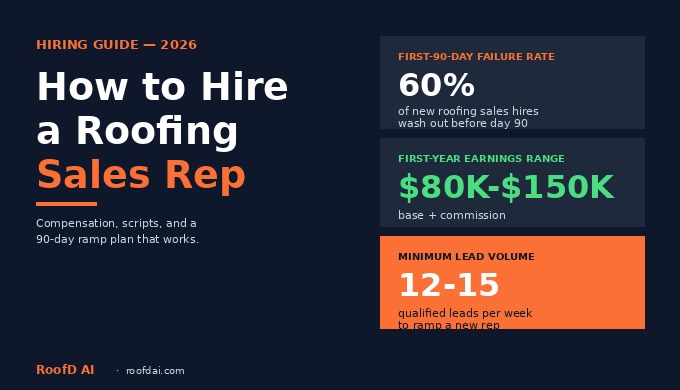
Your new rep needs at least 12 to 15 qualified leads per week to ramp into full production. If your current pipeline cannot support that volume, the hire fails before it starts. Audit your last 90 days of inbound leads. If the number is below 50 per month, fix the lead system first. Hire second.
RoofD AI helps fill this gap by capturing every website visitor 24 hours a day. The leads your team would otherwise miss become the leads your new rep works on day one. For more on why this matters, read: The Real Cost of Not Having a Chatbot on Your Roofing Website
Check 2: A CRM That Routes Leads Automatically
Your rep should never log into a CRM and wonder which leads to call. Every lead in their queue should arrive pre-qualified, pre-scored, and pre-organized. If your current CRM cannot do this, fix it before hiring.
RoofD AI integrates via webhook with AccuLynx, JobNimbus, HubSpot, GoHighLevel, Salesforce, Zapier, Buildertrend, and ServiceTitan, so leads land in your rep’s queue with full context every time. For a full comparison of the top CRMs for sales teams, read: JobNimbus vs AccuLynx: Which CRM Is Right for Your Roofing Company?
Check 3: Defined Success Metrics
Before posting the job, define what success looks like at 30, 60, and 90 days. Number of inspections booked. Close rate target. Average ticket size. Total revenue. Without these metrics, you have no way to evaluate the hire, and the rep has no way to track their own progress.
Compensation Structures That Actually Attract Talent
This is the section most contractors skip, and the section that determines whether your job posting attracts 3 candidates or 30. Roofing sales compensation in 2026 falls into four common structures. Each has tradeoffs.
Structure 1: Pure Commission
The classic. No salary, commission only, typically 8% to 12% of gross job value, sometimes higher for self-generated leads. Attractive only to experienced reps who can ramp themselves. Almost impossible to fill with new talent.
Use this only if you are recruiting a senior rep with a portable book of business. For everyone else, this structure filters out the candidates worth hiring.
Structure 2: Base Plus Commission
A modest base salary ($30,000 to $45,000) plus reduced commission (5% to 8%). The base protects the rep during ramp-up. The commission rewards production. This is the most common structure for serious roofing sales hires in 2026.
According to U.S. Bureau of Labor Statistics data, the median annual wage for sales representatives in wholesale and manufacturing was $73,150 in May 2024. Roofing sales reps on a base-plus-commission structure typically earn between $80,000 and $150,000 annually depending on market and ramp success. Quality candidates expect this range. Paying significantly below it limits your candidate pool.
Structure 3: Draw Against Commission
A weekly or monthly draw the rep can pull against future commissions. The draw protects cash flow during ramp-up. Once commissions exceed the draw, the rep keeps the difference.
This structure works well for candidates with some industry experience but no current pipeline. It signals confidence in the rep’s potential without committing to a full salary.
Structure 4: Full Salary Plus Bonus
A higher base salary ($55,000 to $70,000) with performance bonuses tied to specific metrics: close rate, average ticket size, customer satisfaction. Attracts candidates who value stability over upside.
Best used for inside sales roles or junior reps you plan to develop into outside roles over 12 to 18 months.
The Roofing Sales Rep Job Description That Attracts the Right Candidates
Most roofing sales job postings are interchangeable. “Looking for a hungry, motivated salesperson to join our team.” Every contractor in the country posts the same listing. The candidates who would actually move the needle scroll past it.
A job description that attracts talent does three things differently.
Specify the Lead Source
Top candidates filter job listings by lead quality. A listing that mentions “company-provided leads from our website chatbot, average 18 qualified leads per week” beats a listing that says “leads provided” every time. Be specific about volume and quality.
State the Realistic First-Year Earnings
Vague earnings ranges signal that the contractor either does not know the numbers or is trying to hide them. Both are red flags to experienced candidates. State the realistic range: “Realistic first-year earnings $90,000 to $130,000 based on close rate of 25% to 35%.”
Outline the Ramp Plan
A job listing that includes a structured 30/60/90 day ramp plan signals that the contractor takes hiring seriously. Top candidates will read that section and decide they want to work for you specifically. Most contractors leave this out entirely.
For more on building the broader systems that support a structured ramp plan, read: How to Scale a Roofing Business With AI in 2026
The 90-Day Ramp Plan Template
Once a candidate is hired, the next 90 days determine whether they reach full production or wash out. This is the exact ramp framework that turns new hires into top closers.
Days 1 to 30: Foundation
Week 1: Product knowledge. Shingle brands, slope multipliers, financing options, warranty differences. The rep should be able to answer any homeowner technical question by end of week.
Week 2: CRM training and lead workflow. The rep masters the inbound lead process: how leads arrive, how to log activities, how to advance leads through the pipeline. Connecting CRM activity to your follow-up automation matters here. For a guide to the CRM automation infrastructure your rep should be working inside, read: Roofing CRM Automation: Follow Up Every Lead on Autopilot
Week 3: Ride-alongs. The new rep shadows your top closer on inspections and proposals. Goal is exposure to real-world objection handling.
Week 4: First solo inspections. The rep runs 5 to 8 inspections with a senior rep available by phone for support. Goal is initial confidence, not closing performance.
Success metric for Day 30: 20+ completed inspections, full CRM proficiency, basic objection handling demonstrated.
Days 31 to 60: Production
The rep transitions to full lead volume. Weekly 1:1 coaching with the sales manager focuses on specific deal feedback. Close rate target during this phase is 15% to 20%, below the experienced rep target but above the cold-start baseline.
Equipping the rep with tested follow-up scripts during this phase compounds results dramatically. For a complete library of follow-up text templates your rep can deploy from day one, read: Roofing Follow Up Text Templates That Close More Jobs
Success metric for Day 60: 40+ inspections completed, 6 to 8 jobs closed, average ticket within 10% of company average.
Days 61 to 90: Optimization
The rep should be operating at full lead volume with close rates approaching 25% to 30%. Coaching shifts from fundamentals to optimization: average ticket improvement, upsell opportunities, referral generation.
Success metric for Day 90: 25%+ close rate, $12,000+ average ticket (or local market equivalent), 1+ referral generated per closed job.
What Disqualifies a Roofing Sales Candidate Immediately
Some signals during the interview process should end the conversation immediately. These red flags appear consistently in failed hires.
Red Flag 1: They Cannot Articulate a Sales Process
Ask a candidate to walk you through their close process from first call to signed contract. A serious rep can do this in five minutes with specific steps and timing. A candidate who gives you generic answers like “I just build rapport” does not have a process. They have an attitude.
Red Flag 2: They Blame Past Companies for Performance
A candidate who explains their past underperformance by blaming bad leads, bad management, or bad pricing is telling you exactly what they will say about your company in nine months. Strong candidates own their results.
Red Flag 3: They Have No Questions About Lead Quality
A candidate who does not ask detailed questions about your lead source, lead volume, and lead quality is either inexperienced or not serious about the role. Top candidates know that lead quality determines their income.
Frequently Asked Questions About How to Hire a Roofing Sales Rep
Q: How long does it take to hire a roofing sales rep? The hiring process from first job posting to first day on the job typically takes 4 to 8 weeks. Two to three weeks for sourcing candidates, one to two weeks for interviews and reference checks, and one to two weeks for the candidate’s transition from their current role. Rushing this timeline frequently produces bad hires.
Q: Should I hire experienced roofing sales reps or train new ones? Both can work, but the systems differ. Experienced reps need higher compensation and a strong CRM environment. New reps need a structured 90-day ramp plan and consistent coaching. The wrong system for either profile produces failure. Most contractors succeed with one or two experienced reps who set the standard, plus newer hires who are developed over time.
Q: How many leads does a new roofing sales rep need per week? A new rep typically needs 12 to 15 qualified leads per week during their first 60 days, scaling to 18 to 25 leads per week at full production. Below this volume, ramp-up stalls and frustration builds. For a deeper look at how to build a lead pipeline that supports a sales team, read: How to Never Miss a Roofing Lead Again (Even at 2am)
More Questions About Hiring Roofing Sales Reps
Q: What is the typical commission rate for a roofing sales rep in 2026? Commission rates typically range from 5% to 12% of gross job value. The lower end applies when reps work company-provided leads on a base-plus-commission structure. The higher end applies to self-generated leads or pure-commission roles. Most roofing companies pay between 7% and 10% on company-provided leads.
Q: How do I keep good roofing sales reps from leaving for competitors? Three factors matter most: lead quality, compensation transparency, and growth opportunity. Reps leave when leads dry up, when they suspect their commission calculations are wrong, or when there is no path beyond their current role. Building a strong lead pipeline through tools like RoofD AI, publishing transparent commission reports, and creating a defined sales manager track addresses all three.
Q: Can RoofD AI help my new sales rep close more jobs? Yes. RoofD AI captures website leads 24 hours a day and pushes them to your CRM with full context: name, address, roof size, damage description, material preference, and estimate range. Your rep starts every conversation already informed about the homeowner’s situation, dramatically improving close rates compared to cold form submissions.
Q: How does marketing strategy connect to sales rep success? Sales rep success depends entirely on the quality and volume of leads coming in. Without a marketing strategy generating consistent inbound leads, no sales rep will hit their numbers regardless of skill. For a complete marketing framework that supports a growing sales team, read: Roofing Marketing Strategy: The Complete Contractor Guide for 2026
Build the System Before You Make the Hire
The best roofing contractors do not hire their way out of operational problems. They build systems that make every hire successful: predictable lead flow, defined ramp plans, transparent compensation, and tools that give every rep the same advantages.
RoofD AI handles the lead capture layer of that system, making sure every website visitor becomes a qualified lead in your CRM, ready for your sales team to work the next morning.
Or start your 7-day free trial. No charge until day 8, cancel any time.
