
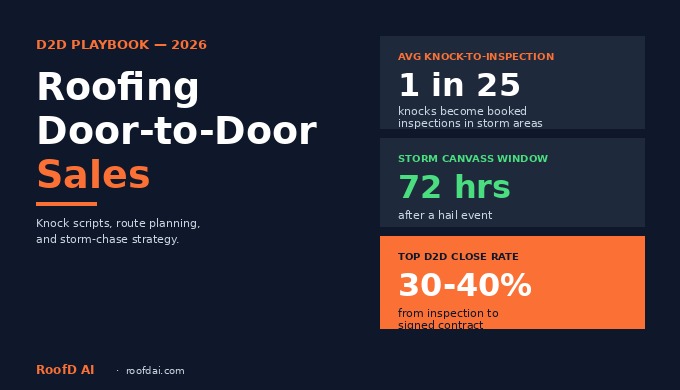
Roofing door to door sales is the highest-leverage sales channel in the entire industry, and the one most contractors get completely wrong. A storm rolls through a neighborhood on Tuesday night. By Wednesday morning, a dozen roofing companies are knocking the same doors. The crews who close 30% of their inspections are running a system. The crews who close 8% are reading scripts off their phones.
The difference is not personality. It is preparation.
At RoofD AI, we work with roofing contractors who run D2D crews ranging from solo canvassers to 20-person storm teams. The patterns are consistent. The contractors who win at door-to-door have systematized every step: route planning, knock scripts, objection handling, follow-up cadence, and lead handoff to the office. In this guide, we break down exactly how roofing door to door sales works in 2026, what the top crews do differently, and how to build a D2D system that produces consistent results.
Why Roofing Door to Door Sales Still Works in 2026
Door knocking has been declared dead in nearly every industry, except roofing. The reason is structural. Roofing decisions are triggered by events most homeowners cannot evaluate themselves. A hailstorm hits. The homeowner glances at their roof. Everything looks fine from the ground. They go back inside.
Then a roofer knocks the door.
The Information Asymmetry Problem
Most homeowners cannot identify hail damage from the ground. They cannot tell the difference between asphalt granules in their gutter and routine wear. They have no way to evaluate whether their roof was affected by Tuesday’s storm. A roofer at the door who can climb up, take photos, and show them what they cannot see provides genuine value.
This is why D2D works for roofing in a way it does not work for almost any other home service. The homeowner needs the information you can provide. They cannot get that information from a Google search.
The Insurance Restoration Multiplier
Most successful D2D roofing operations focus on insurance restoration work. A homeowner who would never spend $15,000 on a new roof out of pocket happily files a claim when a contractor identifies storm damage they did not know existed. The insurance company pays. The homeowner pays only their deductible. The contractor closes a $15,000 to $25,000 job they never would have won through inbound channels.
For a deeper look at how insurance restoration economics work and where AI fits in, read: Roofing Insurance Claims and AI: How Smart Contractors Are Closing More Restoration Jobs
The Three D2D Strategies That Actually Work
Not all door knocking is the same. Roofing contractors who scale their D2D operations typically run one of three distinct strategies. Each requires a different system.
Strategy 1: Storm Chasing
The classic D2D strategy. A hail or wind event hits a metro area. Within 24 to 72 hours, a roofing crew arrives and canvasses every neighborhood inside the storm path. The pitch is direct: “We’re inspecting roofs in your neighborhood for storm damage. Free inspection, no obligation.”
Storm chasing produces enormous volume in compressed windows. A team of 6 canvassers can generate 40 to 60 inspections in a single weekend after a major storm. Close rates on those inspections typically run 25% to 35% when crews are well-trained.
For more on capturing storm-driven demand at every channel, read: How Roofing Contractors Can Win More Storm Season Jobs With AI
Strategy 2: Neighborhood Saturation
Less time-pressured than storm chasing. A contractor identifies a neighborhood where they have just completed a job (yard sign up, branded truck visible) and canvasses the surrounding blocks within 30 days. The pitch leverages social proof: “We just finished a roof for [neighbor name] down the street. We’re checking other roofs in the area while we’re here.”
Neighborhood saturation produces lower volume than storm chasing but significantly higher close rates because the proximity-to-completed-work signal builds trust faster than cold knocks.
Strategy 3: Targeted Aging-Roof Canvassing
The most sophisticated strategy. Using satellite imagery and county property records, a contractor identifies neighborhoods built 15 to 25 years ago, the prime replacement window. Canvassers approach those neighborhoods systematically, pitching free roof inspections regardless of storm activity.
Targeted canvassing requires more upfront preparation but generates inspection volume even in storm-quiet seasons. Close rates run 15% to 20%, lower than storm chasing but consistent year-round.
The Knock Script That Converts
Most D2D roofing crews use scripts that fail at the first sentence. A homeowner opening their door does not want to hear a sales pitch. They want to know who you are, why you are at their door, and what specifically you want from them. The script that works addresses those three questions in under 15 seconds.
The Opening: 10 Seconds Maximum
“Hi, I’m [Name] with [Company]. We’re inspecting roofs in [Neighborhood] for storm damage from [specific event date]. Free inspection, takes about 15 minutes. Would you like me to take a look?”
Three things this opening does right: it identifies you immediately (no mystery), it states a specific reason (storm damage from a specific event), and it asks for a small commitment (15 minutes, free). Vague openings like “How are you doing today?” trigger immediate sales-defense reflexes.
The Common Objections and How to Answer Them
“I’m not interested.” Response: “Totally understand. Most people aren’t until they see what we found on three of your neighbors’ roofs. Five minutes. I’ll take a look from the ground and let you know if anything needs attention.”
“I just had my roof checked.” Response: “Got it. Was the inspection from after the [date] storm? That’s the one we’re specifically checking for. Insurance only covers damage from that event.”
“I don’t have time right now.” Response: “Completely fair. What’s a better time? I can come back tomorrow at [specific time].” Always propose a specific time.
The Close: Booking the Inspection
If the homeowner agrees to an inspection, book it on the spot. Pull out a tablet, show your calendar, and propose two specific times: “I have today at 4pm or tomorrow morning at 9am. Which works better?” Vague handoffs (“I’ll call you to schedule”) lose 60%+ of the bookings you just earned.
For more on the systematic sales process that follows the inspection, read: Roofing Sales Training: Close More Jobs in 2026
Route Planning That Maximizes Knocks Per Hour
Most D2D crews optimize for knock count without optimizing for knock quality. The crews that produce consistent results plan routes that hit the highest-probability doors first while minimizing drive time and walking distance.
The Three-Layer Route Map
Layer 1: Storm path verification. For storm chasing, overlay the National Weather Service storm reports on a neighborhood map. Knock only inside the verified hail or wind path. Knocking outside the storm zone wastes time and damages credibility when you cannot find damage.
Layer 2: Roof age estimation. Using county assessor data or a tool like Property Records, identify homes built 15 to 25 years ago. Within the storm zone, prioritize these homes first.
Layer 3: Front-yard accessibility. Skip homes with locked gates, security signs, or “No Soliciting” placards. Time spent on inaccessible homes is time not spent on workable doors.
Door Density Per Hour
A well-organized canvasser hits 25 to 35 doors per hour in a residential neighborhood. Below 20, the route is poorly planned. Above 40, the canvasser is rushing and not actually engaging homeowners.
The Notes System
Every door gets logged, even no-answers. Top D2D operations use a CRM-connected mobile app that records every door knocked, every conversation outcome, and every callback request. No-answer doors get re-knocked at different times of day. Callback requests get fed into the office for follow-up. For a complete framework on follow-up automation, read: Roofing CRM Automation: Follow Up Every Lead on Autopilot
How AI and Technology Change D2D in 2026
Door knocking is still fundamentally a human activity, but the systems supporting it have evolved dramatically. Crews that integrate the right technology produce 2 to 3 times the results of crews still working from paper notes.
Tablet-Based Damage Documentation
Modern D2D crews carry tablets with photo capture, annotation, and instant report generation. A canvasser who finds storm damage can produce a printed or emailed damage report before leaving the property. That immediacy creates commitment that paper-based pitches cannot match.
Drone-Assisted Inspections
Crews that use drones for the inspection phase document damage faster and more thoroughly than ladder-based inspections. The homeowner sees their damage in high-resolution images on a tablet within 20 minutes of the canvasser knocking. That speed and visual proof closes inspections faster than any verbal pitch.
After-Knock Lead Capture
Here is the gap most D2D operations miss. A canvasser knocks 200 doors. They book 8 inspections. The other 192 doors have not bought yet, but many will Google the company within hours. If your website cannot capture those visitors, you lose them to the next contractor who knocks the same neighborhood next week.
RoofD AI captures every visitor who Googles your company after a D2D knock, 24 hours a day, even at 10pm when the homeowner is finally thinking about that conversation from earlier. Each captured lead arrives in your CRM with full context. For a deeper look at why this matters, read: The Real Cost of Not Having a Chatbot on Your Roofing Website
The Compensation Model That Attracts Top D2D Talent
Most roofing contractors pay D2D canvassers poorly and wonder why turnover is constant. The compensation model determines who shows up and who stays. Here is what works in 2026.
Base Pay Plus Commission Per Booked Inspection
A reasonable hourly base ($15 to $20 per hour) plus a per-inspection bonus ($30 to $75 per booked inspection, paid only when the inspection actually happens). The base protects the canvasser during slow days. The bonus rewards production.
Commission Override on Closed Jobs
Top performers should earn an additional 1% to 2% override on jobs closed from inspections they booked. This aligns the canvasser with quality, not just volume. A canvasser earning override on closed jobs has direct incentive to qualify hard at the door, booking inspections only with homeowners likely to buy.
Why Pure Commission Almost Always Fails
Pure-commission D2D structures attract aggressive but inexperienced canvassers, produce high turnover, and create canvassers who oversell at the door (booking inspections that cannot close). Avoid this structure unless you are recruiting a senior canvasser with proven results.
For a full breakdown of compensation structures across roofing sales roles, read: How to Hire a Roofing Sales Rep: Compensation, Scripts, and 90-Day Ramp Plan
D2D Compliance: The Issues That Will Sink Your Operation
Door-to-door sales is regulated. Most contractors do not realize how regulated until they get a complaint, a fine, or a lawsuit. These are the compliance points every D2D roofing operation must handle.
No Soliciting Signs
Many states give “No Soliciting” signs the force of law. Knocking past one is a misdemeanor in some jurisdictions and the basis for a civil claim in others. Train every canvasser to skip these doors without exception.
Permit Requirements
Many cities require door-to-door solicitor permits, typically $50 to $200 per canvasser per city. Operating without permits exposes you to fines and stop-work orders. Build permit acquisition into your storm-deployment process.
The Three-Day Right of Rescission
Federal law gives consumers a three-day right to cancel any contract signed at their home. This is not optional. Every contract signed during a D2D pitch must include the rescission notice in the required format. Skipping this voids the contract entirely.
State Storm Chaser Laws
Several storm-prone states (Texas, Colorado, Minnesota, Tennessee, and others) have passed specific laws restricting roofing contractor behavior during storm-driven sales. These laws often prohibit contractors from offering to pay or rebate insurance deductibles, require licensing disclosure, and mandate specific contract terms. Know the laws in every state where you canvass.
For a marketing strategy framework that integrates D2D with the rest of your lead generation channels, read: Roofing Marketing Strategy: The Complete Contractor Guide for 2026
Frequently Asked Questions About Roofing Door to Door Sales
Q: How effective is roofing door to door sales in 2026? For storm restoration work specifically, D2D remains the highest-volume sales channel in roofing. Top crews convert 1 in 25 knocks into a booked inspection during storm seasons, with 30% to 40% inspection-to-contract close rates. For non-storm work, D2D is still effective but requires more sophisticated targeting (aging-roof canvassing) and produces lower volume than during storm events.
Q: What is the average close rate for roofing door to door sales? Two distinct numbers matter. Knock-to-inspection: 1 in 25 in active storm zones, 1 in 50 in non-storm canvassing. Inspection-to-contract: 30% to 40% for top crews, 15% to 20% for average crews. Multiplying through, top D2D operations close roughly 1 in 70 knocks into a signed contract during storm periods.
Q: Do I need permits for roofing door to door sales? In most cities, yes. Solicitor permits typically run $50 to $200 per canvasser per city. Some cities require permits per contractor; others require them per individual canvasser. Storm deployment to multiple cities requires permit acquisition in each. Build this into your pre-deployment process. For more on capturing inbound leads from those same neighborhoods, read: How to Never Miss a Roofing Lead Again (Even at 2am)
More Questions About D2D Roofing Sales
Q: How do I keep good D2D canvassers from leaving? Three factors matter most: route quality, compensation transparency, and commission override on closed jobs. Top canvassers leave when they are sent to picked-over neighborhoods, when bonuses are calculated unclearly, or when there is no upside on jobs they booked. Solving these three eliminates most turnover.
Q: Can RoofD AI help my D2D operation? Yes. Most D2D knocks generate inbound traffic to the contractor’s website later that day or week: homeowners who did not commit at the door but Google the company afterward. RoofD AI captures those visitors 24 hours a day, qualifying them and pushing them to your CRM. The leads your D2D crew “missed” become the leads your sales team works the next morning.
Q: How does referral generation connect to D2D operations? Every closed D2D job is a future referral source if you treat it correctly. A D2D customer who is delighted with the work refers their neighbors and family at higher rates than inbound customers because they remember the personal interaction. For a complete referral system framework, read: Roofing Referral Program: Turn Every Job Into 3 More
Q: Should I use AI text follow-up with D2D leads? Absolutely. The booked-inspection-but-not-yet-contracted window is where most D2D revenue gets lost. Automated text follow-up sequences that fire after the inspection but before the close dramatically improve contract rates. For a complete library of follow-up text templates, read: Roofing Follow Up Text Templates That Close More Jobs
Build the System Before You Knock the Door
The roofing contractors who consistently win at door-to-door are not the ones with the best canvassers. They are the ones who systematized every step: route planning, knock scripts, on-tablet documentation, follow-up cadence, and the inbound capture layer that catches every homeowner who Googles them after the knock.
RoofD AI handles the inbound capture layer, making sure every homeowner who heard your pitch and went to your website later becomes a qualified lead in your CRM, exclusive to your business, ready for your sales team.
Or start your 7-day free trial. No charge until day 8, cancel any time.
