
If you’ve been shopping for roofing CRM software, you’ve almost certainly narrowed it down to these two. JobNimbus vs AccuLynx is the most common software decision in the roofing industry. They’re the two most adopted roofing-specific CRMs, they’re both genuinely good, and they’re built on opposite philosophies. Picking the wrong one costs months of onboarding pain and thousands in subscription fees, so this comparison is organized around the question that actually decides it: what kind of roofing company are you?
This isn’t a sponsored comparison. We sell neither product, and RoofD AI integrates with both, so we have no horse in this race except helping you choose correctly.
The Short Answer
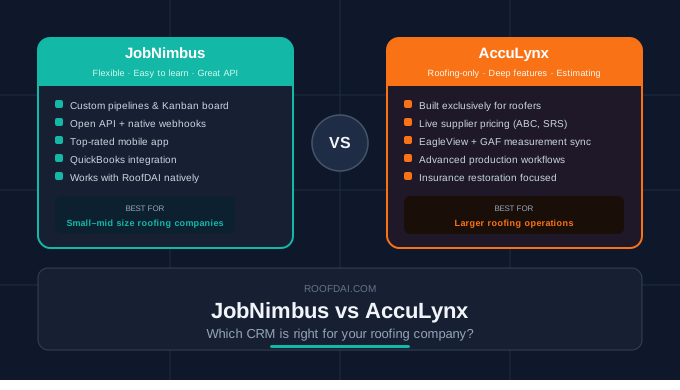
JobNimbus is the flexible one: customizable workflows, an open API, easier onboarding, and a lower entry price. It’s the better fit for small-to-mid-size companies, retail-focused roofers, and anyone who already runs a tech stack the CRM needs to plug into.
AccuLynx is the deep one: built exclusively for roofing from day one, with the strongest native estimating, supplier integrations, and insurance-restoration tooling in the category. It’s the better fit for larger operations, storm-restoration companies, and teams that want opinionated roofing workflows out of the box rather than building their own.
Everything below is the detail behind that answer.
JobNimbus vs AccuLynx at a Glance
| Category | JobNimbus | AccuLynx |
|---|---|---|
| Built for | Contractors broadly, adopted heavily by roofing | Roofing exclusively, from day one |
| Philosophy | Flexibility: bend it to your workflow | Depth: adopt its roofing workflow |
| Best for | Small to mid retail roofers, custom tech stacks | Larger ops, insurance restoration |
| Estimating | Good, with add-ons (SumoQuote) | Excellent native: supplier pricing, EagleView |
| Integrations | Open API, Zapier/Make, webhooks | Native supplier/measurement links, dev-oriented API |
| Mobile app | Faster, simpler in the field | More features, heavier to navigate |
| Pricing model | Quote-based, tiered, lower entry | Quote-based; Essential tier reported ~$250/mo |
| Onboarding | Faster, self-directed | More structured, higher setup investment |
Who They’re Built For
JobNimbus started as a general contractor tool and evolved into a roofing favorite precisely because of how easily it bends: customizable pipeline stages, custom fields, automations by job type, and a drag-and-drop Kanban board your sales team can learn in an afternoon. If you have a specific way you run your process, or you run mixed work like roofing plus gutters, siding, or commercial, JobNimbus lets you build the system around your business.
AccuLynx was built exclusively for roofing contractors, and it shows everywhere: roofing-specific pipeline stages, native material ordering, crew scheduling built around how roofing production actually runs, and the deepest insurance-restoration tooling of any all-in-one roofing platform. The trade-off is that you largely adopt AccuLynx’s way of working rather than designing your own, which is a feature for companies that want proven structure, and a limitation for companies with unusual workflows.
Feature-by-Feature Breakdown
Lead and Contact Management
JobNimbus gives you a visual Kanban pipeline you can reshape completely: rename stages, add fields, trigger automations when jobs move. New staff learn it fast. AccuLynx is more structured, with roofing-specific stages plus lead intelligence and analytics that help identify which leads are most likely to close. Winner: tie. Flexibility versus roofing-tuned structure, matching the platform philosophies exactly.
One thing neither does, worth knowing up front: neither CRM captures leads from your website. They manage leads that already exist. If your website is where leads leak, with visitors leaving without a trace, that’s a lead capture software problem that sits in front of whichever CRM you pick, and it’s worth fixing first since every lead it captures flows into either platform.
Estimating and Proposals
This is AccuLynx’s strongest category. Its estimating is purpose-built for roofing: live material pricing from suppliers like ABC Supply and SRS, direct measurement integrations with EagleView and GAF QuickMeasure, and polished proposal templates out of the box. JobNimbus can reach similar polish with SumoQuote and setup work, but for high-estimate-volume companies, AccuLynx’s native experience is smoother. Winner: AccuLynx.
Production and Project Management
JobNimbus offers clean customizable workflows, task automation, scheduling, and a mobile app field crews genuinely like. AccuLynx layers on roofing-production specifics (material ordering, work orders, crew scheduling tied to roofing milestones) that complex operations otherwise bolt on from third parties. Winner: AccuLynx for complex production, JobNimbus for simplicity.
Insurance Restoration Work
If storm and insurance work is a major share of your revenue, weight this section heavily: AccuLynx’s supplement tracking, claims workflows, and adjuster documentation tooling are the deepest in the category, and it’s the main reason restoration-heavy companies choose it despite the higher cost. Retail-dominant roofers won’t use most of it. (If you’re building out your storm-season machine more broadly, our guide to storm season lead generation covers the demand side.) Winner: AccuLynx, decisively, for insurance-heavy companies only.
Integrations and API
Both connect to QuickBooks, usually the first integration anyone asks about. Beyond that: JobNimbus has a well-documented open API, plays nicely with Zapier and Make, and has native webhooks, which is why tools like RoofD AI push captured website leads straight into JobNimbus the moment a homeowner finishes a chat, no middleware needed. AccuLynx’s API leans developer-oriented, but its native connections to suppliers and measurement services are stronger. Winner: JobNimbus for third-party flexibility, AccuLynx for native roofing-industry links.
Mobile Apps
Both ship iOS and Android apps. Field crews generally rate JobNimbus higher for speed and day-to-day usability on a roof; AccuLynx’s app carries more features but feels heavier in the field. Winner: JobNimbus.
Pricing: What’s Actually Known in 2026
Neither platform publishes full pricing. Both are quote-based, which is genuinely frustrating when you’re comparison shopping. What user reports and industry sources consistently indicate: JobNimbus offers tiered plans that scale with team size and typically comes in at a lower entry point for small-to-mid-size companies. AccuLynx has an Essential tier reported around $250/month for smaller operations, with higher tiers for the full feature depth, and contractors switching platforms report onboarding/implementation investments in the low thousands for AccuLynx’s more structured setup.
The honest framing: for a 3 to 10 person retail roofing company, JobNimbus will usually cost less to start and less to learn. For a restoration company doing volume insurance work, AccuLynx’s higher cost tends to pay for itself in the estimating and supplement tooling alone. Get current quotes from both. Pricing moves, and your team size changes the math.
Which One Should You Choose?
Choose JobNimbus if:
- You’re a small to mid-size roofing company, especially retail-focused
- You want a system your team learns fast and you can shape to your process
- You run other tools (lead capture, marketing, automation) and need real API/webhook support
- You do mixed trade work beyond shingle replacement
Choose AccuLynx if:
- You run a larger operation with complex production workflows
- Insurance restoration is a major revenue stream
- Native estimating accuracy and supplier integrations are business-critical
- You’d rather adopt proven roofing workflows than design your own
Still torn? Do what experienced roofing owners recommend: book both demos in the same week, back to back, and run your actual sales process through each. The right fit is usually obvious within an hour of hands-on use. And if you’re earlier in the journey, still building the sales team that will live in this CRM, start with how to hire a roofing sales rep.
The Gap Neither One Fills
Both platforms are excellent at managing leads after they exist. Neither creates them. Your website traffic, the homeowners comparing contractors at 9pm, leaves no trace in either CRM unless something on your site captures them first.
That’s the layer RoofD AI adds: an AI assistant on your roofing website that engages every visitor 24/7, delivers instant satellite-measured estimates, and pushes fully qualified leads (name, phone, address, roof size) directly into JobNimbus (native webhook) or AccuLynx (via Zapier/Make). Whichever CRM wins your comparison, it works with it. There’s a free plan, so you can watch the leads flow into your new CRM before paying anything. Book a demo to see the integration live, and for the bigger picture of filling the top of your pipeline, our guide to getting roofing leads covers all 15 channels.
Frequently Asked Questions
Is JobNimbus cheaper than AccuLynx?
Usually, at entry level. Both use quote-based pricing, but JobNimbus’s tiers typically start lower for small teams, while AccuLynx’s Essential plan is reported around $250/month with higher tiers above it. For large restoration operations, AccuLynx’s added cost is often justified by its estimating and insurance tooling. Always get current quotes from both.
Which is better for insurance restoration roofing?
AccuLynx, clearly. Its supplement tracking, claims workflows, and adjuster documentation are the deepest available in roofing CRM software. If insurance work is most of your revenue, this category alone often decides the comparison.
Can I switch from one to the other later?
Yes, but switching costs are real. Data migration, workflow rebuilding, and retraining typically take weeks, and contractors report meaningful setup investments especially moving into AccuLynx’s structured system. It’s worth choosing carefully the first time rather than planning to switch.
Do JobNimbus and AccuLynx capture website leads?
No. Both manage leads after they enter the system. Website lead capture is a separate layer: tools like RoofD AI convert site visitors into leads with instant estimates, then push them into either CRM automatically.
Does RoofD AI work with both JobNimbus and AccuLynx?
Yes. JobNimbus receives leads through its native webhook system; AccuLynx connects via Zapier or Make. Either way, captured leads land in your CRM with full contact details and roof data the moment the homeowner finishes the chat.
