
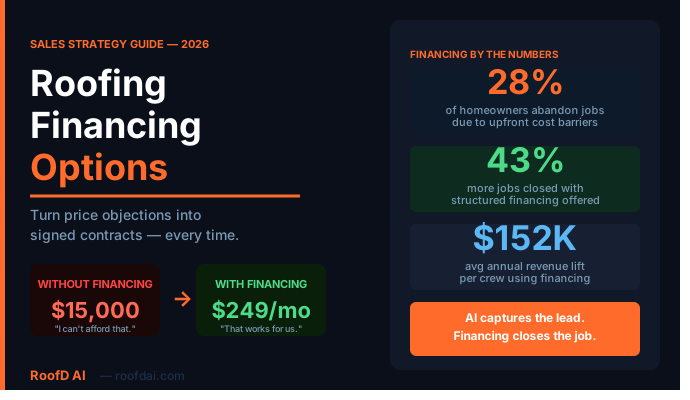
Roofing financing options are one of the most underused sales tools in the entire industry. Industry research shows that 28% of homeowners abandon roofing projects due to upfront payment barriers, even when they qualify for insurance settlements or have the financial capacity to cover the cost over time. Furthermore, contractors who offer structured financing consistently close 43% more insurance-related jobs and see an average annual revenue lift of $152,000 per crew.
The psychology behind this is straightforward. A $15,000 roof replacement feels impossible to most homeowners when presented as a lump sum. However, $249 per month feels manageable, and the homeowner who says “I can’t afford that right now” almost always says “that works for us” when presented with a monthly payment option.
This guide covers exactly how to offer roofing financing options, which platforms work best, and how to present payment plans in a way that turns price objections into signed contracts.
Why Roofing Contractors Avoid Offering Financing, and Why That Is a Mistake
Most roofing contractors either do not offer financing at all or mention it so late in the sales conversation that it feels like a last resort. Both approaches leave significant revenue on the table. Understanding why contractors avoid financing reveals exactly why the ones who embrace it gain such a powerful competitive advantage.
Misconception 1: “It’s Too Complicated to Set Up”
Many contractors assume offering financing requires becoming a lender themselves. In reality, partnering with established financing platforms means all the financial risk, credit checks, and collections are handled by the lender. As a result, the contractor gets paid in full within one to five business days of project completion, regardless of how the homeowner structures their payments.
Misconception 2: “My Customers Won’t Want It”
Research consistently shows the opposite. A 2023 National Association of Home Builders study found that 28% of homeowners abandon roofing projects specifically because of upfront cost barriers. Moreover, homeowners who receive financing options tend to choose premium materials and larger project scopes when paying monthly, because the incremental monthly cost difference between standard and premium shingles is minimal.
Misconception 3: “It Will Slow Down My Sales Process”
Modern financing platforms integrate directly with CRM and estimating systems. Pre-qualification takes two to five minutes and uses a soft credit pull that does not affect the homeowner’s credit score. In contrast, a sales conversation that ends with “I need to think about the budget” and never converts costs far more time than a two-minute pre-qualification check.
For a full look at how the complete sales process connects to financing as a closing tool, read: Roofing Sales Training: Close More Jobs in 2026
The Best Roofing Financing Platforms for Contractors in 2026
Several established platforms specialize in roofing contractor financing. Each has different strengths depending on your job mix, volume, and customer profile. Understanding the differences helps you choose the right partner, or combine two platforms for maximum approval rates.
GreenSky: Best for High Loan Amounts and Promotional Financing
GreenSky offers installment loans and promotional financing plans for home improvement projects with credit limits up to $100,000. Promotional options, including 0% APR for 12 to 18 months, are particularly powerful sales tools for larger replacement projects. Furthermore, GreenSky supports staged funding, which aligns well with insurance restoration workflows where payments arrive in phases.
Hearth: Best for Maximizing Approval Rates
Hearth is a financing marketplace rather than a single lender. When a homeowner applies through Hearth, a single application goes to multiple lenders simultaneously, which significantly increases approval rates because customers see options from several lenders rather than getting declined by one. Additionally, Hearth integrates directly with most roofing CRM platforms and allows contractors to send financing links via text or email, enabling homeowners to pre-qualify from their phone before the sales appointment even begins.
Service Finance Company: Best for Promotional “Same-as-Cash” Deals
Service Finance Company specializes in promotional financing, particularly 0% for defined periods and same-as-cash programs that appeal to homeowners who want flexibility without long-term interest commitments. Consequently, these programs work particularly well for retail roofing customers who are upgrading proactively rather than responding to damage.
Sunlight Financial: Best for High-Volume Operations
Sunlight Financial’s Orange platform is designed specifically for high-volume roofing operations. It offers loan amounts up to $100,000, 0% dealer fee options, Flex Approvals with extra credit for project unknowns and upgrades, and funding in as little as 24 hours. Furthermore, with over 15,000 sales professionals already using the platform, it is one of the most proven options in the roofing industry.
How to Present Financing Options the Right Way
The way financing is introduced into the sales conversation determines whether it closes the deal or creates awkwardness. Most contractors make the mistake of presenting financing only after the homeowner objects to the price, which makes it feel like a consolation prize rather than a standard offering.
Lead With the Monthly Payment, Not the Total
The most effective approach is to introduce the monthly payment amount before the homeowner ever sees the full project cost. Opening with “your new roof system would run about $249 a month” resets the homeowner’s frame of reference entirely. By the time the full investment amount comes up, they are already thinking in terms of monthly affordability rather than lump sum resistance.
Pre-Qualify Before the Estimate Presentation
Modern financing platforms offer soft-pull pre-qualification that takes two to five minutes and does not affect the homeowner’s credit score. Running pre-qualification before or during the estimate review, not after the homeowner objects, positions financing as a standard part of your process rather than a sales tactic. Furthermore, knowing the homeowner’s approved amount and monthly payment options before presenting the estimate allows you to tailor the presentation to options they can realistically access.
Present Three Options
Homeowners given a single price make a yes-or-no decision. Homeowners given three options (good, better, best) make a comparison decision. Presenting three financing tiers alongside three material options consistently increases close rates because the conversation shifts from “can I afford this?” to “which option is right for me?” Additionally, homeowners who choose premium materials when paying monthly generate significantly higher average job values than those paying cash.
For a complete look at how objection handling connects to the financing conversation, read: Roofing Sales Training: Close More Jobs in 2026
Roofing Financing for Insurance Restoration Jobs
Financing is not just for retail roofing. It is a powerful tool for insurance restoration work as well. Understanding how financing complements the insurance claim process opens additional revenue opportunities that most contractors miss entirely.
The Insurance Gap Opportunity
Insurance policies often cover the cost of replacing a roof to its previous condition, meaning basic materials and standard installation. However, many homeowners want upgraded shingles, additional ventilation, gutter replacement, or other improvements beyond what the insurance check covers. Financing the gap between the insurance settlement and the upgraded scope converts what would have been a basic replacement into a significantly higher-value project.
For example, insurance approves $14,000 for a standard tear-off and reshingle. The homeowner wants architectural shingles, new gutters, and improved ventilation, bringing the total to $21,000. Financing the $7,000 gap at $89 per month makes the upgrade feel accessible rather than out of reach. Consequently, the contractor closes a $21,000 job instead of a $14,000 job from the same lead.
Using Financing to Win Insurance Jobs Before Competitors
A roofing contractor who offers financing during the initial inspection, before the insurance adjuster has even processed the claim, creates commitment and control over the project timeline. The homeowner who signs a contract with a financing structure in place is far less likely to accept a competing bid while waiting for the insurance process to complete. In contrast, a contractor who waits for the insurance check before discussing payment terms gives competitors weeks of opportunity to approach the same homeowner.
For a complete guide to winning more insurance restoration jobs, read: Roofing Insurance Claims and AI: How Smart Contractors Are Closing More Restoration Jobs
How AI Connects to Your Financing Strategy
The most effective roofing financing strategy starts before the sales rep ever arrives at the property. RoofD AI captures the lead, delivers an instant satellite-based estimate range, and sets the homeowner’s cost expectations, which means financing conversations start from an informed baseline rather than a price shock.
Setting Expectations Before the Sales Visit
When a homeowner receives an estimate range of $12,000 to $15,000 through the RoofD AI chatbot during their initial website visit, they arrive at the inspection appointment already anchored to a realistic number. Furthermore, the chatbot can mention financing availability (“most homeowners choose to finance over 12 to 60 months. We can show you options during the inspection”), which plants the seed before the rep ever brings it up.
Capturing Leads That Price Objections Would Have Lost
Without financing and without an active AI lead capture system, many homeowners who visit your website at night, get a rough estimate in their head, and decide it is out of budget never reach out at all. With RoofD AI on your website and financing available through your sales process, those homeowners become leads, because both barriers are removed simultaneously.
For a full breakdown of how AI lead capture changes the quality and volume of leads your sales team works, read: How to Never Miss a Roofing Lead Again (Even at 2am)
CRM Automation That Follows Up Financing Leads
Homeowners who received a financing mention during the chatbot conversation but did not immediately book need a follow-up sequence that reinforces the financing option. CRM automation handles this: a follow-up text on day two that mentions monthly payment options, and an email on day five with a direct pre-qualification link. As a result, leads that stalled on price get reactivated by the financing conversation rather than going cold permanently.
For a complete guide to building CRM automation workflows that follow up every lead, read: Roofing CRM Automation: Follow Up Every Lead on Autopilot
Frequently Asked Questions About Roofing Financing Options
Q: Does offering financing cost me anything as a contractor? Most financing platforms charge a dealer fee, typically 3% to 8% of the financed amount, which the contractor can either absorb into their margin or build into their pricing. However, the incremental revenue from projects that would otherwise have been lost to budget objections consistently outweighs the dealer fee cost. Furthermore, promotional programs like 0% APR for 12 months have higher dealer fees but produce significantly higher close rates on large projects. See how RoofD AI features set financing expectations before the sales visit even begins.
Q: What happens if a homeowner is denied financing? Using a marketplace platform like Hearth routes a single application to multiple lenders simultaneously, which significantly reduces outright denials because different lenders have different approval criteria. Additionally, if a homeowner does not qualify for a full financing amount, many platforms offer partial approvals that cover a portion of the project cost, with the homeowner paying the remainder upfront. Having multiple financing options available increases the percentage of homeowners who find a workable path forward.
Q: When in the sales process should I introduce financing? Lead with it, not at the end after a price objection. Introducing financing during the estimate presentation as a standard offering rather than a reactive response to budget concerns positions it as a normal part of your process. Consequently, homeowners approach the price conversation with the monthly payment frame already established, which dramatically reduces resistance compared to hearing the lump sum first.
More Questions About Roofing Financing Options
Q: Can I offer financing on insurance restoration jobs? Absolutely, and it is one of the highest-ROI applications of roofing financing. Insurance settlements often cover standard replacement but leave homeowners wanting upgrades that exceed the settlement amount. Financing the gap between the settlement and the upgraded scope converts basic replacements into premium jobs. For a complete guide to winning more insurance restoration work, read: Roofing Insurance Claims and AI: How Smart Contractors Are Closing More Restoration Jobs
Q: How does roofing financing fit into a complete marketing and sales strategy? Financing addresses the final barrier in the sales process, budget, after every other barrier has been removed. Your marketing strategy drives visibility and generates leads. Your AI chatbot captures those leads and sets cost expectations. Your sales process builds trust and presents the estimate. Financing converts the homeowner who is sold on your company but hesitant about the investment. Together, these layers create a complete system where far fewer qualified leads are lost at any stage. For the complete picture, read: Roofing Marketing Strategy: The Complete Contractor Guide for 2026
Q: How do I train my sales team to present financing effectively? Practice the monthly payment introduction until it feels completely natural: “your new roof system would run about $249 a month.” Train reps to run soft-pull pre-qualification before or during the estimate presentation rather than waiting for a price objection. Additionally, drill the three-option presentation format (good, better, best) until it is second nature. A rep who presents financing confidently as a standard offering closes significantly more jobs than one who introduces it apologetically after a price objection.
Stop Losing Jobs to Budget Objections
Every roofing contractor has lost jobs to “I can’t afford it right now.” In most cases, those homeowners could afford it. They just could not afford it all at once. Offering roofing financing options removes the most common barrier between a motivated homeowner and a signed contract.
The contractors who offer financing consistently, introduce it early in the sales conversation, and combine it with an AI-powered lead capture system are closing jobs their competitors do not even know they lost.
Or start your 7-day free trial. No charge until day 8, cancel any time.
