You have spent years on other people’s crews. You know how to run a tear-off, you can read a roof from the driveway, and you have watched your boss invoice $18,000 for a job you basically ran yourself. At some point, every good roofer does the same math: the skills are already yours. The only thing missing is the company. Learning how to start a roofing company in 2026 comes down to seven steps, and this guide walks through every one of them: the business plan, licensing, startup costs, pricing, your first customers, and the systems that keep a new company alive past year one.
Because here is the uncomfortable truth: most new roofing companies do not fail at roofing. They fail at everything around the roofing: underpricing jobs, skipping insurance, and running out of leads. Let’s make sure that isn’t you.
Is Starting a Roofing Company Worth It in 2026?
Short answer: yes, if you treat it like a business instead of a job with extra paperwork. Roofing remains one of the most resilient trades in the country. Storms do not check the economy before they hit, insurance work keeps flowing in rough years, and an aging housing stock guarantees replacement demand for decades.
Additionally, 2026 gives new companies an advantage that did not exist five years ago: technology has gotten cheap. A solo operator today can run AI tools that answer leads, quote jobs, and follow up automatically, work that used to require an office manager. In other words, a two-person crew can now look and respond like a ten-person company. The contractors who understand that early will out-compete established shops still relying on voicemail.
Step 1: Write a Roofing Business Plan Banks Take Seriously
A roofing business plan does not need to be forty pages. It needs to answer five questions clearly, because every lender, supplier, and insurance agent you meet will ask them:
- What services will you sell? Residential replacement, repair, storm restoration, commercial, or a mix. Pick a primary focus. New companies that try to do everything price everything badly.
- Who is your customer? Define your service area tightly. A 30 to 45 minute radius keeps drive time from eating your margin.
- What will you charge? Your per-square pricing by material (more on this in Step 4).
- What does it cost to operate? Truck, fuel, insurance, materials, labor, software. Monthly, honestly.
- How will customers find you? This is the section most new roofers leave blank, and it is the section that kills them. Steps 5 and 6 fix it.
Write it in a weekend. Keep it to five pages. Revisit it every quarter. The plan matters less than the habit of planning.
Step 2: Licensing, Insurance, and Legal Setup
Roofing license requirements vary by state
There is no national roofing license. Some states require a specific roofing contractor license with an exam (Florida and California are strict), others require a general contractor license above a dollar threshold, and some regulate at the city or county level only. Before anything else, therefore, check your state’s contractor licensing board and your city’s permit office. Budget for exam fees, application fees, and in many states a surety bond of $5,000 to $25,000.
Register your legal entity while you wait. An LLC is the standard choice for a new roofing company. It separates your personal assets from business liability and costs $50 to $500 depending on the state. Get your EIN from the IRS (free, ten minutes online) and open a dedicated business bank account the same week.
The insurance you cannot skip
Roofing is one of the highest-risk trades, and your insurance costs will reflect that. Plan for three policies from day one: general liability (most GCs and homeowners will require $1M minimum), workers’ compensation the moment you have your first employee (and in many states even before that), and commercial auto for the truck. Expect $7,000 to $15,000 per year combined as a small startup. It stings, but one uninsured fall or one shingle bundle through a skylight ends an uninsured company permanently. Insurance is not a cost; it is the license to stay in business.
Step 3: How Much Does It Cost to Start a Roofing Business?
The honest range for a lean residential startup is $15,000 to $40,000. Here is where it goes:
| Startup item | Realistic cost |
|---|---|
| Licensing, LLC, bond | $1,000 to $3,000 |
| Insurance (first year) | $7,000 to $15,000 |
| Used truck or work van | $5,000 to $15,000 |
| Tools & safety equipment | $2,000 to $5,000 |
| Website, branding, software | $1,500 to $4,000 |
| Initial marketing | $1,000 to $3,000 |
Notice what is not on the list: a warehouse, a showroom, or new equipment. Successful new roofing companies stay ruthlessly lean, subcontract labor per job in the early months, and buy materials per project with supplier terms. Furthermore, many suppliers will extend 30-day net terms to licensed, insured contractors even in year one. Ask.
If cash is tight, remember that you can also offer customers payment plans without carrying the risk yourself. Roofing financing options through partners like GreenSky or Service Finance let homeowners say yes to a $14,000 roof at $180 a month, which means your startup can close jobs that “cash only” competitors lose.
Step 4: Price Your Jobs Like a Company, Not a Crew
New owners consistently make the same mistake: they price like an employee who knows labor costs, not an owner who carries overhead. Your price per square has to cover materials, labor, and your insurance, fuel, software, marketing, taxes, and profit. A useful starting framework: take your material + labor cost per square, then add 10% for overhead and 20 to 30% for margin. If asphalt costs you $300 per square all-in, you are quoting $420 to $450, not $330 because you’re “new and hungry.” Hungry pricing attracts the worst customers and starves the company.
Consistently, the contractors who win are not the cheapest; they are the fastest to respond with a credible number. Keep that sentence in mind. It drives everything in the next two steps.
Step 5: Get Your First Customers Without Buying Leads
Start with the free channels
Your first ten jobs will almost certainly come from people, not platforms. Tell every GC, realtor, insurance adjuster, and supplier rep you know that you are licensed and open. Set up your Google Business Profile the day your license clears, and start collecting reviews from job one. A systematic approach to 5-star Google reviews is the single highest-ROI marketing habit a new roofing company can build.
Meanwhile, do not underestimate the oldest channel in the trade. Door-to-door roofing sales still produces jobs at near-zero cost, especially after storms, and as the owner your knock carries more weight than any rep’s. Layer in local SEO beyond your Google Business Profile (citations, city pages, NAP consistency) and by month six your website starts producing leads while you sleep.
When (and whether) to pay for leads
Eventually someone will pitch you HomeAdvisor, Angi, or Modernize. Understand exactly what you are buying first: shared leads at $150 to $300 each, often sold to five competitors simultaneously. We broke down the real economics in our guide to roofing lead generation companies. The short version is that purchased leads can bridge a slow month, but building lead flow you own beats renting it every time.
Step 6: Set Up Systems Before You’re Buried
Here is the pattern that kills promising new roofing companies in year two: the owner is on a roof all day, three homeowners fill out the website contact form, nobody replies until 8pm, and all three jobs go to the contractor who answered in five minutes. The trade skills got the company started; the response systems decide whether it grows.
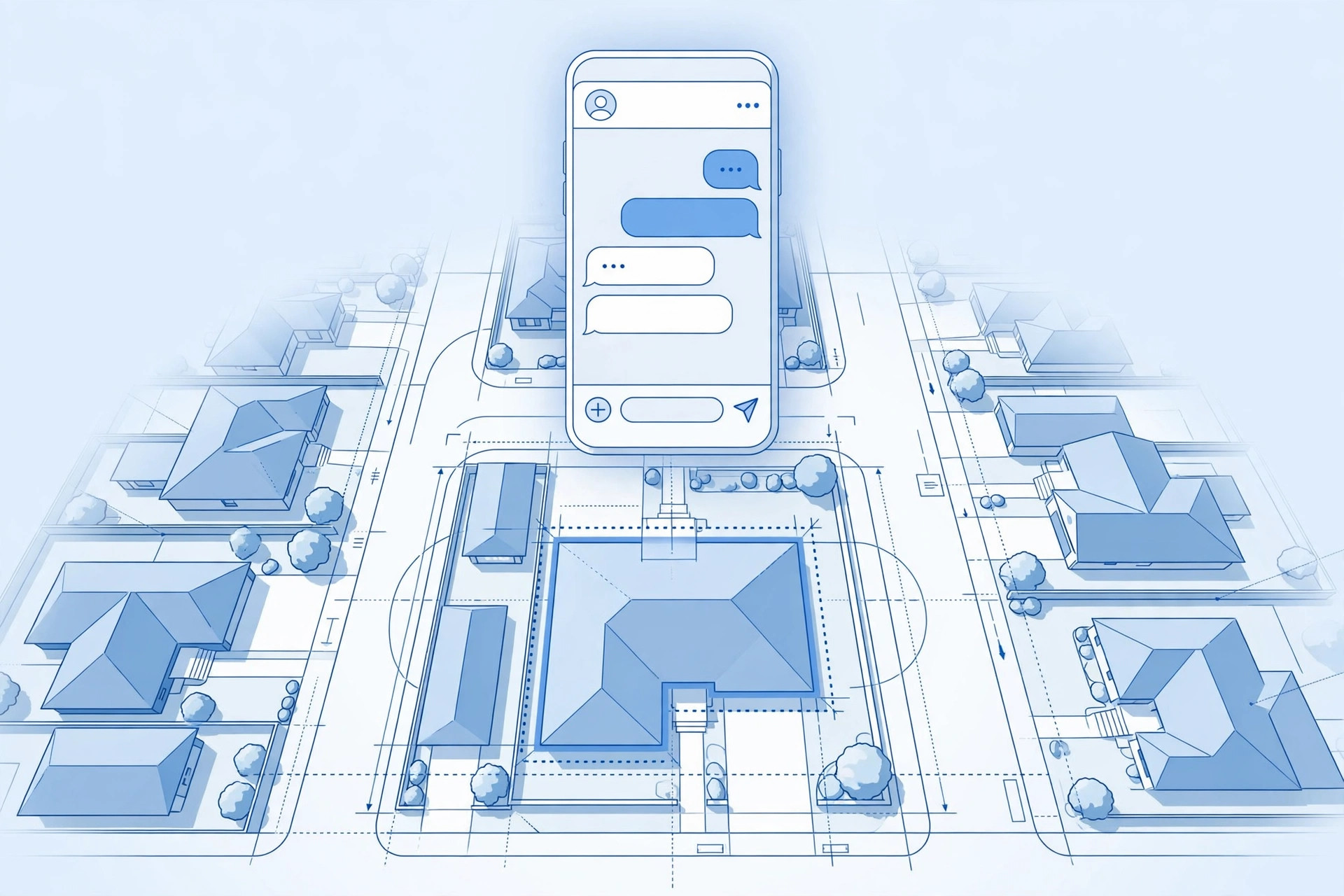
This is exactly the gap modern tools close. An AI chatbot built for roofing contractors sits on your website, gives every visitor an instant satellite-measured roof estimate, answers their questions, and captures their name, phone, and address, 24 hours a day, whether you are on a ridge or at your kid’s game. Every lead lands in one dashboard with the roof size and estimate already attached, and features like CRM sync and instant notifications mean you call the homeowner back before your competitor has even heard the voicemail. For a new company, that is the difference between looking like a startup and operating like an established firm from day one.
Pair it with a simple CRM, a bookkeeping tool, and a calendar system, and you have the full operational stack for under a few hundred dollars a month.
Step 7: Hire Slowly, Scale Deliberately
Your first hire should solve your biggest bottleneck, usually either a lead installer (so you can sell) or a salesperson (so you can build). When the time comes, hiring a roofing sales rep is a process worth doing carefully; a bad rep costs a new company far more than an empty seat. Beyond that, growth becomes a systems question, and our guide on how to scale a roofing business with AI picks up exactly where this one ends.
The 5 Mistakes That Sink New Roofing Companies
- Underpricing to win early jobs. You cannot service your way out of negative margin.
- Skipping workers’ comp. One injury bankrupts everything you built.
- No lead follow-up system. Slow response loses more jobs than bad pricing.
- Growing payroll before pipeline. Hire against booked work, not hoped-for work.
- Ignoring reviews for the first year. Your competitors have a five-year head start on Google; every month you wait widens it.
Frequently Asked Questions
How much does it cost to start a roofing company?
Plan for $15,000 to $40,000 for a lean residential startup. Insurance and licensing are the largest unavoidable costs; the truck and tools flex based on what you already own. Companies that subcontract labor early can start at the low end of the range.
Do I need a license to start a roofing business?
In most states, yes: either a dedicated roofing contractor license or a general contractor license above a certain job value. Requirements vary widely by state and sometimes by city, so verify with your state licensing board before quoting your first job. Unlicensed work risks fines and voids most insurance.
Is a roofing company profitable?
Well-run residential roofing companies typically net 20 to 35% margins on replacement work. Profitability depends far more on pricing discipline and lead flow than on crew size. A two-person operation with steady leads out-earns a ten-person crew with idle weeks.
How long until a new roofing company makes money?
Most new roofing companies reach consistent profitability in 6 to 18 months. The timeline compresses dramatically when lead systems are in place early; it stretches when owners rely on word-of-mouth alone.
Can I start a roofing company with no experience?
You can legally in many states, but you shouldn’t practically. Either gain crew experience first or partner with a seasoned installer. Your reputation is the company’s only asset in year one. Protect it.
Start Your Roofing Company With Leads From Day One
Every step in this guide gets easier when your website is already capturing customers. RoofD AI puts an AI assistant on your new company’s site that delivers instant satellite roof estimates and saves every homeowner’s contact details, so you launch with a lead system most ten-year-old companies still don’t have. Book a free demo to see it trained on your business, or start your 7-day free trial and have it live before your license paperwork clears.