
Roofing local SEO is the growth channel that pays for itself month after month, but most contractors stop at their Google Business Profile and wonder why their competitors keep outranking them. The contractors winning the map pack in 2026 are not just optimized on GBP. They are running coordinated systems across citations, NAP consistency, local landing pages, geo-targeted content, and local link building that compound on top of their profile.
Your Google Business Profile is the foundation. It is not the whole house.
At RoofD AI, we work with roofing contractors who rank in the top 3 of every map pack in their service area, and contractors who cannot crack the top 10 despite having a “complete” profile. The difference is rarely the profile itself. It is everything around the profile. In this guide, we break down exactly how roofing local SEO works beyond GBP, what actually moves the needle in 2026, and how to build a local presence that pulls organic leads month after month.
Why GBP Optimization Alone Is Not Enough
Most roofing contractors think local SEO ends with their Google Business Profile. They fill out every field, upload photos, post weekly, ask for reviews, and assume that is the work. Then a competitor with a less polished profile outranks them, and they cannot figure out why.
Google Uses Three Distinct Ranking Signals for Local Pack
Google’s local ranking algorithm weighs three pillars: relevance, distance, and prominence. GBP optimization improves relevance signals. The other two, distance and prominence, depend on factors that live entirely outside your profile.
Distance is structural (where the searcher is, where you are licensed to operate). Prominence is reputational (how many citations reference your business, how many websites link to you, how many reviews you have, how consistent your name and address appear across the web).
A perfectly optimized GBP with weak prominence signals will lose to a less-optimized GBP with strong prominence signals every time.
For the foundational profile setup, read: Roofing Google Business Profile: Rank Higher and Get More Calls
The Map Pack Decides Who Gets the Calls
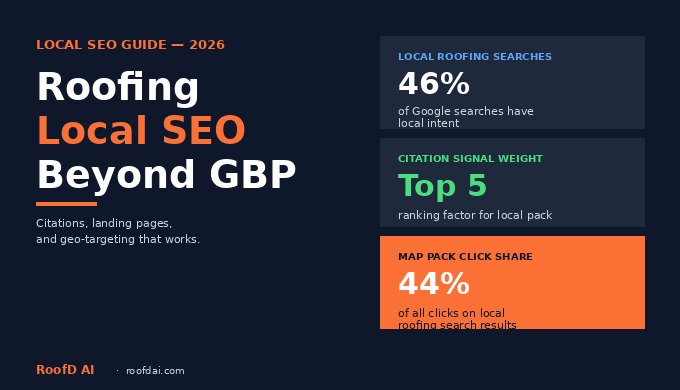
In 2026, the local pack (the map block at the top of local search results) captures roughly 44% of all clicks on local roofing searches. The next 56% is split across organic results, ads, and zero-click searches. Three slots in the map pack split nearly half the available traffic. Spots 1, 2, and 3 capture dramatically more than spots 4, 5, and 6, which most homeowners never click at all.
Getting into those three slots requires the broader local SEO system. GBP alone gets you in the running. Citations, landing pages, and link building decide who actually wins the slot.
NAP Consistency: The Foundation Most Contractors Get Wrong
NAP stands for Name, Address, Phone Number. NAP consistency is the most basic and most frequently violated principle in local SEO. Most roofing contractors have at least one inconsistency that is silently costing them rankings.
What NAP Consistency Actually Means
Your business name, address, and phone number must appear identically across every place they exist online. “Smith Roofing LLC” on your GBP and “Smith Roofing” on your Yelp listing counts as inconsistent. “(615) 555-0100” on your website and “615-555-0100” with different formatting on Yellow Pages counts as inconsistent.
Google’s local algorithm uses NAP signals to verify that your business is real and that the same business appears across multiple directories. Inconsistent NAP triggers algorithmic uncertainty. Google does not know if it is dealing with one business or several similar businesses. The result is suppressed rankings.
How to Audit Your Existing NAP
Search your business name in Google. Pull every result that lists your business: your website, GBP, Yelp, BBB, Yellow Pages, Facebook, industry directories, partner sites. Note the exact NAP listed on each. Mismatches are your audit list.
Common mismatches that hurt rankings: suffix variations (Inc. vs LLC vs no suffix), street abbreviations (Street vs St. vs nothing), suite numbers missing on some listings, formatted vs unformatted phone numbers, and old phone numbers from previous business phases that never got updated.
Fix Order of Priority
Fix in this order: GBP first, then your website, then top-tier citations (Yelp, BBB, Facebook, Apple Maps, Bing Places), then niche directories (Angi, HomeAdvisor, industry-specific listings), then long-tail citations.
Citations: Where Your Business Shows Up Beyond GBP
Citations are mentions of your business name, address, and phone number on third-party websites. Citations signal to Google that your business is real, established, and recognized across the web. The volume, quality, and consistency of citations is a top-five ranking factor for the local pack.
The Three Tiers of Citations
Tier 1: Major Aggregators. Yelp, BBB, Facebook, Apple Maps, Bing Places, Foursquare. These are non-negotiable. Every roofing contractor must have a complete, consistent listing on each. These five citations alone influence a significant percentage of your local pack ranking.
Tier 2: Industry Directories. Angi, HomeAdvisor, Houzz, Thumbtack, Porch, GAF Find a Pro, CertainTeed Find a Contractor, and similar industry-specific directories. These reinforce that you are a recognized roofing contractor specifically, not just a general business.
Tier 3: Local and Regional Directories. Chamber of Commerce listings, city-specific business directories, regional contractor directories, and local newspaper online listings. These reinforce your local presence within specific geographic markets.
How Many Citations Roofing Contractors Need
There is no magic number, but most roofing contractors ranking in the top 3 of their local pack have 50 to 100 active, consistent citations across all three tiers. Contractors stuck below the fold typically have 15 to 30 citations, often with NAP inconsistencies across them.
Citation Building Tools and Services
Manual citation building works but is time-intensive. Services like BrightLocal, Whitespark, and Yext automate the process, submitting your NAP to dozens of directories simultaneously and monitoring for inconsistencies. The investment ($30 to $200 per month) typically pays back through ranking improvements within 90 days.
Local Landing Pages: The Ranking Asset Most Roofers Skip
Most roofing websites have one “Service Areas” page that lists the cities they serve. That single page does not rank for any of those cities. Contractors who dominate local search build dedicated landing pages for each major service area.
What a Strong Local Landing Page Looks Like
A high-performing roofing local landing page contains:
- City or neighborhood name in the H1, URL, meta title, and meta description
- 800 to 1,500 words of unique content specific to that location
- Local trust signals (years serving the area, projects completed, local references)
- City-specific pricing context if available
- Embedded Google Map showing the service area
- Localized photo gallery of completed projects in that area
- Reviews from customers in that specific city
- Call-to-action buttons consistent with your main site conversion strategy
What Kills Local Landing Pages
Three mistakes consistently kill local landing pages: thin content (under 500 words), templated content (the same paragraphs with city names swapped in), and orphaned pages (no internal links from your main navigation pointing to them).
Google’s March 2026 core update specifically targeted templated city pages with thin content. Contractors who rebuilt their city pages with genuine local depth recovered rankings. Contractors who left templated thin pages in place lost significant organic traffic.
How Many Local Landing Pages You Actually Need
Quality over quantity. Most roofing contractors need 5 to 12 strong local landing pages, one for each Tier 1 service city, plus pages for major neighborhoods within their primary metro. Building 50 thin city pages will hurt rankings. Building 8 strong ones will help significantly.
For a deeper look at what makes any roofing page convert (local or otherwise), read: Roofing Website Conversion: What Homeowners Actually Want in 2026
Geo-Targeted Content That Pulls Local Traffic
Beyond city landing pages, roofing contractors who dominate local SEO publish ongoing geo-targeted content: blog posts, neighborhood guides, and storm-event content that captures local search traffic on specific events and topics.
Storm Event Content
After a major hail or wind event in your service area, publish a blog post within 48 hours documenting the event, the affected neighborhoods, and the inspection process homeowners should follow. This content captures massive search volume during the storm aftermath when homeowners are actively researching contractors. For more on capturing storm-driven demand, read: How Roofing Contractors Can Win More Storm Season Jobs With AI
Neighborhood-Specific Roof Replacement Guides
Content like “Roof Replacement Guide for [Neighborhood Name]” captures hyperlocal search traffic that broader content cannot. These guides typically address neighborhood-specific factors: common roof types in that area, HOA considerations, typical age of housing stock, and local material availability.
Local FAQ Content
Pages that answer location-specific questions (“How much does a roof replacement cost in [City]?”) capture pricing-related search intent that homeowners research before contacting any contractor. This content also gets cited in AI Overview responses, which dramatically increases your visibility in modern search.
For more on getting recommended by AI search engines specifically, read: Roofing Company AI Search: Get Recommended by ChatGPT in 2026
Local Link Building That Actually Works for Roofers
Most link building advice does not apply to local service businesses. The link strategies that move the needle for SaaS companies and e-commerce sites are not the strategies that work for a roofing contractor in Tennessee. Here is what actually works.
Local Sponsorship Links
Sponsoring local sports teams, school events, or community organizations typically results in a link from the sponsored organization’s website. These links carry significant local relevance signals and are usually permanent. Investment ranges from $250 to $5,000 depending on the sponsorship. Most produce ROI through both the link and the community goodwill.
Industry Partnership Links
Material suppliers (ABC Supply, SRS Distribution, Beacon), manufacturer programs (GAF Master Elite, CertainTeed SELECT), and trade associations often list certified or affiliated contractors on their websites. Earning these listings provides both authoritative links and trust signals.
Local News and PR
Hyperlocal news outlets (city newspapers, neighborhood blogs, local TV station websites) frequently feature local contractors in storm coverage, community spotlights, and seasonal articles. Reaching out to local journalists with newsworthy angles (completed restoration projects, charity work, expansion announcements) produces links that carry strong local authority.
What to Avoid
Avoid link-building services that promise “100 backlinks for $50.” These produce low-quality links that can trigger algorithmic penalties under the March 2026 helpful content update. Slow, intentional link building from real local sources beats volume every time.
For a complete marketing strategy that integrates local SEO with the rest of your channels, read: Roofing Marketing Strategy: The Complete Contractor Guide for 2026
Reviews and Their Role in Local SEO
Reviews are simultaneously a GBP signal, a local SEO signal, and a conversion factor. Most contractors think of reviews only in terms of their star rating. The reality is that review volume, recency, keyword content, and response rate all influence local rankings independently.
Review Volume Beats Review Average
A contractor with 250 reviews at 4.7 stars consistently outranks a contractor with 35 reviews at 4.9 stars in the local pack. Volume signals legitimacy and longevity. Five-star perfection signals either a small business or manipulated reviews.
Recent Reviews Outweigh Old Reviews
Google weights review recency heavily. A contractor adding 10 to 15 fresh reviews per month outranks a contractor with 200 reviews from three years ago. Building a system that generates ongoing reviews matters more than the historical total.
Keywords Inside Reviews Matter
Reviews that mention specific services, materials, or city names contribute to local relevance signals. A review that says “great storm damage repair in Knoxville” reinforces both your service category and your geographic relevance.
For a complete framework on building review volume automatically, read: How to Get More 5-Star Google Reviews for Your Roofing Company Automatically
How AI Lead Capture Compounds Your Local SEO Results
Local SEO drives traffic to your website. What happens after that traffic arrives determines whether the SEO investment produces actual revenue. Most roofing websites convert only 2% to 3% of their organic traffic into leads, meaning 97% of your hard-won local SEO traffic bounces without becoming a lead.
RoofD AI closes that gap. Every visitor your local SEO efforts deliver gets engaged immediately by an AI chatbot, qualified, and pushed to your CRM with full context. The same SEO traffic produces 4 to 6 times the lead volume when paired with active engagement instead of a passive contact form.
For more on the conversion math behind this, read: The Real Cost of Not Having a Chatbot on Your Roofing Website and How to Get More Roofing Leads From Your Website Without Paying More for Ads
Frequently Asked Questions About Roofing Local SEO
Q: How long does roofing local SEO take to produce results? Most local SEO improvements take 60 to 120 days to show measurable ranking movement. Citations and NAP consistency fixes can move rankings faster (30 to 60 days). New local landing pages and link building typically take longer (90 to 180 days). Sustained investment produces compounding results. Six months of consistent local SEO work typically doubles or triples organic lead volume for established roofing contractors.
Q: Does roofing local SEO still work in 2026 with AI search rising? Yes, and arguably more than ever. AI search engines like ChatGPT and Google AI Overview pull from the same authority signals that drive traditional local SEO: citations, reviews, structured content, and link building. Strong local SEO improves visibility in both traditional and AI search simultaneously. For more on AI search optimization specifically, read: Roofing Company AI Search: Get Recommended by ChatGPT in 2026
Q: What is the single highest-impact roofing local SEO change I can make this month? Auditing and fixing NAP consistency across all major citations. Most roofing contractors have at least three to five inconsistencies across their major listings, and each one suppresses local pack ranking. A complete NAP audit and correction typically takes 4 to 8 hours and produces ranking movement within 30 to 60 days.
More Questions About Roofing Local SEO
Q: How many local landing pages should my roofing website have? Most roofing contractors need 5 to 12 strong local landing pages, one for each Tier 1 service city, plus pages for major neighborhoods within their primary metro. Quality matters far more than quantity. Building 50 thin templated city pages hurts rankings under the March 2026 helpful content update. Building 8 strong, content-rich local pages helps significantly.
Q: Are paid citation services worth the cost for roofers? For most roofing contractors, yes. Services like BrightLocal, Whitespark, or Yext at $30 to $200 per month automate citation building and monitor for NAP inconsistencies across dozens of directories simultaneously. The time savings alone usually justify the cost, and the ranking improvements typically pay back the subscription within 90 to 120 days.
Q: How do I know if my roofing local SEO is actually working? Track three metrics monthly: local pack rankings for your top 5 keywords (use a tool like BrightLocal, GeoRanker, or Local Falcon), organic traffic from Google Search Console filtered by location, and qualified leads attributed to organic traffic in your CRM. Movement in all three indicates the local SEO investment is producing genuine business results, not just vanity metrics.
Q: How does RoofD AI fit into my roofing local SEO strategy? RoofD AI does not replace local SEO. It amplifies it. Local SEO drives traffic to your website. RoofD AI converts that traffic into qualified leads at 4 to 6 times the rate of a standard contact form. The same SEO investment produces dramatically more revenue when paired with active website engagement. For more on what causes most roofing websites to lose traffic, read: Roofing Website Not Converting? 7 Signs It’s Time for an AI Upgrade
Build the Full Local SEO Stack, Not Just the Profile
The roofing contractors dominating local search in 2026 are not the ones with the prettiest GBP profiles. They are the ones running coordinated systems: consistent NAP across 75+ citations, dedicated local landing pages for every service city, geo-targeted content published monthly, deliberate local link building, and active review generation.
RoofD AI handles the conversion layer of that system, making sure every visitor your local SEO delivers becomes a qualified lead in your CRM, not a bounce in your analytics.
Or start your 7-day free trial. No charge until day 8, cancel any time.
