Roofing has its own language, and it shows up at the worst possible time, when you’re staring at a $14,000 estimate full of words like “drip edge,” “ice and water shield,” and “ACV” and wondering which ones are real work and which are padding. This glossary translates all of it into plain English: 60+ roofing terms organized by category, from the structure under your shingles to the fine print on your insurance claim.
Bookmark it, and the next estimate or adjuster meeting will read like a document instead of a foreign language.
Roof Structure & Framing Terms
Decking (or sheathing): The wooden boards (usually plywood or OSB) fastened to the framing that everything else attaches to. Rotted decking discovered during tear-off is the most common source of surprise costs.
Rafters: The sloped framing members that carry the roof; in modern homes usually part of prefabricated trusses, the triangulated frames that support the deck.
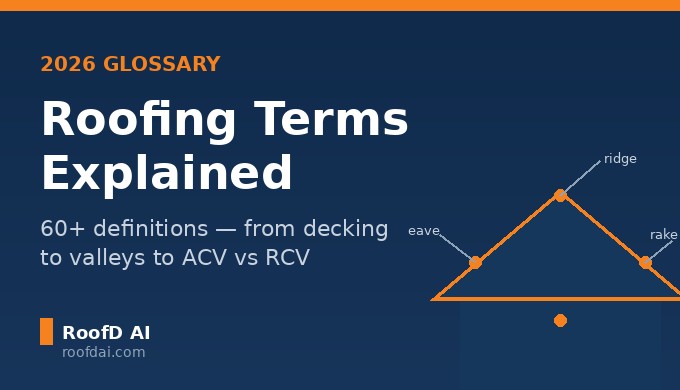
Eave: The lower horizontal edge of the roof, where it meets or overhangs the wall.
Fascia: The vertical board running along the eave, where gutters attach.
Soffit: The underside of the roof overhang, usually vented to let air into the attic.
Ridge: The horizontal line at the very top where two roof planes meet.
Hip: An external sloped edge where two roof planes meet (a “hip roof” has no vertical gable walls).
Valley: The internal channel where two roof planes meet and water concentrates. The hardest-working, most leak-prone line on any roof.
Gable: The triangular wall section at the end of a ridged roof.
Dormer: A framed structure (often with a window) projecting from the roof slope; every dormer adds flashing work and cost.
Overhang: Any part of the roof extending past the exterior walls.
Measurement & Geometry Terms
Square: Roofing’s core unit: one square = 100 square feet of roof surface. A “30-square roof” is 3,000 sq ft. Materials and labor are priced per square. You can find your own number with our roof square footage calculator.
Pitch (or slope): The steepness of the roof, written as rise over run: a 6/12 pitch rises 6 inches for every 12 inches of horizontal distance. Steeper pitch = more surface area and more labor cost. Measure yours in seconds with our roof pitch calculator.
Pitch multiplier (slope factor): The number that converts a home’s footprint into true sloped roof area (a 6/12 roof carries ~12% more surface than its footprint).
Low-slope / steep-slope: Industry dividing line around 3/12: below it, shingles are generally not allowed and membrane systems take over; above roughly 8/12, most crews charge steep-work premiums.
Takeoff: The measured count of all materials a job needs, produced from measurements or satellite imagery.
Material & Component Terms
Asphalt shingle: The standard American roofing material. Three-tab shingles are the flat, single-layer budget version; architectural (dimensional/laminate) shingles are thicker, layered, longer-lived, and now the default.
Bundle: How shingles are sold; typically 3 bundles cover one square. Our shingle calculator converts your roof size into exact bundles, nails, and underlayment.
Underlayment: The water-resistant layer between decking and shingles, traditionally felt (“tar paper”), now usually synthetic.
Ice and water shield: Self-adhering waterproof membrane applied at eaves, valleys, and penetrations in cold climates; code-required in many northern states.
Starter strip: The first course of shingle material at the eave, sealing the edge against wind lift.
Ridge cap: Shaped shingles covering the ridge and hips.
Standing seam: Premium metal roofing with raised interlocking seams and hidden fasteners, as opposed to exposed-fastener (corrugated) panels with visible screws. The full price picture is in our metal roof cost calculator.
Gauge: Metal panel thickness; lower number = thicker metal (24-gauge outperforms and outprices 29-gauge).
TPO / EPDM: The two dominant flat-roof membranes: TPO is white heat-welded thermoplastic; EPDM is black rubber.
Membrane: Any sheet-applied waterproof flat-roof system.
Granules: The mineral surface on asphalt shingles; granule loss (check your gutters) is the classic sign of an aging roof.
Flashing & Water Management Terms
Flashing: Metal shaped to waterproof every place the roof meets something else: walls, chimneys, valleys, pipes. Most leaks are flashing failures, not shingle failures.
Step flashing: Individual overlapping flashing pieces where a roof slope meets a vertical wall.
Counter flashing: The second layer embedded in masonry (chimneys) that covers the top edge of step flashing.
Drip edge: Metal edging at eaves and rakes that directs water off the fascia into the gutter; code-required in most jurisdictions.
Pipe boot (pipe jack): The flashing collar sealing around plumbing vent pipes; cracked boots are a top-three leak source.
Valley flashing: Metal lining an open valley; in a closed (woven) valley, shingles cross the channel instead.
Cricket (saddle): A small peaked diverter built behind chimneys to split water flow around them.
Scupper: A drainage outlet through the edge or parapet wall of a flat roof.
Ventilation & Energy Terms
Ridge vent: Continuous exhaust vent along the ridge line, usually paired with soffit vents (intake) to move air through the attic.
Attic ventilation: The intake-plus-exhaust system that removes heat and moisture; poor ventilation cooks shingles from below and can void warranties.
Radiant barrier: Reflective decking or foil layer that cuts attic heat gain in hot climates.
Cool roof: Reflective roofing (coatings, light membranes, reflective metal) engineered to lower surface temperature and cooling loads.
Damage, Repair & Storm Terms
Blistering: Bubbles in shingle surfaces from trapped moisture or gas.
Cupping / curling: Shingle edges turning up or centers lifting. End-of-life signals.
Hail bruising: Impact damage that crushes granules and fractures the mat underneath; often invisible from the ground but claim-eligible.
Wind uplift: Suction force that peels shingles starting at edges and ridges.
Punch list: The final list of small fixes before a job is closed out.
Tear-off: Removing existing roofing down to the deck, priced per layer; most codes allow a maximum of two shingle layers, which is why an overlay (layover), installing over the existing layer, is sometimes allowed once but never twice.
Estimate, Business & Insurance Terms
Scope of work: The itemized description of everything the contractor will do; the heart of any legitimate estimate. What a professional scope should include, line by line, is covered in roofing quotes explained.
Line item: A single priced element in the estimate (tear-off, underlayment, disposal…). Vague lump-sum bids hide problems; itemized bids invite comparison.
Allowance: A pre-agreed contingency price for conditions found mid-job (most commonly decking replacement per sheet).
Change order: A written, signed amendment to the contract when scope changes. Verbal change agreements are how disputes are born.
Waste factor: Extra material (typically 10 to 15%) added for cuts, valleys, and complexity.
ACV (Actual Cash Value): What insurance pays first: replacement cost minus depreciation for the roof’s age.
RCV (Replacement Cost Value): The full cost to replace; on RCV policies, the withheld recoverable depreciation is released after the work is completed.
Deductible: Your out-of-pocket share of a claim, and a legal red flag: contractors offering to “cover your deductible” are proposing insurance fraud in most states. The whole claims process, adjuster meetings included, is walked through in our guide to roofing insurance claims.
Supplement: A documented request to the insurer for items missed in the original adjuster scope.
Xactimate: The pricing software most insurers use to value claims; “Xactimate pricing” means insurer-standard line-item prices.
Material warranty vs. workmanship warranty: The manufacturer covers the product (20 to 50 years); the contractor covers the installation (commonly 2 to 10). Most real-world failures are workmanship, so the shorter warranty matters more.
Satellite estimate: A roof measurement and price generated from aerial/satellite imagery instead of a ladder visit, accurate to within a few percent on most homes, and the technology behind instant online quotes. It’s how our instant roof estimate widget gives a homeowner a real number from nothing but their address. And if you want the full journey from these definitions to an actual budget, our roof replacement cost calculator turns square footage, pitch, and material into a 2026 price range.
Frequently Asked Questions
What is a “square” in roofing?
One square = 100 square feet of roof surface. It’s the unit all roofing pricing uses: a 24-square roof is 2,400 sq ft, and at 3 bundles of shingles per square it needs about 72 bundles. Measure your roof in squares with a square footage calculator before comparing any quotes.
What’s the difference between decking and underlayment?
Decking is the structural wood layer (plywood/OSB) nailed to the framing, the roof’s skeleton skin. Underlayment is the water-resistant sheet installed on top of the decking, beneath the shingles, the backup waterproofing. Decking gets replaced when rotten; underlayment gets replaced with every reroof.
What’s the difference between ACV and RCV on an insurance claim?
RCV is the full replacement cost; ACV is that number minus depreciation for the roof’s age. An RCV policy pays ACV up front, then releases the withheld depreciation once the roof is actually replaced. An ACV-only policy never pays the depreciation, a distinction worth checking before storm season, not after.
What is flashing and why does it matter so much?
Flashing is the shaped metal sealing every transition on the roof: chimneys, walls, valleys, pipes. It matters because transitions are where roofs actually leak: shingle fields rarely fail, but a $30 pipe boot or badly stepped chimney flashing can wreck a ceiling. When comparing estimates, look for flashing called out explicitly. “Reuse existing flashing” is a corner being cut.
Fluent now? Put the vocabulary to work. If you’re a homeowner, run your numbers before the salesman arrives. And if you’re a roofing contractor, imagine your website answering every one of these questions, plus “what would my roof cost?”, automatically, at any hour: book a free RoofD AI demo and see the AI assistant and instant estimate widget live on a roofing site.