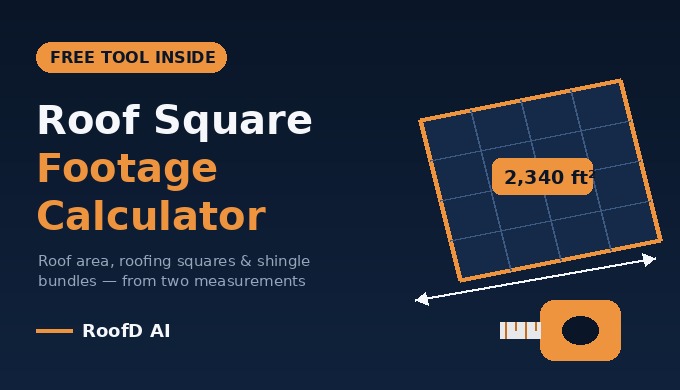
Whether you are a homeowner sanity-checking a contractor’s quote or a roofer pricing your next job, everything starts with one number: the roof’s square footage. The problem is that a roof is bigger than the house under it — pitch adds surface area, overhangs add more, and guessing wrong by 15% means ordering wrong by 15%. This free roof square footage calculator solves it in seconds: enter your home’s footprint and roof pitch, and it returns your roof area, roofing squares, and shingle bundle count. Below the tool, we’ll show you exactly how the math works so you can verify any measurement yourself.
How the Roof Square Footage Math Works
The calculator runs the same three steps professional estimators use, and they’re worth understanding even if you never do them by hand.
Step 1: Footprint. Measure your home’s length and width at ground level, then add the eave overhang on each side. A 50×30 house with 12-inch overhangs has a 52×32 footprint = 1,664 sq ft.
Step 2: Pitch multiplier. A sloped surface is longer than the flat ground beneath it, so footprint gets multiplied by a factor based on pitch. That’s the whole trick of roof math:
| Roof pitch | Multiplier | Roof area on a 1,664 sq ft footprint |
|---|---|---|
| 3/12 | 1.031 | 1,716 sq ft |
| 4/12 | 1.054 | 1,754 sq ft |
| 6/12 | 1.118 | 1,860 sq ft |
| 8/12 | 1.202 | 2,000 sq ft |
| 10/12 | 1.302 | 2,167 sq ft |
| 12/12 | 1.414 | 2,353 sq ft |
The multiplier is just the hypotenuse: for a 6/12 pitch, √(6² + 12²) ÷ 12 = 1.118. Steeper roof, more surface, more shingles, which is one of the reasons two same-sized houses get different roofing quotes.
Step 3: Waste factor. Cutting shingles around edges, valleys, and penetrations wastes material. Simple gable roofs need ~10% extra; cut-up roofs with hips, valleys, and dormers need 15 to 20%. Skipping this step is the most common DIY ordering mistake.
What Is a Roofing Square?
Roofing has its own unit: one square = 100 square feet of roof surface. A 2,000 sq ft roof is a “20-square roof.” Contractors price materials and labor per square, suppliers sell per square, and three bundles of standard architectural shingles cover one square. So when your quote says “24 squares @ $450,” you now know exactly what’s being counted, and you can check it against this calculator in about a minute.
Three Ways to Measure a Roof (Ranked by Accuracy)
1. Satellite measurement: the modern standard. Professional roofing companies now measure roofs from satellite and aerial imagery, tracing every plane and calculating pitch without a ladder. It’s how AI-powered roofing estimates deliver accurate numbers in minutes: homeowner enters an address, the roof gets outlined from above, and the math you just learned runs automatically against real dimensions.
2. Ground measurement + pitch multiplier: this calculator’s method. Accurate within a few percent for standard roof shapes, and completely safe. Its weakness is complex roofs, where multiple planes and intersections make footprint math fuzzier. That’s what the higher waste factors compensate for.
3. On-roof tape measurement. The traditional method: measure every plane, sum them. Most accurate for complex roofs and completely unnecessary risk for homeowners. Leave walking the roof to insured professionals. Falls are the roofing industry’s most serious hazard, and no material estimate is worth one.
For Contractors: Stop Measuring, Start Quoting
If you’re a roofer reading this, you already know the real cost of measurement isn’t the math. It’s the drive. Every “can I get a quote?” call means a truck roll, a ladder, and an hour, whether or not the homeowner is serious. That’s the exact problem satellite-based instant quoting kills: RoofD AI measures the roof from imagery and delivers your pricing to website visitors automatically, so you only drive to homeowners who’ve already seen a real number and shared their contact details. It’s this calculator, weaponized, running 24/7 on your own website with your per-square pricing behind it. And if you’re just setting up shop, per-square pricing discipline is step four in our guide to starting a roofing company.
Frequently Asked Questions
How do I calculate the square footage of my roof?
Multiply your home’s footprint (length × width, including overhangs) by a pitch multiplier: 1.054 for a 4/12 pitch, 1.118 for 6/12, 1.302 for 10/12. Then add a 10 to 20% waste factor for material ordering. The calculator above runs all three steps automatically.
How many squares is a 2,000 square foot roof?
A 2,000 sq ft roof is 20 roofing squares, since one square equals 100 square feet. With a 10% waste factor, you’d order materials for 22 squares, about 66 bundles of standard architectural shingles.
Is roof square footage the same as house square footage?
No. The roof is almost always larger. House square footage measures living space across floors; roof area covers the footprint plus overhangs, stretched by pitch. A 2,000 sq ft two-story home might have only a 1,000 sq ft footprint and a 1,200 sq ft roof, while a 2,000 sq ft ranch could carry a 2,400 sq ft roof.
How many shingle bundles do I need per square?
Three bundles of standard architectural or 3-tab shingles cover one roofing square (100 sq ft). Heavier designer shingles sometimes run four or five bundles per square. Check the bundle coverage printed on the wrapper before ordering.
How accurate are online roof calculators?
Footprint-and-pitch calculators like this one land within 3 to 7% on standard gable and hip roofs, plenty for budgeting and quote-checking. Complex roofs with many planes deserve a satellite measurement or professional estimate before any materials are ordered.
Get the Exact Number From a Satellite
This calculator gets you a solid estimate; a satellite measurement gets you the real thing. RoofD AI gives roofing contractors an instant-estimate widget that measures any visitor’s roof from imagery and quotes real prices in two minutes. Book a free demo to see it on your website, or start your 7-day free trial and turn measurement requests into captured leads.