
Roofing sales objections are the moments where deals are won and lost. A homeowner who said “yes” to your inspection just got the estimate. They look at the number. They pause. And then they say one of fourteen things, and how you respond in the next 30 seconds determines whether you walk out with a signed contract or a “let me think about it.”
Top closers do not improvise these moments. They have rehearsed responses to every objection that exists in roofing.
At RoofD AI, we work with roofing contractors whose sales teams close 30% to 40% of inspections, and contractors whose teams close 8% to 12% of the same lead pool. The gap is rarely lead quality. It is what happens when the homeowner pushes back. In this guide, we break down the 14 most common roofing sales objections and the word-for-word responses that consistently move deals forward.
Why Objection Handling Is the Highest-Leverage Sales Skill in Roofing
Most roofing sales training focuses on the pitch. The truth is that the pitch matters far less than what happens after the pitch. A homeowner who likes your presentation but has unanswered concerns will not buy. A homeowner who pushed back hard but had every concern resolved often becomes your best customer.
Roofing Closes Require 5 to 7 Objections
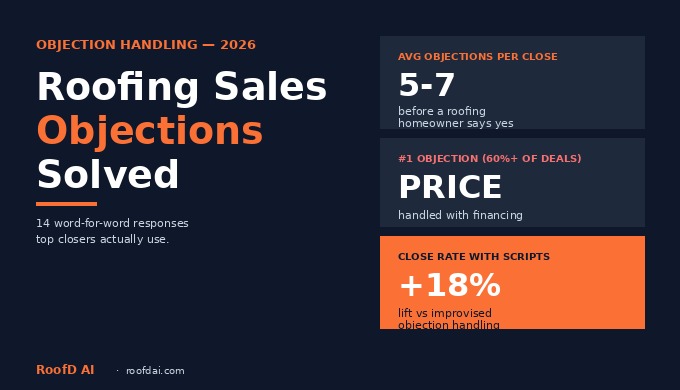
The average residential roofing sale involves the homeowner raising 5 to 7 distinct concerns between the inspection and the signed contract. These concerns are not roadblocks. They are buying signals. A homeowner who has stopped asking questions has stopped considering you.
A rep who handles each objection with a confident, prepared response moves the conversation forward. A rep who fumbles or improvises sends the homeowner into “let me think about it” territory, which closes at less than 10%.
The Stat That Defines Modern Roofing Sales
Industry data consistently shows that reps using rehearsed objection-handling scripts close at rates 18% to 25% higher than reps who improvise. The same lead, the same product, the same price. The only variable is the response delivered when the homeowner pushes back.
For a complete framework on the broader sales process that surrounds these objections, read: Roofing Sales Training: Close More Jobs in 2026
The 14 Most Common Roofing Sales Objections
These are the objections every roofer encounters. Every response below is written exactly as a top closer would deliver it. Memorize them, adapt them to your voice, and rehearse them out loud until they sound natural.
Objection 1: “Your price is too high.”
This is the number one objection in roofing, appearing in over 60% of all closed deals. The wrong response is to defend the price. The right response is to reframe.
Response: “I hear that a lot, and I get it. A roof is one of the biggest home expenses a family will face. Can I ask what specifically feels high? Is it the total number, the monthly payment if we financed it, or the comparison to another quote you got? I want to make sure we’re solving the right problem.”
This response does three things: validates the concern without apologizing, asks a clarifying question, and surfaces whether the real issue is total cost or something else (often it is).
For more on the financing tools that resolve total-cost objections specifically, read: Roofing Financing Options: Close More Jobs With Payment Plans
Objection 2: “I got a lower bid from another company.”
Common but defeatable. The wrong response is to attack the competitor. The right response is to ask for the comparison.
Response: “That’s worth taking seriously. Can I see their proposal real quick? I want to make sure we’re comparing apples to apples. Sometimes the difference is in materials, warranty terms, or what’s actually included. Let’s look at it together.”
Most low bids in roofing are missing line items. When you compare proposals side by side, the homeowner usually sees the gap themselves. You did not have to attack the competitor. The math did it.
Objection 3: “I need to think about it.”
The classic stall. Almost never about thinking. Almost always about an unspoken concern.
Response: “Totally fair. This is a big decision. Help me out for a second though: if it’s not the price, the materials, or the timing, what’s actually on your mind? I’d rather address it now while I’m here than have you sitting on a question all weekend.”
This response acknowledges the stall, then surfaces the real objection. Roughly half the time, the homeowner volunteers the actual concern. The other half, you uncover that the homeowner needs to talk to a spouse, which is a different objection (see Objection 7).
Objection 4: “I want to talk to a few more contractors.”
Reasonable on its face. Often a politeness signal that you have not differentiated.
Response: “I think that’s smart. I’d do the same thing. But let me ask: what specifically are you trying to learn from those other conversations? If it’s about price, I can show you exactly where our number comes from. If it’s about quality, I can put you in touch with three customers from your neighborhood. What would actually help you decide?”
This response does not block the homeowner from shopping. It surfaces what they actually need to feel confident. Often the answer is something you can address immediately, saving them the time of getting two more inspections.
Objection 5: “I’m waiting until next spring/summer.”
Timing objections in roofing are usually about cash flow or seasonality myths.
Response: “I hear you. Can I ask what specifically about spring feels better? Because honestly, prices typically rise 5% to 8% over the winter as material costs adjust, and our crews have more flexibility on scheduling right now than they will in May. If we lock in pricing today, you can still schedule installation whenever works best for you.”
This response addresses the underlying assumption (that waiting is cheaper or smarter) and gives the homeowner a concrete reason to move now without being pushy.
Objection 6: “My roof still has a few years left.”
Pre-emptive replacement objection. Almost always paired with hidden concerns about expense.
Response: “That’s possible. Here’s what I can tell you from what I saw up there today: [specific damage observation]. The question isn’t really whether your current roof can last another year or two. It’s whether you’d rather replace it on your timeline, when prices and crews are predictable, or whether you’d rather replace it on the roof’s timeline, usually after a leak in the middle of winter. Which feels better to you?”
Reframes the decision from “is it time” to “who controls the timing.” For homeowners with visible damage, this works powerfully.
Objection 7: “I need to talk to my spouse.”
Common, often legitimate. The mistake is leaving without booking the next conversation.
Response: “Of course. This isn’t a decision one person makes alone. When are you and [spouse] both home together? I’d rather be there to walk through this with both of you than have you trying to explain it secondhand. I have tomorrow at 6pm or Wednesday at 7pm. Which works?”
This response respects the spouse’s involvement while preventing the lead from going cold. Booking a specific follow-up appointment dramatically reduces the dropout rate.
For automated follow-up support during this waiting period, read: Roofing Follow Up Text Templates That Close More Jobs
Objection 8: “We don’t have the cash for this right now.”
Honest objection. Usually solvable with financing, if the rep introduces it correctly.
Response: “Completely understand. Most homeowners don’t have $15,000 sitting in a checking account waiting for a roof. That’s actually why we work with [financing partner]. For most homeowners, this comes out to around [$X] per month, which is less than a monthly cell phone bill for most families. Want me to run the actual numbers based on your situation?”
This response normalizes the cash-flow concern and immediately offers a path forward without pressure.
Objection 9: “How do I know your company is legitimate?”
Trust objection. Common with newer contractors or after a storm event when scammers flood an area.
Response: “That’s a fair question. There are absolutely roofers out there you should not hire. Here’s what I’d suggest: pull up our Google reviews on your phone right now. We have [X] reviews from customers in this area. Pull up our license on the state contractor board. And here are three customers who’d be happy to take your call today if you want to verify.”
The strongest answer to this objection is to invite verification rather than verbally claim legitimacy.
For more on building the review volume that resolves trust objections preemptively, read: How to Get More 5-Star Google Reviews for Your Roofing Company Automatically
Objection 10: “Can you do better on the price?”
Direct discount request. The wrong response is to immediately discount. The right response is to explore alternatives.
Response: “I appreciate you asking. Honestly, our pricing is built around quality materials and a crew that doesn’t cut corners. There’s not a lot of room to discount without changing what you’re getting. But here’s what I can offer: we could look at slightly different shingle options that might bring the total down, or I can lock in current pricing and get you on next month’s schedule when material costs typically adjust. Which would help more?”
This response protects margin while showing flexibility on options. Discounting on demand teaches every future homeowner to ask for the same.
Objection 11: “What if we have a leak after you finish?”
Quality concern. Often raised after a homeowner had a bad experience with a previous contractor.
Response: “That’s exactly the right question to ask. Our workmanship warranty covers any installation-related leak for [X years]. If something happens because of how we installed it, we come back, fix it at zero cost to you, and document it. If you’d like, I can email you the warranty paperwork right now so you can read through it before signing anything.”
The strongest answer here is the offer to send written documentation. Verbal promises lose to written guarantees.
Objection 12: “We’re going to wait and see if insurance will cover it.”
Insurance restoration objection. Often misunderstood by both contractor and homeowner.
Response: “Smart move. Here’s what most homeowners don’t realize: most policies have a one-year window to file a claim from the date of the storm event. If you wait too long, the claim gets denied for delayed reporting, even if the damage is real. We can actually help you file the claim and document the damage properly. Want me to walk you through how that works?”
For a full breakdown of how AI changes the insurance restoration sales process, read: Roofing Insurance Claims and AI: How Smart Contractors Are Closing More Restoration Jobs
Objection 13: “Just send me a written quote and I’ll review it.”
Email-the-quote objection. The hidden meaning: “I want to compare you to others without committing.”
Response: “Happy to send you everything in writing. Before I do, let me ask you this: if everything in the quote checks out the way I just walked you through, are you in a position to move forward this week? If yes, I’ll send the quote tonight. If you’re still in the early stages of figuring this out, I’d rather not waste your time with paperwork until you’re ready.”
This response qualifies the seriousness of the request without being pushy. It also surfaces whether the homeowner is genuinely close to deciding or just collecting comparison material.
Objection 14: “I saw the same job done for half this price online.”
Internet pricing objection. Almost always based on misleading content or non-comparable jobs.
Response: “I’d love to see what you’re looking at. Can you pull it up? Roofing prices online are often national averages or quotes from years ago, and they almost never match local material costs and labor in [your area]. Sometimes they’re also for partial jobs, not full replacements. Let’s look at it together so we can compare what you’re seeing to what we’re actually doing here.”
Inviting comparison disarms the objection. Pricing claims that survive a side-by-side comparison are rare.
For more on how AI estimating tools standardize pricing transparency, read: AI Roofing Estimates: How Technology Is Changing the Game in 2026
How to Practice These Responses Until They Sound Natural
Reading objection responses is not the same as delivering them. The reps who actually close more jobs spend deliberate time rehearsing. Here is the practice sequence that works.
Practice Method 1: Out-Loud Repetition
Say each response out loud 20 to 30 times until it flows without thinking. Words you read silently will not come out smoothly under sales pressure. Words you have spoken aloud dozens of times will.
Practice Method 2: Role-Play With Another Rep
Pair up with a teammate. One plays the homeowner and throws objections randomly. The other responds. Rotate roles. Top sales teams run 30-minute objection drills weekly. The compounding effect is enormous.
Practice Method 3: Record and Review
Record your objection responses on your phone. Listen back. Notice where you sound rehearsed versus natural. Adjust until every response sounds like something you would actually say in conversation.
For more on the systems that support sustained sales performance over time, read: Roofing CRM Automation: Follow Up Every Lead on Autopilot
How AI Lead Capture Reduces Objection Volume
Objections are partially a product of context. A homeowner who walks into your sales conversation cold, knowing nothing about your company, your pricing, or your process, raises far more objections than a homeowner who arrived already informed.
This is where AI lead capture changes the equation. RoofD AI engages every website visitor before they ever speak to a rep. The chatbot answers initial questions about pricing, materials, and timing, and pushes a fully qualified lead to your CRM with full context. By the time your rep calls, the homeowner has already been pre-educated on the basics. The objections that remain are real ones worth addressing, not basic informational questions disguised as objections.
For more on the lead capture infrastructure that shapes the conversation before it starts, read: How to Never Miss a Roofing Lead Again (Even at 2am)
Frequently Asked Questions About Roofing Sales Objections
Q: How many objections does the average roofing sale involve? Most residential roofing sales involve 5 to 7 distinct objections between the inspection and the signed contract. Pricing is the most common (60%+ of deals), followed by timing concerns, spousal involvement, and competitor comparisons. The reps who close consistently have prepared responses for all of them rather than improvising in the moment.
Q: What is the most important roofing sales objection to handle correctly? Price objections. They appear in more than 60% of closed deals. The reps who handle pricing well typically use a three-step framework: validate the concern, clarify what specifically feels high, and offer a path forward (financing, alternative materials, or scheduling flexibility). For the financing tools that resolve total-cost concerns, read: Roofing Financing Options: Close More Jobs With Payment Plans
Q: How do I get my sales reps to use objection scripts consistently? Three practices work consistently: weekly 30-minute role-play drills with rotating partners, recording real sales conversations and reviewing them as a team, and tying a portion of commission to demonstrated objection-handling proficiency rather than just close rate. Reps who know they will be evaluated on script delivery rehearse on their own time.
More Questions About Roofing Sales Objections
Q: Should I create my own objection responses or use industry standards? Both. Start with proven industry-standard responses like the 14 in this guide. Then adapt the wording to match your voice, your specific company, and your local market. Rigid scripts sound robotic. Internalized responses delivered naturally close at much higher rates than memorized recitations.
Q: How does objection handling differ for storm restoration vs retail roofing? Storm restoration objections center on insurance: claim filing timelines, deductible coverage, and insurance carrier disputes. Retail roofing objections center on financing, timing, and competitor pricing. Reps working both market segments need separate objection libraries for each. For the storm and insurance side specifically, read: Roofing Insurance Claims and AI: How Smart Contractors Are Closing More Restoration Jobs
Q: Can RoofD AI help reduce objections during the sales conversation? Yes, by handling objections before the sales conversation even begins. RoofD AI engages every website visitor 24 hours a day, answers their initial questions about pricing, materials, financing, and process, and pushes a fully qualified lead to your CRM with full context. By the time your rep calls, the homeowner has already received basic information that would otherwise come up as objections. The objections that remain are the real ones worth addressing.
Q: What is the highest-leverage objection to resolve before any sales conversation? Trust. A homeowner who already knows your company has 50+ five-star reviews, multiple manufacturer certifications, and verified customer references walks into the sales conversation with most trust objections already resolved. Building visible trust signals before the inspection compounds across every deal you ever do. For a complete framework on building review volume systematically, read: How to Get More 5-Star Google Reviews for Your Roofing Company Automatically
Stop Improvising. Start Closing.
The roofing contractors with consistently high close rates are not better salespeople than their competitors. They are more prepared salespeople. Every objection their reps face has a rehearsed, tested, conversational response, not an improvised reaction.
RoofD AI handles the lead capture and qualification layer that shapes every conversation before it starts, making sure every homeowner who reaches your sales team arrives already informed, already qualified, and ready to engage with the real questions instead of the basic ones.
Or start your 7-day free trial. No charge until day 8, cancel any time.
