
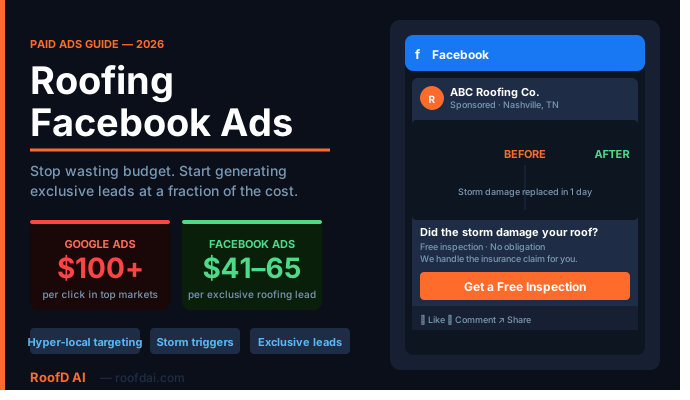
Roofing Facebook ads are the most cost-efficient paid lead generation channel available to contractors in 2026. While Google Ads for roofing keywords cost $50 to $100 or more per click in competitive markets, exclusive roofing leads from Facebook campaigns average $41 to $65 each. Furthermore, Facebook leads arrive before homeowners start comparing contractors, which means you reach them at the decision-forming stage rather than fighting for attention against four other roofers on a shared lead platform.
Most roofing contractors who try Facebook ads waste their budget and conclude the platform does not work. In reality, the platform works extremely well, but it requires a fundamentally different strategy than Google. This guide covers exactly how to build a Facebook ad system that generates qualified, exclusive roofing leads without burning through your budget on audiences that will never hire you.
Why Facebook Ads Work Differently Than Google Ads for Roofers
Understanding the core difference between Facebook and Google advertising is essential before spending a single dollar. Each platform operates on a completely different intent model, and confusing the two is the most common reason Facebook campaigns fail for roofing contractors.
Google Captures Demand. Facebook Creates It.
When a homeowner searches “roofing contractor near me” on Google, they are actively looking for a roofer right now. Google captures that existing demand. Facebook, however, reaches homeowners before they start searching, interrupting their feed at the moment they are thinking about their home, their neighborhood, or their recent storm experience. As a result, Facebook leads typically require more nurturing than Google leads, but they cost a fraction of the price and arrive exclusively to your business rather than being shared with four competitors simultaneously.
Why Facebook Works Particularly Well for Storm Season
After a significant weather event, homeowners are on their phones browsing social media within hours. Consequently, a roofing Facebook campaign targeting the affected zip codes with a storm damage inspection offer reaches motivated, high-intent homeowners at exactly the right moment, often before they have started searching on Google at all. The contractors who have storm campaigns pre-built and ready to launch within six hours of an event consistently capture the highest-quality storm leads in their market.
For a broader look at how to win more storm season jobs across all channels, read: How Roofing Contractors Can Win More Storm Season Jobs With AI
Setting Up Your Facebook Ad Campaign the Right Way
Most roofing Facebook campaigns fail because of poor setup: wrong objective, wrong audience, wrong creative, or wrong landing page. Getting these four elements right from the start determines whether your budget generates qualified leads or disappears into impressions that never convert.
Step 1: Choose the Right Campaign Objective
Facebook offers two primary campaign objectives that work for roofing lead generation: Lead Generation campaigns and Traffic campaigns. Each has distinct advantages depending on your situation.
Lead Generation campaigns use Facebook’s native instant forms. When a homeowner clicks the ad, a pre-filled form appears without leaving Facebook. The advantage is low friction. Leads submit quickly. The disadvantage, however, is that the low friction also attracts lower-intent submissions. As a result, Lead Generation campaigns produce higher volume but require more follow-up to convert.
Traffic campaigns send homeowners to a dedicated landing page on your website. The extra step of loading a page filters out casual browsers. Furthermore, homeowners who arrive on your website encounter your AI chatbot, which engages them immediately, delivers an instant estimate, and captures a fully qualified lead with far more context than a basic Facebook form submission provides.
For roofing contractors with RoofD AI active on their website, Traffic campaigns almost always outperform Lead Generation campaigns because the chatbot converts arriving traffic into richer, more qualified leads automatically.
Step 2: Build the Right Target Audience
Audience targeting is where most roofing Facebook ad budgets are wasted. Targeting “everyone interested in home improvement” within 50 miles generates impressions from renters, apartment dwellers, and people three states away who have no relevance to your business. In contrast, a tightly built audience targeting homeowners in your specific service area produces dramatically better results at lower cost per lead.
The most effective roofing Facebook audience targets include homeowners aged 35 to 65 in your specific service area zip codes, people with household incomes above $60,000, and custom audiences built from your existing customer list for lookalike modeling. Additionally, targeting people who have recently interacted with your website or Facebook page, through retargeting campaigns, consistently produces the highest conversion rates of any Facebook audience type.
Step 3: Create Ad Creative That Stops the Scroll
Before-and-after photos are the single highest-performing creative format for roofing Facebook ads. A homeowner scrolling their feed at 9pm after noticing their ceiling water stain stops on a before-and-after image of a damaged roof transformed into a beautiful new installation. The visual does the selling before they read a single word of copy.
Video ads showing the inspection and replacement process work extremely well for building trust. Furthermore, storm damage inspection offer ads (“Free roof inspection after last week’s storm. We handle the insurance paperwork”) consistently generate the highest lead volume because they address an urgent, specific problem with a low-commitment offer.
What Ad Copy Works Best for Roofing
Effective roofing Facebook ad copy follows a simple formula: identify the problem, present the offer, remove the barrier, and provide a clear next step. For example: “Did the recent storm damage your roof? We’re offering free inspections this week, no obligation. We handle the insurance claim process for you. Limited slots available.” That copy identifies the problem (storm damage), presents the offer (free inspection), removes the barrier (no obligation, insurance handled), and creates urgency (limited slots). Moreover, keeping copy under 100 words consistently outperforms long-form copy on Facebook.
The 4 Types of Roofing Facebook Ad Campaigns Worth Running
Different campaign types serve different purposes in a complete roofing Facebook advertising strategy. Running all four creates a system that generates leads at every stage of the homeowner’s decision process.
Campaign Type 1: Storm Response Campaigns
These are your highest-urgency, highest-ROI campaigns. Pre-build them before storm season starts, with ad creative ready, audiences saved, and budget allocated. The moment a significant weather event hits your service area, launch the campaign targeting affected zip codes within six hours. A homeowner who sees your storm damage inspection offer the morning after a storm is far more likely to book than one reached three days later after competitors have already canvassed their neighborhood.
For a complete guide to capturing storm season leads before competitors do, read: How to Never Miss a Roofing Lead Again (Even at 2am)
Campaign Type 2: Free Inspection Lead Generation
A free inspection offer removes every barrier between a curious homeowner and a booked appointment. Running this campaign year-round at a modest budget ($15 to $30 per day) generates a steady flow of inspection requests from homeowners who are noticing roof age, minor damage, or upcoming insurance renewal concerns. Additionally, the homeowners who book free inspections are significantly more likely to approve a repair or replacement than cold inbound leads from shared platforms.
Campaign Type 3: Before-and-After Showcase Campaigns
These campaigns build brand awareness and trust in your service area without requiring immediate action from the homeowner. Featuring your most dramatic transformation photos (a damaged storm roof replaced with a beautiful new installation, a sagging old shingle roof converted to architectural shingles) keeps your brand visible and trusted among homeowners who are not ready to act yet but will be within the next year.
Furthermore, homeowners who have seen your work multiple times in their feed are significantly more likely to choose you over an unknown competitor when the moment arrives. Retargeting these audiences with inspection offer ads creates a powerful two-stage conversion funnel.
Campaign Type 4: Retargeting Campaigns
Website visitors who did not convert during their first visit represent some of the highest-value prospects in your entire marketing system. Retargeting campaigns show your ads specifically to people who visited your website, including those who chatted with your RoofD AI chatbot but did not book an appointment. These audiences already know your company and have shown purchase intent, making them significantly more likely to convert at lower cost per lead than cold audiences.
How to Connect Your Facebook Ads to Your Lead Capture and Follow-Up System
Generating Facebook leads is only half the equation. Converting those leads into booked inspections and signed contracts requires an active engagement system that responds faster than any competitor.
Why Speed Is Even More Critical for Facebook Leads
Facebook leads are typically earlier in the buying process than Google leads. They have not started actively comparing contractors yet, which means the first company that responds professionally and instantly earns a significant advantage. Furthermore, a homeowner who submitted a Facebook form while scrolling at 10pm needs an immediate, automated response that keeps them engaged before they move on and forget they submitted anything.
How RoofD AI Connects Facebook Traffic to Instant Lead Capture
When your Facebook Traffic campaign sends homeowners to your website, RoofD AI engages them the moment they land. The chatbot asks about their damage, collects their address, pulls a satellite-based estimate range, and captures their contact details, all before the homeowner decides whether to call or leave. As a result, every Facebook visitor who reaches your website becomes a fully qualified lead in your CRM automatically, complete with roof size, damage description, and material preference.
For a full breakdown of how AI lead capture converts paid traffic into qualified leads, read: The Real Cost of Not Having a Chatbot on Your Roofing Website
CRM Automation That Follows Up Instantly
Every lead captured from a Facebook campaign needs to receive an automated text within 60 seconds of submission. This is the single most impactful follow-up action available, and it is the one most roofing companies fail to execute consistently. Additionally, a complete CRM automation sequence fires follow-up touchpoints over the next 5 to 10 days for leads that do not respond immediately, capturing the significant percentage of Facebook leads who need multiple contacts before booking.
For a complete guide to building your CRM automation workflows, read: Roofing CRM Automation: Follow Up Every Lead on Autopilot
Budgeting and Measuring Your Roofing Facebook Ads
Running Facebook ads without proper tracking is the fastest way to waste money. Measuring the right metrics tells you exactly which campaigns are generating profitable leads and which ones need adjustment.
Starting Budget Recommendations
For roofing contractors running Facebook ads for the first time, $500 to $1,000 per month is a realistic starting budget to generate meaningful data. Furthermore, storm response campaigns deserve dedicated budget. Allocating $300 to $500 for the first 48 to 72 hours after a significant weather event consistently produces the highest ROI of any Facebook spend in the calendar year.
The Metrics That Actually Matter
Cost per lead is the most commonly tracked metric, but it is not the most important one. A $30 Facebook lead that never answers the phone is worth less than a $65 lead that converts to a $14,000 job. Therefore, track cost per booked inspection and cost per signed contract rather than cost per lead alone.
Additionally, track lead-to-inspection conversion rate by campaign type. Storm response campaigns typically convert at significantly higher rates than general awareness campaigns. Before-and-after campaigns often generate lower-quality leads than inspection offer campaigns. Knowing which campaigns produce the best-converting leads, not just the cheapest leads, lets you allocate budget toward the highest actual ROI.
When to Scale and When to Stop
Scale campaigns when cost per booked inspection drops below your target threshold and you have operational capacity to handle more jobs. In contrast, pause campaigns when cost per lead rises above $80 without a corresponding improvement in conversion rate, or when lead quality deteriorates, evidenced by low phone answer rates or high no-show rates on booked inspections.
For a complete look at how Facebook ads fit into a full roofing marketing strategy, read: Roofing Marketing Strategy: The Complete Contractor Guide for 2026
Frequently Asked Questions About Roofing Facebook Ads
Q: How much does it cost to run Facebook ads for a roofing company? Starting budgets of $500 to $1,000 per month generate enough data to optimize campaigns effectively. Storm response campaigns deserve an additional $300 to $500 allocated specifically for the 48 to 72 hours following a significant weather event. Furthermore, the average cost per exclusive roofing lead from Facebook runs $41 to $65, significantly lower than Google Ads where clicks alone can exceed $100 in competitive markets. See how RoofD AI features convert Facebook traffic into fully qualified leads automatically.
Q: Should I use Facebook Lead Ads or send traffic to my website? For roofing contractors with RoofD AI active on their website, Traffic campaigns consistently outperform Lead Generation campaigns. The AI chatbot engages arriving visitors instantly, delivers a satellite-based estimate, and captures a richer, more qualified lead than a basic Facebook instant form. However, for contractors without an active website engagement system, Lead Generation campaigns produce faster lead volume while that infrastructure is being built.
Q: What type of creative works best for roofing Facebook ads? Before-and-after photos are the single highest-performing creative format for roofing Facebook ads. Storm damage inspection offer ads consistently produce the highest lead volume because they address an urgent, specific problem with a low-commitment offer. Additionally, short video ads showing the inspection and replacement process build trust effectively for homeowners who are researching but not yet ready to book.
More Questions About Roofing Facebook Ads
Q: How do I target the right homeowners on Facebook? Target homeowners aged 35 to 65 in your specific service area zip codes with household incomes above $60,000. Furthermore, build lookalike audiences from your existing customer list to reach homeowners with similar profiles to your best customers. Retargeting audiences (people who visited your website or interacted with your Facebook page) consistently produce the highest conversion rates because they already have familiarity with your company.
Q: How quickly should I follow up with Facebook leads? Within 60 seconds is the gold standard. Facebook leads are typically earlier in the buying process and require immediate engagement to stay warm. A homeowner who submitted a form while scrolling at 10pm and receives a professional automated text within 60 seconds wakes up the next morning already engaged with your company. For a full library of follow-up text templates for every stage of the process, read: Roofing Follow Up Text Templates That Close More Jobs
Q: What is the biggest mistake roofing contractors make with Facebook ads? Targeting too broadly and measuring cost per lead instead of cost per closed job. A $30 lead that never converts is more expensive than a $65 lead that signs a $14,000 contract. Moreover, failing to build a storm response campaign in advance means scrambling to set one up after the event, when the best opportunity window has already closed. For a full breakdown of the complete roofing lead generation system, read: How to Get More Roofing Leads From Your Website Without Paying More for Ads
Start Generating Exclusive Roofing Leads From Facebook
The roofing contractors winning on Facebook in 2026 are not the ones spending the most money. They are the ones who built the right system. Precise audience targeting, proven creative formats, storm response campaigns ready to launch, and an AI-powered website that converts every click into a qualified lead automatically.
That combination turns Facebook from a budget-draining experiment into a predictable, scalable lead generation channel.
Or start your 7-day free trial. No charge until day 8, cancel any time.
