Knowing how to scale a roofing business is the question every contractor asks when they hit a ceiling. Revenue is growing, the phone is ringing, and the crews are busy — but everything still runs through the owner. Every estimate, every follow-up call, every scheduling decision, every review request. The business grows and so does the workload, but the owner cannot be in five places at once.
That ceiling is not a people problem. It is a systems problem. The roofing companies breaking through it in 2026 are not necessarily the ones hiring the fastest — they are the ones systematizing the fastest. AI tools now handle the work that used to require additional staff, enabling roofing companies to scale revenue without scaling headcount at the same rate.
This guide breaks down the exact growth stages most roofing companies move through, which AI systems unlock each stage transition, and how RoofD AI fits into the foundation of every stage.
Why Most Roofing Companies Stop Growing at the Same Point
Most roofing companies plateau somewhere between $500,000 and $1,000,000 in annual revenue. The pattern is consistent — a solo operator or small crew builds a solid local reputation, generates a steady flow of referrals and leads, wins enough jobs to stay busy, and then hits a wall.
The Owner Bottleneck
At this plateau, the owner is handling sales, estimating, scheduling, customer communication, and quality control simultaneously. Every hour spent on follow-up calls is an hour not spent closing new jobs. Every afternoon spent building estimates manually is an afternoon the business cannot scale.
Why Hiring More People Is Not the Answer
Adding staff solves some problems and creates others. More salespeople mean more leads to manage. More crews mean more scheduling complexity. More jobs mean more follow-up, more reviews to request, more estimates to send. Without systems underneath the headcount, growing the team simply amplifies the chaos rather than eliminating it.
What Actually Unlocks Growth
McKinsey research shows that up to 30% of administrative tasks can be automated with existing technology. For roofing companies specifically, the tasks that consume the most owner time — lead follow-up, estimate delivery, inspection scheduling, review requests, and CRM management — are exactly the tasks AI handles most effectively. Automating those tasks before adding headcount is what enables scalable growth.
For a full breakdown of the AI tools that power this automation, read: The Best AI Tools for Roofing Companies in 2026
The 4 Growth Stages and the AI Systems That Unlock Each One
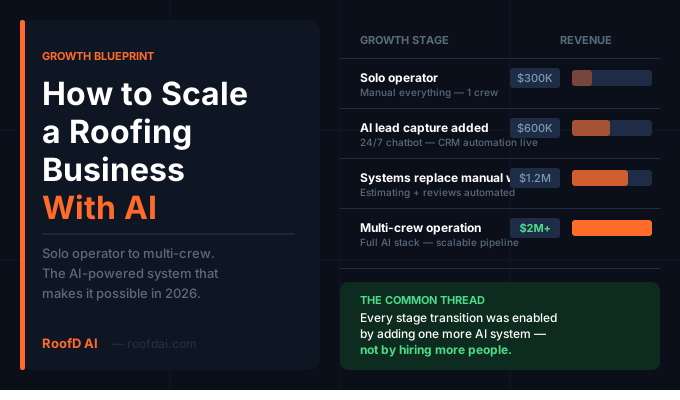
Most roofing companies move through four distinct stages on the path from solo operation to multi-crew company. Each stage transition requires adding a specific system — not just more effort or more staff.
Stage 1 — The Solo Operator ($0 to $300K)
At this stage, one person or a very small crew handles everything. Revenue is limited by hours — the owner can only do so many jobs per week, and lead follow-up happens whenever there is time. Many promising leads go cold simply because there was no time to call back.
The biggest opportunity at this stage is lead capture and instant response. A solo operator cannot answer their phone while on a roof. Without an AI chatbot capturing leads on their website, every visitor who arrives after hours or during active work is a missed opportunity.
Adding RoofD AI at this stage means the website works as a 24/7 sales assistant — capturing leads, delivering instant estimates, and pushing qualified prospects to a CRM automatically. The owner wakes up to warm leads with full context instead of cold form submissions they never had time to follow up on.
Stage 2 — The Growing Crew ($300K to $700K)
Revenue growth at this stage depends on converting a higher percentage of leads — not just generating more of them. The team is larger, jobs are coming in, but follow-up is still inconsistent. Some leads get three calls; others get one and disappear.
Adding CRM automation at this stage is the unlock. Every lead that enters the CRM triggers an automatic text sequence. Every estimate sent triggers a follow-up sequence. Every closed job triggers a review request. The sales process becomes consistent regardless of how busy the crew is — and consistency is what drives close rate improvement.
For a complete guide to setting up roofing CRM automation workflows, read: Roofing CRM Automation: Follow Up Every Lead on Autopilot
Stage 3 — The Systematized Operation ($700K to $1.5M)
At this stage, the business has consistent lead flow, solid follow-up, and a growing review base. The next bottleneck is estimating speed and inspection efficiency. A sales team that takes three days to deliver an estimate loses jobs to competitors who deliver same-day. Inspections that require manual measurements and documentation slow down the pipeline.
Adding AI estimating tools — like satellite-based instant estimates through RoofD AI and drone inspection software with AI damage detection — compresses the time between lead arrival and signed contract. Homeowners get a number faster. Inspections produce professional documentation faster. The sales cycle shortens and revenue per team member increases.
For a detailed breakdown of AI estimating tools and how they fit into the sales cycle, read: AI Roofing Estimates: What Changed for Roofers in 2026
Stage 4 — The Multi-Crew Company ($1.5M and Beyond)
Breaking through $1.5M in revenue requires operational infrastructure that does not depend on any single person. Scheduling, crew dispatch, materials management, and customer communication all need systems that run independently.
At this stage, AI tools like ServiceTitan’s scheduling optimization and GoHighLevel’s full automation suite handle the operational complexity that would otherwise require a full-time office manager. The owner shifts from working in the business to working on it — setting strategy, hiring key people, and expanding service areas while systems handle the day-to-day.
The Foundation All 4 Stages Share
Every stage of roofing business growth depends on one thing working correctly before anything else — lead capture. A business cannot scale sales, estimating, or operations if leads are slipping through the cracks at the top of the funnel.
Why Lead Capture Is the First Investment
Before adding CRM automation, before optimizing estimates, before building operational infrastructure — the website needs to capture every visitor and turn them into a qualified lead automatically. A homeowner who never becomes a lead cannot be helped by any other system in the stack.
RoofD AI sits at the foundation of every growth stage because it solves the first problem every roofing company faces — leads arriving at night, on weekends, and during storms when nobody is available to respond. Every lead the chatbot captures pushes to your CRM automatically, triggering whatever automation sequence is configured at your current growth stage.
How the System Compounds Over Time
Each system added builds on the previous one. Lead capture feeds the CRM. CRM automation feeds consistent follow-up. Consistent follow-up drives close rate. Higher close rate generates more completed jobs. More completed jobs trigger more review requests. More reviews improve Google Business Profile ranking. Better ranking drives more leads to the website. And the website captures those leads automatically — day or night — feeding the cycle again.
For a look at how this full system plays out during the highest-volume period of the year, read: How Roofing Contractors Can Win More Storm Season Jobs With AI
The AI Stack for Each Growth Stage
Building the right stack at the right stage prevents over-investing in tools you are not ready to use and under-investing in tools that would immediately move the needle.
Stage 1 Stack — Solo Operator
Priority tools: RoofD AI chatbot for 24/7 lead capture, a basic CRM for lead organization, and an automated review request system. Total monthly cost: $150 to $250. One additional closed job per month from leads that would otherwise have been missed covers the entire investment.
Stage 2 Stack — Growing Crew
Add to Stage 1: Full CRM automation workflows — instant lead acknowledgment, follow-up sequences, inspection confirmations, and estimate follow-ups. GoHighLevel or JobNimbus handles this well at this stage. Total monthly cost: $300 to $500.
Stage 3 Stack — Systematized Operation
Add to Stage 2: AI estimating tools for faster proposals, drone inspection software for professional documentation, and AI-powered review generation automation. Total monthly cost: $500 to $800. Each element pays for itself through improved close rates and faster cycle times.
Stage 4 Stack — Multi-Crew Company
Add to Stage 3: Enterprise CRM with scheduling optimization, AI-powered dispatch, and full operational automation. ServiceTitan or an equivalent enterprise platform handles this level. Total monthly cost: $1,500 and above. At this revenue level, the ROI is measured in retained jobs per week rather than per month.
For a full comparison of the tools available at each stage, read: AI Tools for Roofing Companies: Best Picks for 2026
Why Private Equity Is Buying Roofing Companies Right Now
Understanding the broader market context makes the case for systematization more urgent. Private equity firms are actively acquiring roofing companies across the United States — not because roofing is a glamorous business, but because it is a highly fragmented, largely unsystematized industry where operational efficiency creates significant value quickly.
What PE Firms Are Actually Buying
When private equity acquires a roofing company, they immediately install systems — CRM automation, lead capture infrastructure, estimating standardization, and review generation workflows. Those systems increase revenue per crew, improve close rates, and reduce owner dependency. The business becomes more valuable because it runs without requiring any single person to hold it together.
What This Means for Independent Contractors
Independent roofing contractors who build these systems themselves — before a PE-backed competitor enters their market — operate at the same efficiency level as a much larger company. AI gives a 5-person roofing crew the operational infrastructure of a 50-person operation. That competitive advantage compounds every month it is in place before the competition catches up.
For a full look at how AI is reshaping the competitive landscape for roofing contractors, read: 5 Ways Roofing Companies Are Using AI to Book More Jobs in 2026
Frequently Asked Questions About Scaling a Roofing Business
Q: What is the most important first step to scale a roofing business? Systematizing lead capture is the first and most impactful step. Before investing in additional staff, more advertising, or operational tools — make sure every lead that reaches your website gets captured automatically, regardless of the time. A solo operator with a properly configured AI chatbot captures more leads per dollar of marketing spend than a larger company without one. See how RoofD AI features work for roofing-specific lead capture.
Q: How much revenue does a roofing company need before investing in AI tools? AI tools deliver ROI at every revenue level — but the entry-level tools are specifically designed for small operations. RoofD AI starts at $99 per month. One additional closed job per month from a lead that would otherwise have been missed covers the entire investment. The question is not whether you can afford AI tools — it is whether you can afford the leads you are currently losing without them.
Q: How do I know which stage my roofing business is at? Stage identification comes down to where the primary bottleneck sits. If leads are slipping through because of slow response — Stage 1 tools are the priority. If leads are converting inconsistently because follow-up is unreliable — Stage 2 automation is the unlock. If the sales cycle is too long because estimating takes too long — Stage 3 tools accelerate it. If growth requires the owner to be involved in every decision — Stage 4 infrastructure is needed.
More Questions About Scaling a Roofing Business With AI
Q: Can AI tools replace the need to hire additional staff? AI tools delay the need for certain hires by handling tasks that would otherwise require a dedicated person. A 24/7 AI chatbot replaces the need for an after-hours receptionist. CRM automation replaces the need for a dedicated follow-up coordinator. Review generation automation eliminates a manual task that would otherwise fall to someone on the team. As revenue grows, human staff are still needed — but AI ensures each hire is added at the right time rather than as a reaction to chaos.
Q: How long does it take to see revenue growth after adding AI systems? Lead capture improvements show results immediately — the first storm event or busy period after going live typically produces measurable improvement in after-hours lead volume. CRM automation improvements show up in close rate within 30 to 60 days. Review volume improvements affect Google Business Profile ranking within 60 to 90 days. For a broader look at what the full revenue impact looks like, read: Roofing Website Not Converting? 7 Signs It’s Time for an AI Upgrade
Q: What is the biggest mistake roofing companies make when trying to scale? Adding staff before adding systems is the most common and costly mistake. Every new hire in an unsystematized business creates more management overhead without proportional revenue gain. Building the AI foundation first — lead capture, CRM automation, estimating efficiency, review generation — means each new hire operates within a system that multiplies their effectiveness rather than adding to the owner’s management load.
Start Building the System That Scales Your Business
The roofing companies growing fastest in 2026 are not necessarily the best roofers in their markets. They are the most systematized. Lead capture runs automatically. Follow-up fires without manual effort. Estimates reach homeowners faster. Reviews accumulate consistently. Each system compounds the next — and the whole operation scales without the owner having to be everywhere at once.
Building that foundation starts with one tool and one commitment to stop doing manually what a system can do better.
If you’re ready to add AI lead capture to your own operation, RoofD AI’s pricing starts with a free plan — no credit card, live in five minutes.

Or start your 7-day free trial — no charge until day 8, cancel any time.