
The roofing industry has always been relationship-driven. Word of mouth, referrals, showing up on time, doing good work. That hasn’t changed — and it won’t.
But the way homeowners find roofers, research them, and decide who to call? That has changed dramatically. And the companies keeping up with that shift are pulling ahead fast.
AI is at the center of that shift. Not the scary, replace-your-whole-business kind of AI — the practical, save-you-three-hours-a-day kind. The kind that answers leads at midnight, writes your follow-up emails, and tells you which jobs are most likely to close.
Here are five ways roofing companies are actually using it right now.
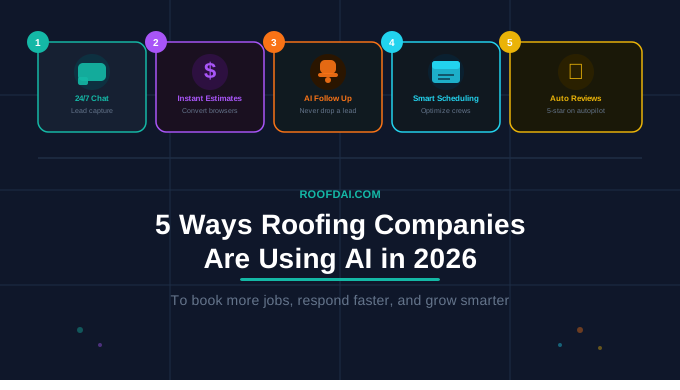
1. Capturing Leads 24/7 With AI Chat on Their Website
This is the one that’s making the biggest immediate difference for roofing companies, and it’s the most straightforward to understand.
A homeowner notices a water stain on their ceiling at 9pm on a Wednesday. They Google “roofing company near me,” click your website, and start looking around. They have questions — how much is this going to cost, how soon can someone come out, do you work with insurance?
If your website has a contact form, they fill it out and wait. Maybe you call them back the next morning. Maybe you don’t get to it until afternoon. By then they’ve already booked with someone else.
If your website has an AI chatbot, the conversation starts immediately. It asks about the damage, the roof size, the materials. It gives them a ballpark estimate. It captures their contact info and pushes a fully qualified lead into your CRM before you wake up. You call them first thing in the morning already knowing everything about the job.
That speed advantage compounds over time. Roofing companies using AI chat on their websites are converting more of their existing traffic without spending another dollar on ads. If you haven’t seen what this looks like in practice, book a demo with RoofDAI and we’ll show you a live roofing website with it running.
2. Instant Estimates That Convert Browsers Into Buyers
One of the biggest friction points in the roofing sales process is the gap between “homeowner shows interest” and “homeowner gets a number.” Traditionally that gap involves a phone call, a site visit, measurements, and a follow-up — often taking days.
AI is collapsing that timeline.
Roofing companies are now embedding instant estimating tools directly into their websites that can generate a ballpark figure based on address, roof type, material preference, and slope — all collected through a simple chat conversation. The homeowner gets a number in minutes instead of days.
This does something important psychologically. Once a homeowner has a number in their head — even a range — they’re much more committed to the process. They’ve invested time, they’ve gotten value, and they’re more likely to move forward with the company that gave it to them.
It also pre-qualifies leads beautifully. By the time the estimate lands in your CRM, you already know the job size, the material, the approximate value, and whether it’s in your service area. You’re not wasting time on tire kickers.
Check out our features page to see how RoofDAI handles the estimate conversation from first message to CRM entry.
3. AI-Powered Follow Up That Never Drops the Ball
Ask any roofing sales manager what their biggest problem is and they’ll tell you the same thing — follow up. The leads come in, things get busy, and half of them never get a second touch.
Studies consistently show that most sales require five to eight follow-up attempts before a decision is made. Most roofing companies give up after one or two. That gap is where jobs are lost.
AI is solving this in two ways. First, automated follow-up sequences that trigger the moment a lead comes in — an immediate text, a follow-up email the next day, a reminder three days later — all personalized with the homeowner’s name and job details, all sent without anyone on your team lifting a finger.
Second, AI tools that analyze your CRM data and flag leads that have gone cold but still have high potential. Instead of manually sorting through hundreds of contacts, your team gets a short list of who to call today and why.
The result is a sales process that’s consistent regardless of how busy your crew is. Storm season hits, you’re slammed, and your follow-up still goes out on time every time. That consistency is what separates roofing companies that scale from ones that plateau.
For more on building a follow-up system that never misses, read our post on how to never miss a roofing lead again.
4. Smarter Scheduling and Dispatch
Once the job is sold, AI is helping roofing companies run production more efficiently too.
Route optimization tools are helping crews spend less time driving and more time on roofs — especially important for companies running multiple crews across a wide service area. Instead of a dispatcher manually building the day’s schedule, AI analyzes job locations, crew availability, material delivery windows, and weather forecasts to suggest the most efficient schedule automatically.
Some roofing companies are also using AI to predict job duration more accurately. By analyzing historical data from past jobs — square footage, slope, material type, crew size — AI can give much tighter time estimates for new jobs, which reduces scheduling conflicts and improves the customer experience with more accurate arrival windows.
This might sound like enterprise-level technology but it’s increasingly accessible to mid-size roofing operations. Tools like ServiceTitan have AI scheduling features built in, and the ROI shows up quickly in reduced drive time and fewer scheduling conflicts.
5. Review Generation and Reputation Management on Autopilot
In 2026, your Google review count and rating are one of the biggest factors in whether a homeowner calls you or your competitor. Most homeowners won’t even click on a roofing company with fewer than 20 reviews or below a 4.5 star rating.
The problem is most roofing companies are terrible at asking for reviews. The job gets done, everyone moves on, and the review never happens — even when the homeowner was thrilled.
AI is automating this completely. The moment a job is marked complete in your CRM, an automated text goes out to the homeowner with a direct link to leave a Google review. The timing is perfect — they just had a great experience and they’re still in a positive headspace about it. Response rates on these automated review requests are dramatically higher than asking manually.
Some platforms are also using AI to monitor and respond to reviews automatically, flagging anything that needs personal attention and handling routine positive reviews with a personalized response. This keeps your online reputation active and engaged without adding work to anyone’s plate.
The compounding effect is significant. More reviews means better Google rankings, which means more organic traffic, which means more leads — all without paying for them.
The Common Thread
Look at all five of these and you’ll notice the same pattern. AI isn’t replacing the human side of roofing — the craftsmanship, the relationships, the trust. It’s handling the repetitive, time-sensitive work that was always getting dropped or done inconsistently.
The roofing companies winning right now are the ones who’ve stopped trying to hire their way out of operational problems and started automating the right things instead.
If you want to see how much of this you can put in place starting with your website, RoofDAI is the fastest place to start. Our AI chatbot captures leads, gives instant estimates, pushes to your CRM, and starts the follow-up process automatically — all from a single embed on your site.
And if you want to go deeper on the website side specifically, our post on the real cost of not having a chatbot on your roofing website has the numbers that make the case.
