AI roofing estimates are no longer a novelty. In 2026, they are becoming the standard — and the roofing contractors who understand what changed and why are pulling ahead of every competitor still running manual takeoffs and three-day proposal turnarounds.
This is not about replacing your estimating experience. It is about removing the bottlenecks that cost you jobs before your expertise even gets a chance to close them. A homeowner who gets a rough estimate in four seconds from your website is far more committed to the process than one who submitted a contact form and is waiting for a callback.
This guide breaks down exactly how AI roofing estimates work in 2026, which tools are leading the shift, and how RoofD AI fits into the estimating conversation as the first step in your sales funnel.
Why Roofing Estimates Used to Be a Bottleneck — And Still Are for Most Contractors
For most of the history of the roofing industry, estimating worked the same way. A homeowner called. A rep scheduled a site visit. The rep climbed the roof, took measurements, noted the damage, and drove back to the office. An estimate got built over the next few hours — sometimes days — and a proposal went out.
That process worked when it was the only option. However, in 2026, homeowners are no longer willing to wait three days for a number. They are submitting inquiries to three or four contractors simultaneously. The first one to deliver a credible estimate wins the inspection appointment. The rest get ignored.
The Speed Gap Is Now a Revenue Gap
Industry research consistently shows that contractors who deliver estimates same-day close at significantly higher rates than those who take 48 to 72 hours. Furthermore, the roofing market in 2026 has become more competitive, not less. Storm chasers, national brands, and franchise operations all move faster than the average independent contractor.
The speed gap is therefore a revenue gap. Every day your estimate sits in a queue is a day the homeowner is being courted by someone faster. AI roofing estimates close that gap by generating a credible, satellite-based number within seconds of a homeowner’s first inquiry — before they ever talk to a human on your team.
For a broader look at how lead response speed affects your close rate, read: How to Never Miss a Roofing Lead Again (Even at 2am)
How AI Roofing Estimates Actually Work
Understanding how the technology works helps you evaluate which tools are worth using and which ones are marketing fluff. There are three primary methods AI roofing estimate tools use to generate numbers.
Method 1 — Satellite Measurement and AI Analysis
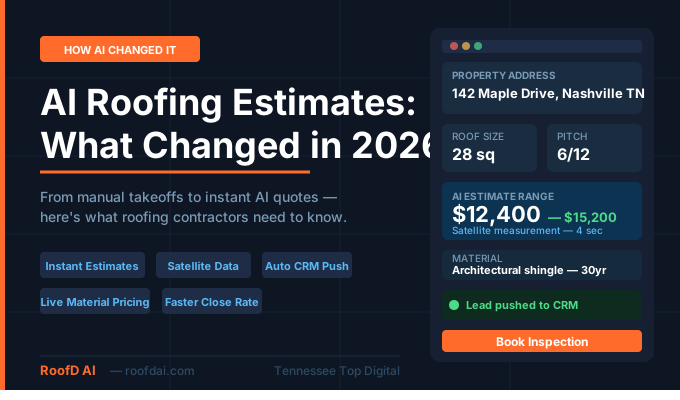
This is the most common and most useful method for lead capture and initial estimates. The homeowner enters their address. The AI pulls satellite imagery of the property, measures the roof dimensions, calculates the square footage and pitch, identifies the roof geometry, and generates a material and labor cost estimate based on current regional pricing data.
The entire process takes 4 to 10 seconds. The homeowner gets a real number — or a credible range — without anyone climbing a ladder. This is the technology that RoofD AI uses to deliver instant estimates through your website chatbot. A homeowner visits at 11pm, asks about their roof, and gets a satellite-based estimate range before the conversation ends.
Method 2 — Photo and Drone-Based AI Damage Assessment
For more detailed estimates — particularly insurance restoration work — AI tools like IMGING by Loveland Innovations analyze drone footage or uploaded photos to identify damage type, severity, and scope. The AI classifies cracked shingles, missing flashing, ponding water, and membrane damage automatically, producing a report with GPS-tagged damage locations.
This method is more accurate than satellite measurement for scoped repair work. Additionally, it significantly reduces the time your estimator spends on manual documentation. The drone captures 200 to 400 high-resolution images in under 30 minutes. The AI does the analysis. Your estimator reviews and approves.
Method 3 — Historical Job Data and Predictive Pricing
The most advanced AI estimating tools analyze your own completed job history to improve future estimates. By reviewing past jobs — square footage, slope, material type, crew size, actual vs. estimated costs — the AI identifies patterns that manual estimating misses. For example, it may show that jobs on homes built before 1985 consistently run 12% over budget due to deck repair. Consequently, future estimates for similar properties automatically adjust.
This capability is most relevant for larger operations with significant job history. However, it represents where AI estimating is heading for all roofing contractors over the next two to three years.
The Tools Leading the AI Roofing Estimate Shift in 2026
Not all AI estimating tools serve the same purpose. Understanding which tool solves which problem helps you build a stack that works together rather than duplicating effort.
RoofD AI — Instant Estimates at the Top of the Funnel
RoofD AI is not a full estimating platform — it is the first step in the estimating conversation. When a homeowner visits your website, the AI chatbot engages them, collects their address, pulls satellite roof measurements, and delivers an instant estimate range during the chat. By the time the conversation ends, you have a qualified lead in your CRM complete with roof size, material preference, damage description, and estimate range.
This is the highest-ROI point to introduce AI estimates. A homeowner who gets a number from your website is emotionally invested before your sales rep ever calls. Moreover, the lead arrives in your CRM fully contextualized — your rep is not starting from scratch, they are confirming details and booking the inspection.
For a full breakdown of the estimating tools available and how they compare, read: Roofle vs Roofr vs RoofD AI — Which Roofing Estimate Tool Is Right for Your Business?
EagleView — Insurance-Grade Aerial Measurements
EagleView is the industry standard for aerial roof measurements accepted by insurance carriers, manufacturers, and adjusters. Independent testing has confirmed 98.77% measurement accuracy. Reports integrate directly into Xactimate and most major roofing CRMs.
For contractors doing significant insurance restoration work, EagleView reports carry more credibility in adjuster negotiations than any other measurement method. In addition, the cost per report is easily justified on a single avoided scope dispute.
Roofr — Satellite Estimates With Homeowner-Facing Proposals
Roofr combines satellite measurement with a digital proposal tool that lets contractors send branded, polished estimates to homeowners electronically. It is particularly strong for retail roofing companies that want to shorten the time between initial contact and a signed contract. Homeowners can review, compare options, and accept proposals from their phone.
XBuild — AI Estimating From Plain Language Input
XBuild is an emerging AI estimating platform that lets contractors describe a job in plain language and receive a fully built, margin-accurate estimate in under 15 minutes. It pulls live material pricing from ABC Supply, SRS Distribution, and QXO. It also accepts EagleView and Roofr measurement reports as input, making it compatible with your existing workflow.
For high-volume operations where estimating consistency across multiple reps is a problem, XBuild standardizes output significantly. As a result, every estimate that leaves your team is accurate and professionally formatted regardless of who built it.
How AI Estimates Connect to Your Full Sales System
Understanding AI roofing estimates in isolation misses the bigger picture. The real value is not just in the estimate itself — it is in how the estimate connects every other part of your sales process.
The Estimate as the First Touchpoint
Before AI, the first real touchpoint in most roofing sales processes was the site visit. Everything before that — the inquiry, the callback, the scheduling — was administrative friction. AI estimates change that completely.
With RoofD AI on your website, the first touchpoint becomes the chatbot conversation. The homeowner gets value immediately — a real number, based on their actual roof, in seconds. That value exchange creates trust and commitment before your sales rep is ever involved. It also means the homeowner is less likely to shop around, because they already got what they came for from you.
The Estimate as a CRM Trigger
Every estimate generated by RoofD AI pushes a fully qualified lead to your CRM automatically via webhook. The lead includes the homeowner’s contact details, roof size, pitch, material preference, damage description, and estimate range. Your CRM then triggers your follow-up sequence — automated text within 60 seconds, automated email within 5 minutes, task for your sales rep within the hour.
This connection between estimate and CRM follow-up is where most contractors leak revenue. They generate an estimate lead but fail to follow up consistently. For more on building a follow-up system that captures every lead, read: The Real Cost of Not Having a Chatbot on Your Roofing Website
The Estimate as a Closing Tool
A homeowner who received an estimate range during their first chatbot conversation arrives at the inspection already anchored to a number. That psychological anchoring works in your favor. They are not starting fresh — they are confirming details and moving toward a decision they already began making.
For a deeper look at how AI tools work together across your full sales process, read: 5 Ways Roofing Companies Are Using AI to Book More Jobs in 2026
What AI Estimates Cannot Replace — And Why That Matters
It is important to be honest about what AI roofing estimates do well and where human judgment is still essential.
AI Estimates Are Ranges, Not Final Quotes
A satellite-based AI estimate is a credible starting point — not a binding quote. Roof pitch variations, decking conditions, flashing complexity, valley details, and accessibility all affect final pricing in ways satellite imagery cannot fully capture. Your experienced estimator adjusts for these variables during the site visit.
AI Cannot Assess Hidden Damage
Storm damage below the surface — damaged decking, compromised underlayment, deteriorated flashing — requires a physical inspection. AI estimates based on satellite data do not account for this. However, the estimate is not meant to replace the inspection. It is meant to get the homeowner committed enough to book one.
AI Estimates Need Your Pricing Data to Be Accurate
The accuracy of an AI estimate depends on the quality of the data it is working with. Regional material costs, your specific labor rates, and your waste factor assumptions all need to be configured correctly. A tool trained on national averages will produce numbers that are off for your specific market.
This is why RoofD AI requires you to configure your pricing per square, service areas, and material options during setup. The estimate the homeowner receives reflects your business — not a generic national average.
Frequently Asked Questions About AI Roofing Estimates
Q: How accurate are AI roofing estimates? Satellite-based AI estimates are accurate enough to give homeowners a credible range and set realistic expectations before the site visit. EagleView’s independent testing has confirmed 98.77% accuracy for roof measurements. However, final pricing always requires an on-site inspection to account for decking conditions, hidden damage, and site-specific factors that satellite imagery cannot capture.
Q: Will homeowners trust an AI-generated estimate? Yes — and increasingly so. Homeowners in 2026 are accustomed to instant pricing from other industries. An AI estimate that arrives within seconds of their inquiry signals that your business is modern, responsive, and organized. Furthermore, a range estimate presented with transparency — explaining that final pricing requires an inspection — builds more trust than a vague “we’ll get back to you.”
Q: Does using AI estimates reduce my close rate? The data suggests the opposite. Contractors who deliver estimates faster close at higher rates because they reach homeowners before competitors do. A homeowner who gets a number from your website is more likely to book an inspection with you than with a competitor they haven’t heard from yet. For a practical look at how this plays out during peak demand, read: How Roofing Contractors Can Win More Storm Season Jobs With AI
More Questions About AI Roofing Estimates
Q: Can I use AI estimates for insurance restoration work? For insurance restoration, satellite-based estimates are a useful starting point but not sufficient for the claim process. Insurance-grade estimates require tools like EagleView for accepted aerial measurements and Xactimate for scope writing. AI tools like RoofD AI are most valuable for capturing and qualifying the lead before the insurance process begins — getting the homeowner committed to working with you before they contact their adjuster.
Q: How does RoofD AI generate its estimates? RoofD AI uses satellite imagery and your configured pricing data — price per square, material options, service areas — to generate an estimate range during the chatbot conversation. The homeowner enters their address, the AI measures the roof, and a range is delivered within seconds. Every lead generated through this process pushes automatically to your CRM via webhook with full context — roof size, pitch, material preference, and estimate range included.
Q: What CRMs does RoofD AI push estimate leads into? RoofD AI integrates via webhook with AccuLynx, JobNimbus, HubSpot, GoHighLevel, Salesforce, Zapier, Buildertrend, and ServiceTitan. For a full breakdown of which CRM platform is right for your operation, read: JobNimbus vs AccuLynx — Which CRM Is Right for Your Roofing Company?
Q: How do I get AI estimates live on my website? Setup with RoofD AI takes under 10 minutes. Paste your website URL, configure your pricing and service areas, upload your logo, and embed one line of code. From that point forward, every homeowner who visits your website can get an instant satellite-based estimate — day or night, weekday or weekend, during a storm or after one.
Start Delivering Instant AI Roofing Estimates Before Your Next Storm Season
The roofing contractors gaining ground in 2026 are not waiting for homeowners to call. Their websites deliver estimates the moment a homeowner shows interest. Leads arrive in their CRM fully qualified. Follow-up fires automatically. Additionally, their sales reps spend their time confirming details and booking inspections — not chasing cold inquiries.
That system starts with an AI estimate on your website. Everything else builds from there.
Or start your 7-day free trial — no charge until day 8, cancel any time.