How to Get More 5-Star Google Reviews for Your Roofing Company — Automatically
By the RoofD AI Team | Roofing Business Growth | For Roofing Contractors
Roofing Google reviews are one of the most powerful drivers of new business in your market — and most roofing contractors are leaving them almost entirely to chance. A homeowner has a great experience. Your crew does excellent work. Everyone leaves happy. And then nothing happens. No review. No record of that job ever helping you win the next one.
This is not a customer satisfaction problem. It is a timing and system problem. And it is completely fixable.
At RoofD AI, we have seen firsthand how review volume and rating directly affect how many leads a roofing website generates. In this guide, we break down exactly why Google reviews matter so much for roofing contractors — and how to build a system that collects them automatically without adding a single task to your day.
Why Google Reviews Matter More for Roofing Than Almost Any Other Industry
Most industries benefit from good reviews. Roofing benefits more than most. Here is why.
Roofing Is a High-Stakes, Low-Frequency Purchase
A homeowner replaces their roof once every 20 to 30 years. They have no personal experience choosing a roofing contractor. They cannot evaluate your craftsmanship before hiring you. They are making a $10,000 to $25,000 decision based almost entirely on trust signals — and Google reviews are the most visible trust signal available.
When a homeowner searches “roofing contractor near me,” the companies appearing in the Google Local Pack — the map results at the top of the page — with the most reviews and the highest ratings get the overwhelming majority of clicks. A contractor with 4.8 stars and 120 reviews will get significantly more calls than a contractor with 4.2 stars and 11 reviews — even if the second contractor does objectively better work.
Reviews Directly Affect Your Local SEO Ranking
Google’s local ranking algorithm uses review quantity and quality as direct ranking signals. More reviews — particularly recent ones — signal to Google that your business is active, legitimate, and trusted by the community. This pushes you higher in local search results for every roofing keyword in your area.
The compounding effect is significant. More reviews push you higher. Higher rankings bring more visitors. More visitors means more opportunities for jobs. More jobs means more opportunities for reviews. The cycle builds on itself — but only if you have a system to start it.
Homeowners Read Reviews Before Calling
Most homeowners read at least three to five reviews before contacting a roofing contractor. They are not just looking at the star rating — they are reading the actual content. They want to know how the crew behaved, whether the job was done on time, how the company handled problems, and whether the homeowner felt respected and informed throughout the process.
This means every review is not just a rating — it is a sales conversation happening without you. A specific, detailed review that mentions storm damage, insurance coordination, or a clean job site is worth ten generic five-star ratings.
Why Most Roofing Contractors Struggle to Get Reviews
The work is done. The homeowner is happy. The review never comes. Here is why this happens consistently.
Timing Is Everything — And Most Contractors Miss It
The moment a homeowner is most likely to leave a review is the first 24 to 48 hours after job completion — when the experience is fresh, the roof looks great, and the relief of having it handled is still present. This window closes fast. By the time the homeowner has moved on to the next thing in their life, the motivation to leave a review has largely evaporated.
Most contractors follow up days or weeks later — if at all. By then the homeowner is no longer in the emotional headspace that produces reviews. The moment has passed.
Asking in Person Does Not Work Reliably
Most contractors who do ask for reviews do it verbally at job completion. This almost never produces a review. The homeowner nods, says they will, and forgets. Not because they did not mean it — but because there was no direct path to action in the moment. They had to remember, find your Google listing, click through to the review form, and write something. Every step between intention and action reduces follow-through significantly.
There Is No System
The contractors who consistently generate reviews are not doing anything magical. They have a system. A specific process that triggers a review request at the right moment, with the right message, through the right channel, with a direct link that removes all friction. Contractors without a system get reviews occasionally and randomly — usually only when a homeowner is exceptionally motivated.
The Anatomy of a Review Request That Actually Works
Before building a system, you need to understand what makes a review request convert. Not all requests are equal.
Text Message Beats Email Every Time
Roofing contractors live on their phones. So do their customers. A text message review request gets read within minutes of delivery. An email review request gets opened — if it gets opened — hours or days later. By then the moment has passed.
Always send your review request via text. Use email as a backup only.
The Request Needs a Direct Link
Do not ask homeowners to “find us on Google and leave a review.” Give them a direct link to your Google review form — a link that opens the review input immediately with zero navigation required. Every extra step between the request and the review form reduces your conversion rate significantly.
To get your direct Google review link: search your business name on Google, find the review count, click it, and copy the URL. Alternatively, use Google’s Place ID lookup tool to generate a direct review link for your business.
The Message Needs to Be Personal and Specific
Generic review requests convert poorly. A message that references the specific job — “the roof we completed at your home on Oak Street” — converts significantly better than “how was your recent service?” Specificity signals that this is a real human reaching out about a real experience — not an automated blast.
The Timing Must Be Precise
Send the review request within 24 hours of job completion. Ideally within the first few hours. The homeowner’s satisfaction is highest and their motivation is strongest in this window. Waiting until the following week — or sending a monthly review request batch — delivers a fraction of the results that precise timing produces.
Building Your Automatic Review Request System
Here is exactly how to build a system that collects roofing Google reviews automatically — without relying on memory, manual follow-up, or anyone on your team remembering to ask.
Step 1 — Connect Your CRM to a Review Request Trigger
Your CRM — whether AccuLynx, JobNimbus, HubSpot, or any other — is where you mark jobs complete. The moment a job is marked complete in your CRM should automatically trigger a review request. This is the foundation of the entire system.
Most CRMs support automation workflows or webhook triggers that can fire when a job status changes. If yours does not have this natively, Zapier can connect your CRM status change to almost any messaging platform. Read more about CRM options for roofing contractors here: JobNimbus vs AccuLynx — Which CRM Is Right for Your Roofing Company?
Step 2 — Write One Great Review Request Text
Write a single text message template that you will send to every customer after job completion. Keep it short, personal, and direct. Here is a template that converts well:
“Hey [Name] — this is [Your Name] from [Company]. We just finished up your roof today and we hope everything looks great. If you have 60 seconds, we’d really appreciate a Google review — it helps more than you know. Here’s the direct link: [Google Review Link]. Thank you so much.”
Three things this message does right: it is personal, it gives a specific time commitment (“60 seconds”), and it includes a direct link with zero friction.
Step 3 — Set Up the Automation
Connect your CRM job completion trigger to send this text automatically. The message goes out within the first few hours after job completion — while your crew is still cleaning up or just finished loading out.
If your CRM connects to RoofD AI, this process can be fully automated via webhook. Every job marked complete fires a review request without anyone on your team doing anything manually. For more on how AI is automating the parts of roofing sales that used to fall through the cracks, read: 5 Ways Roofing Companies Are Using AI to Book More Jobs in 2026
Step 4 — Build a One-Day Follow-Up
Not every homeowner responds to the first message. A single follow-up text sent 24 hours after the first — if no review has been left — recovers a significant percentage of the reviews you would otherwise lose. Keep it short:
“Hey [Name] — just wanted to follow up on the review link I sent yesterday. Totally understand if you’re busy — whenever you get a chance it means the world to us. [Google Review Link]”
Two messages. Sent automatically. No manual effort. This two-message sequence is the entire system for most contractors — and it produces dramatically more reviews than any verbal request at job completion.
Step 5 — Respond to Every Review
This step is often skipped — and it is a mistake. Responding to reviews signals to Google that your business is active and engaged. It also signals to future homeowners reading your reviews that you care about your customers even after the job is done.
Respond to every positive review with a genuine, specific thank-you. Respond to every negative review calmly and professionally — acknowledging the concern and offering to make it right. A well-handled negative review often converts skeptical readers better than a string of unchallenged five-stars.
What to Do When You Get a Negative Review
Even the best roofing contractors get negative reviews occasionally. How you respond matters enormously — both for the individual homeowner and for every future customer reading the exchange.
Never Respond in the Moment
If a negative review makes you angry, wait. Come back to it in a few hours. A defensive or confrontational response to a negative review is one of the most damaging things you can do to your online reputation.
Acknowledge First, Defend Second
Start every response to a negative review by acknowledging the homeowner’s experience — even if you disagree with their account. Something like: “We’re sorry to hear your experience didn’t meet our standards — that’s genuinely not acceptable to us.” This signals to readers that you take concerns seriously.
Offer a Path to Resolution
Always include a direct invitation to resolve the issue — a phone number or email where the homeowner can reach you directly. This shows that you are willing to make things right and moves the conversation off the public platform.
Never Ask Google to Remove a Legitimate Review
Attempting to game or remove negative reviews almost always backfires. Focus instead on burying them with volume — a business with 200 reviews and a 4.7 rating is far more credible than one with 20 reviews and a 5.0 rating. Volume and recency beat perfection every time.
How Review Volume Compounds Over a Season
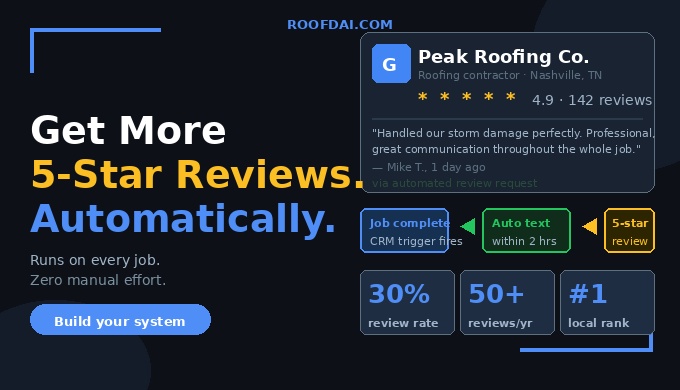
Here is the math that most contractors never think about. If your review request system converts at 30% — meaning 3 out of every 10 customers leave a review — and you complete 15 jobs per month, you are adding 4 to 5 new reviews every month automatically.
Over a 12-month period, that is 50 to 60 new reviews. Over two years, you have 100 to 120 reviews. At a 4.7 average rating, you are now one of the most reviewed roofing contractors in your market. Your Google Local Pack ranking improves. Your click-through rate improves. Your call volume improves. And it all started with one text message template and a CRM trigger.
The contractors who dominate local search in 2026 are not necessarily the best roofers. They are the ones who built systems like this while their competitors were still relying on word of mouth and the occasional organic review.
For more on how systems like this connect to your overall lead generation strategy, read: How to Never Miss a Roofing Lead Again (Even at 2am)
Roofing Contractors Using These Systems Are Already Ahead
Roofing contractors like Cupples Construction in Central Illinois understand that reputation is infrastructure. Building review volume systematically — not accidentally — is what separates contractors who dominate their local market from those who compete on price because they have not built enough trust signals to compete on reputation.
The good news is that building this system takes less than a day to set up. Once it is running, it works in the background on every single job you complete — with no ongoing effort required.
For a deeper look at the tools that make this kind of automation possible for roofing contractors, read: Roofle vs Roofr vs RoofD AI — Which Roofing Estimate Tool Is Right for Your Business?
Frequently Asked Questions About Roofing Google Reviews
Q: How many Google reviews does a roofing company need to rank well locally? There is no magic number — but in most markets, 50 or more recent reviews puts you in a competitive position. Markets with strong competition may require 100 or more. More importantly, recency matters. A consistent flow of new reviews signals to Google that your business is active. Twenty reviews added in the last 90 days is worth more than 100 reviews that are all two years old.
Q: Can I offer incentives for Google reviews? No — Google’s policies explicitly prohibit incentivizing reviews. You cannot offer discounts, gift cards, or any reward in exchange for a review. Violating this policy risks having your reviews removed or your listing penalized. The right approach is making it easy, personal, and timely — not transactional.
Q: What is the best time to ask for a Google review? Within the first 24 hours of job completion — ideally within the first few hours. This is when homeowner satisfaction is highest and motivation is strongest. Waiting more than 48 hours significantly reduces the likelihood of getting a review.
Q: Should I respond to all my Google reviews? Yes — every single one. Responding to positive reviews reinforces the relationship and signals to Google that your business is active. Responding to negative reviews professionally demonstrates accountability and often reassures potential customers more than a perfect rating alone would.
More Questions About Roofing Reputation Management
Q: How do I get a direct Google review link for my business? Search your business name on Google. When the business panel appears on the right side, scroll down to the reviews section and click “Write a review.” Copy the URL from the browser. This is your direct review link. Shorten it with a tool like Bitly before including it in text messages.
Q: What if a competitor is leaving fake negative reviews on my listing? You can flag suspicious reviews through Google Business Profile using the “Report” function. Document your concern clearly. Google does investigate flagged reviews — though the process takes time. Simultaneously, focus on generating more legitimate positive reviews to minimize the impact of any questionable ones.
Q: How does RoofD AI help with review generation? RoofD AI integrates with your CRM via webhook. When a job is marked complete, the integration can trigger automated review requests as part of your post-job workflow. Combined with our AI chatbot for lead capture, this creates a closed-loop system — from first website visit to captured lead to closed job to automatic review request — that runs without manual intervention at any step. See the full integration capabilities on our features page.
Ready to Build Your Review System?
Every job you complete without a review request is a missed opportunity. The system takes one afternoon to set up and then runs automatically on every job from that point forward.
RoofD AI connects to your CRM and helps automate the post-job workflow that most contractors handle manually — or not at all.
Or start your 7-day free trial — no charge until day 8, cancel any time.