Roofing storm season leads are the most valuable and most competitive leads in the entire industry. A hailstorm rolls through your county on a Tuesday night. By Wednesday morning, every roofing contractor within 50 miles is competing for the same homeowners. Storm chasers flood in from out of state. Phones are ringing. Doors are being knocked. And somewhere in the middle of all that chaos, a homeowner visits your website at 11pm looking for help.
What happens next determines whether you get that job or your competitor does.
At RoofD AI, we work with roofing contractors who have figured out how to win disproportionately during storm season — not by working harder, but by building systems that work while they sleep. In this guide, we break down exactly how AI gives roofing contractors a decisive edge during the most competitive weeks of the year.
Why Storm Season Is Both Your Biggest Opportunity and Your Biggest Problem
Storm season creates a surge in demand that every roofing contractor wants to capture. However, that same surge creates operational chaos that makes consistent follow-up almost impossible.
The Demand Spike Is Real
A single significant hail event in a metro area can generate thousands of homeowner inquiries within 48 hours. Homeowners who had no intention of replacing their roof are suddenly highly motivated buyers with insurance money available. The average job value in storm season is often higher than standard replacement work — insurance claims frequently cover full replacements including supplements.
This is the biggest revenue opportunity most roofing contractors will see all year. However, capturing it requires being fast, available, and responsive at exactly the moment when your team is most stretched and distracted.
The Operational Problem Is Just as Real
During a major storm event, your crew is slammed. You are coordinating emergency tarp jobs, managing insurance adjusters, chasing materials, and scheduling inspections. The last thing anyone on your team has time to do is answer every website inquiry within 5 minutes.
However, that is exactly what winning requires. Industry data consistently shows that leads contacted within 5 minutes are 9 times more likely to convert than leads contacted after 30 minutes. During storm season, your competitors are having the same conversation with the same homeowner. The one who responds first wins. For more on why speed to lead defines your conversion rate, read: How to Never Miss a Roofing Lead Again (Even at 2am)
The 3 Ways Roofing Contractors Lose Storm Season Jobs
Before getting into the solution, it helps to understand exactly where storm season jobs are lost. The same three failure points show up consistently.
Failure Point 1 — The After-Hours Gap
Storms do not follow business hours. A hailstorm hits at 6pm on a Friday. Homeowners start researching contractors that evening. They visit websites, look at reviews, and try to contact someone. Most roofing websites offer nothing but a phone number and a contact form. The homeowner fills out the form and goes to bed. By the time you call them Saturday morning, three other contractors have already been to their door.
The after-hours gap is where storm season jobs go to die. Every hour your website sits silent after a storm is an hour your competitors are capturing your leads.
Failure Point 2 — The Information Gap
Homeowners who have just experienced storm damage have urgent questions. How bad does the damage need to be to file a claim? Does their deductible make a claim worthwhile? How soon can someone come out? Roughly how much is this going to cost?
A contact form answers none of these questions. A website that cannot engage with a homeowner’s specific situation in the moment they are asking loses them to a competitor who can. Furthermore, homeowners who get real information immediately feel a sense of obligation and trust toward the company that provided it — making them far more likely to book with that contractor.
Failure Point 3 — The Follow-Up Gap
Storm season generates a flood of leads. Most roofing companies capture some of them but follow up inconsistently — because the team is overwhelmed. A lead that does not get a second touch within 24 to 48 hours during storm season is effectively a lost lead. The homeowner has been contacted by multiple contractors. They hire whoever stays present and consistent. For a practical guide to building follow-up systems that do not drop leads, read: The Real Cost of Not Having a Chatbot on Your Roofing Website
How AI Solves All Three Failure Points Simultaneously
This is where the game changes for contractors who implement AI on their websites before storm season hits. Each of the three failure points above has a direct AI solution.
Solving the After-Hours Gap — 24/7 Instant Engagement
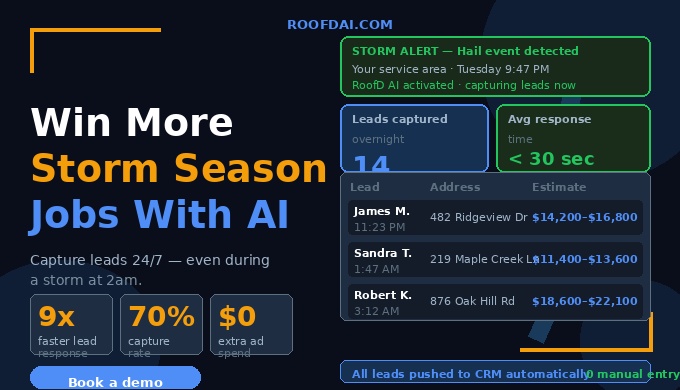
An AI chatbot on your website responds to every visitor the moment they land — day or night, weekday or weekend, during a storm or after one. When a homeowner visits your site at 11pm after a hailstorm, they do not find a silent contact form. They find an active conversation.
The bot asks about the damage. It collects the address. It gives them a rough estimate range based on satellite roof measurement. It captures their name, phone number, and email. And it pushes that fully qualified lead directly into your CRM — all before you wake up the next morning.
That is not a marginal improvement. That is the difference between capturing the lead and losing it entirely. RoofD AI was built specifically for this scenario — roofing contractors who cannot be available 24/7 but cannot afford to miss the leads that come in when they are not.
Solving the Information Gap — AI That Knows Your Business
A generic chatbot that says “thanks for reaching out, someone will contact you soon” does not solve the information gap. It just delays it. What solves it is an AI that is trained on your specific business — your service areas, your process, your shingle brands, your financing options, and your answers to the most common storm damage questions.
When RoofD AI scans your website and trains on your company profile, it learns how to represent your business specifically — not generically. A homeowner asking “do you work with State Farm?” gets a real answer. A homeowner asking “how long until someone can come out?” gets a realistic timeframe based on your service area. This specificity is what builds trust in the first interaction — and trust is what converts storm leads into booked inspections.
To see exactly how the AI trains on your website and what it learns, visit the RoofD AI features page.
Solving the Follow-Up Gap — CRM Integration That Fires Automatically
Every lead captured by RoofD AI pushes automatically to your CRM via webhook — AccuLynx, JobNimbus, HubSpot, GoHighLevel, and others. The moment a lead lands in your CRM, your automated follow-up sequences can fire immediately.
This means your team wakes up to a CRM full of qualified, organized storm leads — complete with address, roof size, damage description, material preference, and estimate range. They are not starting from scratch. They are prioritizing and calling. That is the operational difference between a contractor who closes 30% of storm leads and one who closes 10%.
For more on how CRM integration fits into the full AI-powered roofing sales system, read: 5 Ways Roofing Companies Are Using AI to Book More Jobs in 2026
Preparing Your Website for Storm Season Before It Hits
The worst time to set up your storm season lead capture system is during a storm. The contractors who win big in storm season prepared before it started. Here is exactly what that preparation looks like.
Set Up Your AI Chatbot Before Storm Season
Your AI chatbot needs to be live, trained, and tested before the first major storm event of the season. This means having your company profile fully configured — service areas, pricing per square, shingle brands, financing options, and FAQ answers — so the bot is representing your business accurately from the first conversation.
RoofD AI setup takes 5 minutes. Paste your website URL, let the AI scanner fill your profile, configure your pricing, upload your logo, and paste one line of embed code. You are live. The time to do this is before storm season — not during it.
Optimize Your Website for Storm-Related Search Terms
Homeowners searching for help after a storm use specific language. “Hail damage roof repair,” “storm damage roofing contractor,” “roof inspection after hail” — these are high-intent searches that spike dramatically after weather events in your area. Your website should have content that speaks directly to these searches so you appear when homeowners are actively looking.
Your AI chatbot captures the homeowners who find you. Your SEO gets you found in the first place. Both need to be in place before storm season for the full system to work.
Connect Your CRM and Test Your Webhook
Before storm season, test your CRM webhook integration end-to-end. Send a test lead through your chatbot and confirm it lands in your CRM with all fields populated correctly. Fix any issues now — not when you have 50 real leads coming in and no time to troubleshoot.
The contractors who treat their lead capture system as infrastructure — not an afterthought — are the ones who dominate storm season every year.
The Storm Season Math That Changes How You Think About Preparation
Here is a simple calculation that illustrates why AI preparation for storm season is one of the highest-ROI investments a roofing contractor can make.
Assume a significant storm event generates 80 homeowner inquiries to your website over 72 hours. Without an AI chatbot, your after-hours capture rate is roughly 20% — you catch the ones who call during business hours and fill out forms and wait. That is 16 leads. You close 35% — about 5 or 6 jobs. At $12,000 average storm job value, that is $60,000 to $72,000 in storm revenue.
With an AI chatbot capturing leads 24/7 and pushing them to your CRM instantly, your capture rate climbs to 70% or higher. That is 56 leads. Close the same 35% and you have 19 to 20 jobs. At $12,000 average, that is $228,000 to $240,000 in storm revenue from the same event.
The difference — roughly $168,000 — came from a system that costs $99 per month and took 5 minutes to set up. That is the storm season math. One good hail event pays for years of the tool.
What Separates Storm Season Winners From Storm Season Survivors
The roofing contractors who consistently win big in storm season share a common characteristic — they treat lead capture as infrastructure, not a last-minute reaction. They have systems in place before the first storm hits. Their websites engage visitors automatically. Their CRMs fill up with qualified leads while their crews are on roofs. Their follow-up sequences run without anyone manually managing them.
The contractors who survive storm season — rather than winning it — are the ones who scramble after every event. They know they are losing leads. They just cannot figure out where. The answer is almost always in the after-hours gap, the information gap, and the follow-up gap. And the solution to all three is the same — a properly configured AI system that runs before you even know the storm is coming.
Roofing contractors like Jeff Woods Construction & Roofing in Tennessee operate in a market where severe weather events are a regular seasonal reality. Having an AI system that captures leads during and after those events — without requiring anyone to be awake at 2am — is not a competitive advantage. It is becoming a competitive necessity.
For a full breakdown of how to compare the tools available to power this kind of system, read: Roofle vs Roofr vs RoofD AI — Which Roofing Estimate Tool Is Right for Your Business?
Frequently Asked Questions About Storm Season Roofing Leads
Q: When is the best time to set up an AI chatbot for storm season? Before storm season starts — ideally at least 30 days before your region’s peak severe weather window. This gives you time to configure the bot correctly, test the CRM integration, and make any adjustments before real leads start coming in. For most of the US, that means having everything live before April 1st.
Q: How does an AI chatbot handle storm damage inquiries specifically? A properly configured AI chatbot — trained on your company’s services and FAQ answers — can answer questions about storm damage inspection timelines, insurance claim processes, material options, and service area coverage. It collects the homeowner’s address, describes the damage, captures contact information, and delivers a satellite-based roof estimate. Everything a homeowner needs to feel informed and ready to book an inspection.
Q: Does AI replace my sales team during storm season? No — AI handles the first touch and lead capture so your sales team can focus entirely on closing. Instead of spending time chasing cold form submissions and playing phone tag, your team wakes up to a CRM full of warm, qualified leads with full context. AI makes your sales team more effective — it does not replace the human relationship that closes the job.
Q: Can RoofD AI handle the volume spike during a major storm event? Yes. RoofD AI is cloud-based and scales automatically. Whether you have 5 website visitors or 500 in a single evening, every one gets the same instant, consistent response. There is no bottleneck, no queue, and no degraded experience during high-volume periods.
More Questions About AI and Storm Season Roofing
Q: What CRMs does RoofD AI integrate with for storm lead management? RoofD AI integrates via webhook with AccuLynx, JobNimbus, HubSpot, Salesforce, GoHighLevel, Zapier, Buildertrend, and ServiceTitan. Every storm lead captured by the chatbot arrives in your CRM with full contact details, roof size, damage description, material preference, and estimate range — automatically, with no manual data entry required.
Q: How do I get more Google reviews after a strong storm season? The same automation that captures storm leads can trigger review requests after every job closes. Read our complete guide here: How to Get More 5-Star Google Reviews for Your Roofing Company — Automatically
Q: How quickly can I get RoofD AI live on my website before a storm? Setup takes 5 minutes. Paste your website URL, configure your profile, upload your logo, and paste one line of embed code. You can go from sign-up to live chatbot in under 10 minutes — which means even if a storm is already forecast, you have time to get the system in place before leads start coming in.
See RoofD AI in Action Before Storm Season Hits
The fastest way to understand the difference is to see it running on a real roofing website. Our personalized demo scans your website in 30 seconds and launches a fully trained bot — complete with your company name, service areas, and pricing. Do not wait until a storm hits to set this up.
Or start your 7-day free trial — no charge until day 8, cancel any time.