Ask five roofers how long a roof lasts and you’ll get five different answers, and honestly, all five can be right. A roof’s lifespan isn’t one number. It’s a range that depends heavily on the material, your climate, how well it was installed, and whether anyone’s actually maintained it. At RoofD AI, we work with roofing contractors across the country, and the single biggest factor we see separating a roof that dies at year 15 from one that’s still solid at year 30 isn’t the material at all, it’s maintenance.
Here’s what you can actually expect by material, what shortens a roof’s life, and the signs that tell you where yours really stands.
Roof Lifespan by Material
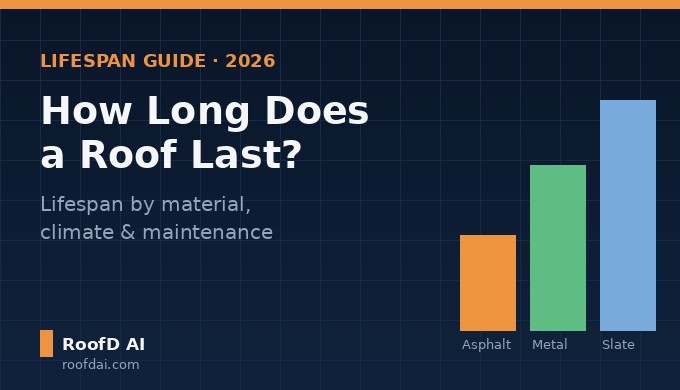
| Material | Typical Lifespan |
|---|---|
| Asphalt shingles (3-tab) | 15-20 years |
| Architectural shingles | 25-30 years |
| Metal roofing | 40-70 years |
| Clay or concrete tile | 50+ years |
| Slate | 75-100+ years |
| Wood shakes | 25-30 years |
| Flat/membrane (TPO, EPDM) | 15-25 years |
Asphalt Shingle Roofs
Standard 3-tab shingles are the most common roofing material in the US and the shortest-lived, typically 15 to 20 years. Architectural (dimensional) shingles cost more upfront but run thicker and last closer to 25 to 30 years. Climate matters a lot here: shingles in hot, sun-heavy regions degrade faster than the same product in a milder climate.
Metal Roofs
Metal roofing regularly lasts 40 to 70 years, with some standing-seam systems holding up even longer. It handles snow, wind, and fire better than shingles, and it doesn’t lose granules or curl the way asphalt does over time. The tradeoff is a higher installation cost, though the lifespan often makes it cheaper per year than replacing shingles two or three times over the same span.
Slate and Tile Roofs
Slate is the longest-lasting common roofing material, frequently reaching 75 to 100 years or more when properly installed and maintained. Clay and concrete tile aren’t far behind at 50+ years. Both are heavy and require a structure built to support that weight, which is why you’ll mostly see them on homes designed with tile or slate in mind from the start rather than added later.
Flat and Membrane Roofs
TPO, EPDM, and other membrane systems common on flat and low-slope roofs typically last 15 to 25 years. They’re more exposed to standing water and UV than a pitched roof, which is the main reason their lifespan runs shorter than steep-slope materials.
What Shortens a Roof’s Lifespan
- Poor attic ventilation: traps heat and moisture that cook shingles from underneath
- Skipped maintenance: small issues like a lifted shingle or failing flashing go unnoticed until they become bigger ones
- Improper installation: even good materials fail early if the underlayment, flashing, or nailing pattern is wrong
- Extreme climate exposure: intense sun, heavy snow load, or frequent hail all accelerate wear
- Algae and moss growth: holds moisture against the surface and breaks down shingles over time
A lot of these come down to catching problems early rather than the material itself. If it’s been a while since anyone’s checked yours, our roof inspection cost guide covers what a proper inspection catches before small issues turn into a full replacement.
Signs Your Roof Is Nearing the End
- Shingles curling, cracking, or losing granules in visible patches
- Multiple repairs in the last two to three years
- Daylight visible through the roof deck from inside the attic
- Sagging anywhere on the roofline
- Rising energy bills with no other clear cause
How Long Does a Roof Last FAQ
How long does a metal roof last?
Most metal roofs last 40 to 70 years, with standing-seam systems on the higher end of that range when properly installed and maintained.
How long does a shingle roof last?
Standard 3-tab asphalt shingles last 15 to 20 years. Architectural shingles, which are thicker, typically last 25 to 30 years.
How long does a slate roof last?
Slate roofs commonly last 75 to 100 years or more, making it the longest-lasting common roofing material when installed correctly.
How long should a roof last before replacement?
Most roofs should be evaluated for replacement once they’re within a few years of their material’s typical lifespan, or sooner if repairs are becoming frequent or the roof is showing widespread wear rather than isolated damage.
If your roof is getting close to the end of its expected lifespan, it’s worth getting real numbers before deciding between another round of repairs and a full replacement. Our repair vs. replacement guide walks through that decision, and the roof replacement cost calculator gives you a size- and material-based estimate in under a minute.
Are you a roofing contractor? Lifespan and replacement-timing questions are some of the most common things homeowners search for before they ever call a roofer. RoofD AI’s lead capture software puts an AI chat widget on your site to answer those questions instantly and turn that research phase into a booked estimate. Book a free demo to see it in action.