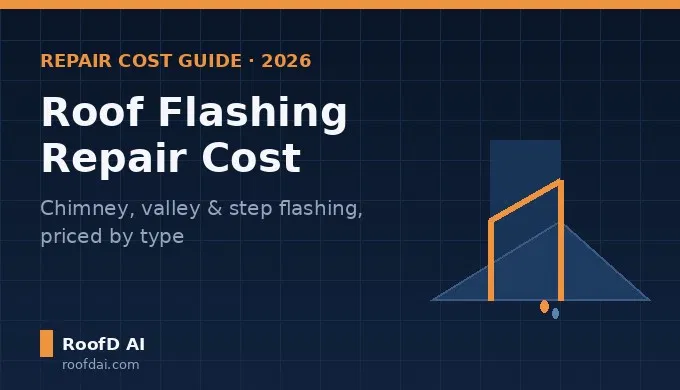
Flashing is the thin metal barrier tucked into every joint on your roof, around the chimney, along the valleys, up against walls, and it’s doing more work to keep water out than the shingles get credit for. When it fails, you usually don’t see the flashing itself go bad. You see a stain on the ceiling below it, months after the actual damage started.
Here’s what flashing repair actually costs by type, what makes it more or less expensive, and how to tell you’re dealing with a flashing problem before it turns into a bigger one.
How Much Does Roof Flashing Repair Cost?
Most flashing repairs run between $150 and $800, with the price driven almost entirely by which type of flashing is failing and how much of it needs replacing.
- Chimney flashing repair: $200 to $800
- Step flashing repair (along walls): $150 to $500
- Valley flashing repair: $300 to $1,000
- Vent pipe or skylight flashing: $150 to $400
- Drip edge replacement: $1 to $3 per linear foot
Small, localized repairs (resealing a section, replacing a single piece of step flashing) sit at the low end. A full re-flash of a chimney or valley, especially if the surrounding shingles have to come up and go back down, pushes toward the top.
What Drives the Price
Flashing Type and Location
Valley flashing tends to cost the most to repair because it sits at the point where two roof planes meet and channels the highest volume of water on the entire roof. Chimney flashing is next, since it’s usually a two-part system (base flashing and counter-flashing) and both pieces often need attention at once. Step flashing along a wall is typically the least expensive because it’s replaced piece by piece rather than as one continuous run.
How Much Shingle Removal Is Needed
If the flashing is exposed and accessible, a repair can be quick. If shingles have to be lifted or removed to get at the flashing underneath, that adds labor time, and the price climbs even if the flashing material itself is cheap.
Material
Aluminum flashing is the most common and least expensive. Copper flashing costs significantly more upfront but lasts far longer and is common on higher-end homes and older builds. Galvanized steel sits in between.
Signs Your Flashing Is Failing
- Water stains on the ceiling near a chimney, skylight, or wall line
- Visible rust, cracking, or lifted edges on the metal itself
- Gaps where sealant has dried out and pulled away from the flashing
- Daylight visible around a chimney or vent pipe from inside the attic
- A musty smell in the attic with no obvious source
Flashing problems are one of the most common causes behind a roof leak that seems to come from nowhere, since the shingles themselves can look completely fine while the metal underneath has already failed.
DIY Flashing Repair vs. Hiring a Pro
Resealing a small gap with roofing sealant is a reasonable DIY fix if you’re comfortable on a ladder and the damage is minor and easy to reach. Replacing an entire section of step flashing or re-flashing a chimney is a different job. It usually means removing shingles, cutting and bending new flashing to fit, and reinstalling everything so it still sheds water correctly. Get that sequencing wrong and you can create a leak that wasn’t there before.
If you’re seeing more than one of the warning signs above, or the flashing is around a chimney or valley rather than a single vent pipe, it’s worth having a roofer look at it before deciding to DIY.
Roof Flashing FAQ
What is roof flashing?
Roof flashing is thin metal, usually aluminum, steel, or copper, installed at the joints and transitions on a roof, such as chimneys, valleys, walls, and vent pipes, to direct water away from those vulnerable points and keep it from getting underneath the shingles.
How much does it cost to fix roof flashing?
Most flashing repairs cost $150 to $800, depending on the type and location. Chimney and valley flashing sit at the higher end; single-section step flashing repairs are usually the cheapest.
How do you put flashing on a roof?
Flashing is installed by tucking metal pieces under the shingle courses at joints and transitions, overlapping each piece so water always flows over the top of the layer below it, then sealing the top edge where it meets a wall or vertical surface. Getting the overlap direction wrong is the most common cause of a failed installation.
How often does flashing need to be replaced?
Quality flashing can last 20 to 30 years, close to the lifespan of the roof itself, but sealant around it typically needs to be checked and refreshed every few years, especially around chimneys and skylights where it’s exposed to the most movement and weather.
If flashing damage turns out to be part of a bigger problem, it’s worth getting a full picture before you spend on repairs. Our roof inspection cost guide covers what a professional inspection should catch, and if the roof is old enough that repair isn’t the right call anymore, the roof replacement cost calculator gives you a real number in under a minute.
Are you a roofing contractor? Flashing and leak calls are some of the easiest jobs to lose to a slow follow-up. RoofD AI’s lead capture software answers and qualifies these calls instantly with an AI-powered chat widget, so a homeowner with a leak isn’t waiting on a callback. Book a free demo to see it live.