Roof pitch is the one number that touches everything on a roof — how much material it needs, what shingles are allowed on it, whether a crew can walk it, and what the job costs. The catch is that pitch gets expressed four different ways (6/12, 26.6°, 50% slope, 1.118 multiplier), and converting between them is where most people get stuck. This free roof pitch calculator handles all of it: enter a rise and run — or an angle — and get your pitch, degrees, slope percentage, and area multiplier instantly, plus what that pitch means in practice.
What Roof Pitch Actually Means
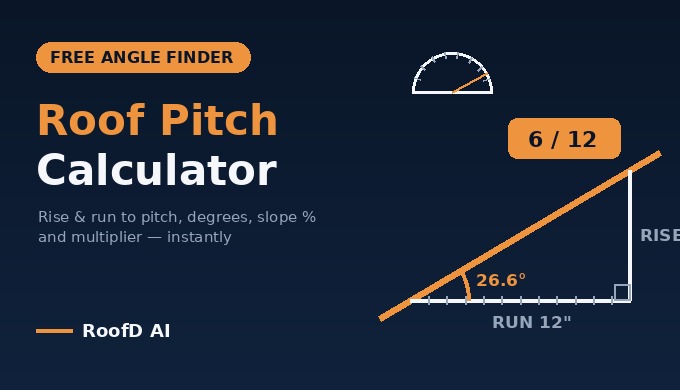
Roof pitch is simply how many inches a roof rises for every 12 inches it runs horizontally. A 6/12 pitch rises 6 inches per foot of run; a 12/12 pitch rises at a perfect 45°. That’s the whole system. Everything else (degrees, slope percent, multipliers) is the same triangle expressed differently. The math behind the calculator: angle = arctan(rise ÷ run), slope % = rise ÷ run × 100, and the area multiplier = √(rise² + run²) ÷ run, the hypotenuse that stretches a flat footprint into real roof surface.
Roof Pitch Conversion Chart
| Pitch | Angle | Slope % | Area multiplier | In practice |
|---|---|---|---|---|
| 2/12 | 9.5° | 16.7% | 1.014 | Minimum for shingles (with special underlayment) |
| 3/12 | 14.0° | 25% | 1.031 | Low slope |
| 4/12 | 18.4° | 33.3% | 1.054 | Standard minimum, easily walkable |
| 5/12 | 22.6° | 41.7% | 1.083 | Common on ranches |
| 6/12 | 26.6° | 50% | 1.118 | The most common residential pitch |
| 7/12 | 30.3° | 58.3% | 1.158 | Walkable with care |
| 8/12 | 33.7° | 66.7% | 1.202 | Steep-slope labor begins |
| 9/12 | 36.9° | 75% | 1.250 | Roof jacks required |
| 10/12 | 39.8° | 83.3% | 1.302 | Steep |
| 12/12 | 45.0° | 100% | 1.414 | A-frame territory |
Print-worthy rule of thumb: pitch ÷ 12 = slope as a decimal, and anything at 8/12 or steeper changes the labor math on your quote.
How to Measure Roof Pitch (Without Guessing)
From the attic: safest and most accurate. Hold a level horizontally against a rafter, measure 12 inches along the level from where it touches, then measure straight down from the 12-inch mark to the rafter. That vertical measurement is your rise: 6 inches means a 6/12 pitch. Two minutes, no ladder.
At the gable end or gutter edge. Same level-and-tape method against the roofline from a ladder at the eave. You never step on the roof.
With a phone. Most phones have a built-in level/measure app; lay the phone flat on a rake board or attic rafter, read the angle, and switch this calculator to Angle mode to convert. Photo-based “pitch finder” estimates from the ground work in a pinch but can miss by a full pitch increment.
From satellite imagery: how the pros do it now. Modern roofing companies skip manual measurement entirely: AI-driven estimate systems detect pitch and dimensions from aerial imagery and apply the right multipliers automatically. It’s the same math on this page, run against real measured geometry.
Why Pitch Changes the Price of Everything
Two identical footprints with different pitches are two different jobs. Pitch drives cost three ways: more surface area (a 12/12 roof has 26% more surface than a 6/12 on the same footprint; run your numbers through our roof square footage calculator to see it), slower, riskier labor (8/12 and up means jacks, harnesses, staging, and steep-slope rates), and material rules (below 2/12 shingles aren’t allowed at all; 2/12 to 4/12 requires doubled underlayment by code). This is a big reason roofing quotes vary between homes that “look the same size”, and once you know your pitch and area, our shingle calculator turns them into an exact materials list.
For Contractors: The Pitch Question Is a Buying Signal
A homeowner figuring out their roof’s angles is a homeowner heading toward a roofing decision. This keyword gets searched tens of thousands of times a month, and almost every search is early-stage roof research. The companies that capture that research traffic are the ones whose websites answer with real numbers: RoofD AI detects pitch and dimensions from satellite imagery and delivers a full estimate with your pricing, then saves the visitor’s contact details to your dashboard. The homeowner gets the answer this calculator gives, plus a price, and you get the lead.
Frequently Asked Questions
How do I calculate my roof pitch?
Measure how many inches the roof rises over a 12-inch horizontal run. A level and tape measure in the attic is the easiest method. Six inches of rise per 12 of run is a 6/12 pitch. Enter any rise and run in the calculator above to get pitch, degrees, and slope percent together.
What is a 6/12 roof pitch in degrees?
A 6/12 pitch equals 26.6 degrees, or a 50% slope, with an area multiplier of 1.118. It’s the most common residential pitch in the US: steep enough to shed water well, shallow enough to walk with care.
What roof pitch is walkable?
Most crews consider up to 7/12 walkable with proper footwear and dry conditions. From 8/12 up, roof jacks and fall protection become necessary, and labor pricing rises accordingly. Never walk any roof that’s wet, frosty, or covered in debris.
What is the minimum roof pitch for shingles?
Asphalt shingles require at least a 2/12 pitch, and between 2/12 and 4/12, building code requires special underlayment (typically two plies of felt or an ice-and-water membrane). Below 2/12, use membrane or rolled roofing systems instead.
What’s the difference between roof pitch and roof slope?
In everyday use they’re interchangeable. Technically, slope is rise over run expressed as x/12 or a percentage, while pitch historically meant rise over the full span. Modern contractors, suppliers, and this calculator all use the x/12 convention.
Every Measurement, Without the Ladder
Pitch, area, materials, price: RoofD AI runs the whole chain from satellite imagery in about two minutes, on your website, for every visitor, around the clock. Book a free demo to see it measure a real roof live, or start your 7-day free trial and turn measurement traffic into booked inspections.