
Here’s a conversation that happens in roofing offices every single month.
Leads are slow. The owner calls their marketing agency or logs into Google Ads and turns up the budget. Leads pick up a little. The budget goes up again next month. And the month after that. Until suddenly you’re spending $5,000 a month on ads and wondering where all the margin went.
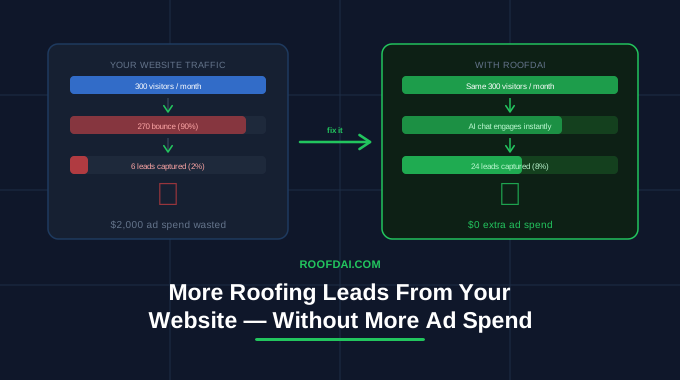
The problem isn’t the ads. The problem is the bucket has a hole in it.
You’re driving traffic to your website and most of it is leaking out the bottom without converting. Paying for more traffic doesn’t fix a conversion problem — it just makes it more expensive.
This post is about fixing the hole. Here’s how roofing companies are pulling more leads out of the traffic they already have, without touching their ad budget.
Understand Where Your Traffic Is Actually Going
Before you can fix anything, you need to know what’s happening right now. Most roofing company owners are surprised when they actually look at their Google Analytics data.
The typical pattern looks like this: a visitor lands on your homepage, looks around for 45 seconds, and leaves. Maybe they hit your contact page. Maybe they don’t. Your bounce rate is probably sitting somewhere between 60 and 80 percent, meaning the majority of people who find you online are gone before you ever had a chance to capture them.
That bounce rate is your opportunity. Every percentage point you bring it down is more leads from the same traffic.
Start by looking at three things in your analytics: which pages get the most traffic, which pages have the highest bounce rates, and where visitors are dropping off before they reach your contact page. Those three data points will tell you exactly where to focus first.
Make Your Homepage Do More Work
Most roofing company homepages are built to look good, not to convert. They have a hero image, a tagline, a list of services, and a phone number. That’s it.
A converting homepage does something different. It anticipates the question the homeowner is already asking — “how much is this going to cost me?” — and answers it immediately.
The fastest way to do this is to put your lead capture front and center. Not buried in a footer form. Not hidden on a contact page. Right there on the homepage, above the fold, with a clear value proposition: “Get an instant roof estimate in 60 seconds.”
That simple change — moving your call to action from the contact page to the homepage hero — can double or triple your conversion rate on its own. Homeowners don’t want to hunt for a way to reach you. They want it obvious and immediate.
Speed Is a Conversion Strategy
We’ve talked about this in our post on how to never miss a roofing lead again, but it bears repeating here because it directly affects your website conversion rate.
When a homeowner fills out a form or starts a chat on your website, the speed of your response is the single biggest factor in whether they convert to a booked estimate. Leads contacted within five minutes convert at dramatically higher rates than leads that wait even 30 minutes.
For most roofing companies, consistently hitting that five-minute window during business hours is hard. After hours it’s basically impossible without automation.
This is why an AI chatbot on your website isn’t just a nice-to-have — it’s a conversion tool. It responds in seconds, not minutes. It engages the homeowner while they’re still on your site, still thinking about their roof, still in the mindset to book. That immediacy is worth more than any ad optimization you could do.
RoofDAI does exactly this. Our AI chatbot responds instantly, qualifies the lead, gives them an estimate, and pushes everything to your CRM automatically. The homeowner gets a great experience, you get a qualified lead, and nobody had to be awake at 2am to make it happen.
Your Contact Form Is Costing You Leads
This is one of the most overlooked conversion killers on roofing websites.
Standard contact forms ask for too much, promise too little, and create too much friction. Name, email, phone, message, submit. That’s four fields and zero value given in return. The homeowner has no idea what happens next or when they’ll hear from you.
Two changes make a massive difference here.
First, reduce the fields. Research consistently shows that every additional field in a form reduces completion rates. For initial lead capture, you need a name and a phone number. That’s it. You can get everything else in the follow-up conversation.
Second, replace the passive form with an active conversation. Instead of “fill this out and we’ll call you,” give them something that feels like progress. An AI chat that asks about their roof and gives them a real number in return is infinitely more compelling than a blank form. It works harder, converts better, and gives you richer lead data at the same time.
For a deeper look at what a chatbot-driven contact experience looks like, check out the real cost of not having a chatbot on your roofing website.
Use Your Blog to Capture High-Intent Traffic
Homeowners searching for roofing help don’t just search for “roofing company near me.” They search for answers to questions they have right now.
“How much does a roof replacement cost in Nashville?” “How do I know if my roof needs replacing or just repairs?” “What roofing material lasts the longest?”
These are high-intent searches from people actively thinking about their roof. If your website has blog content that answers these questions, you can capture that traffic organically — without paying for a single click.
The key is making sure every blog post has a clear path to becoming a lead. Not just a general “contact us” link at the bottom — a specific, contextual call to action that connects the content to the next step. If someone is reading about roof replacement costs, the CTA should be “Get your personalized estimate in 60 seconds.” That’s relevant, timely, and much more likely to convert than a generic contact button.
This is exactly how we’ve built the RoofDAI blog — every post ends with a path to our demo because content without conversion is just content.
Optimize for Local Search, Not Just General Traffic
One of the highest-converting traffic sources for roofing companies is local organic search — people in your city searching for a roofer right now. This traffic is free, high-intent, and consistently underutilized by roofing companies that focus all their SEO energy on broad keywords.
A few things move the needle most here. Your Google Business Profile should be fully complete with photos, service areas, hours, and a steady stream of fresh reviews. Your website should have location-specific pages for every city or neighborhood you serve. And your on-page content should include local signals — city names, neighborhood references, local landmarks — that tell Google you’re the right result for someone in that area.
The compounding effect of local SEO is significant. It takes a few months to build but once it’s working it delivers consistent free traffic that converts at higher rates than paid traffic because the intent is so specific.
For more on how AI tools are helping roofing companies grow their online presence without more ad spend, read our post on 5 ways roofing companies are using AI to book more jobs in 2026.
Put It All Together
Getting more leads from your existing website traffic isn’t one big change — it’s a handful of smaller ones that compound together.
Move your call to action above the fold. Reduce friction on your contact form. Add an AI chat that responds instantly and gives homeowners real value. Create blog content that captures high-intent local searches. Build out your Google Business Profile. Track your conversion rate and improve it systematically.
None of these require a bigger ad budget. They just require treating your website like the sales tool it should be — not a digital brochure that sits there looking nice while leads bounce off it.
RoofDAI is built to handle the hardest part of this — the real-time engagement that turns visitors into leads. It takes about 10 minutes to embed on your site and starts working immediately.
The highest-converting version of this strategy is giving visitors a real number: an instant roof estimate widget turns the traffic you already have into named, phone-numbered leads.
