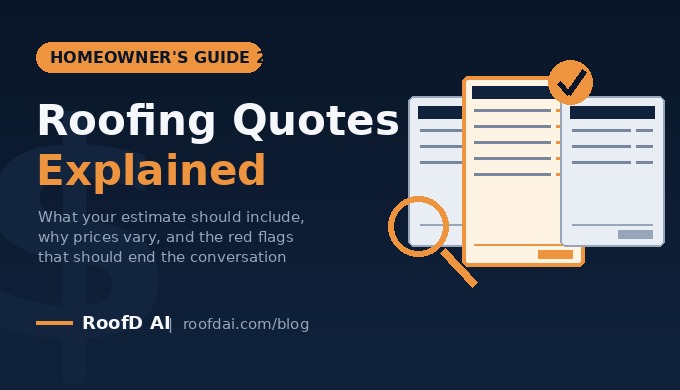
Three contractors looked at the same roof. One quoted $9,400, one quoted $14,200, and one quoted $19,800, and all three called it a “free estimate” with a straight face. If you have ever stared at roofing quotes wondering how the same shingles can vary by ten thousand dollars, this guide is for you. We will break down exactly what a legitimate roof estimate should include line by line, why prices swing so wildly, the red flags that should end a conversation immediately, and how to compare quotes so you are judging roofs against roofs, not paperwork against paperwork.
Because here is the truth most homeowners learn too late: the number at the bottom of roofing quotes matters far less than what is itemized above it.
What a Legitimate Roofing Quote Must Include
A professional roof estimate is a specification document, not a sticky note with a price. Before comparing anything, confirm every quote contains these items:
- Materials, by brand and product line. “Architectural shingles” is not a specification. “GAF Timberline HDZ, Charcoal” is. The same goes for underlayment, ice and water shield, drip edge, and ventilation components.
- Full scope of work. Tear-off (how many layers), deck inspection, replacement terms for rotten decking (usually priced per sheet), flashing replacement versus reuse, and ridge vent installation.
- Labor and installation standards. Nailing pattern, manufacturer installation specs, and who is actually on the roof: employees or subcontractors.
- Warranty terms, both of them. The manufacturer’s material warranty and the contractor’s workmanship warranty are different documents. A 30-year shingle with a 1-year workmanship warranty is a 1-year roof.
- Proof of license and insurance. License number, general liability, and workers’ comp. If a crew member falls and the roofer is uninsured, the claim can land on your homeowner’s policy.
- Payment schedule and timeline. Deposit amount, progress payments, final payment terms, and start/completion windows. Never pay in full up front.
- Cleanup, disposal, and property protection. Dumpster, magnetic nail sweep, landscaping protection.
- Permit responsibility. Who pulls it, and whose name it is in. It should be the contractor’s.
Missing items are not oversights. They are the change orders you will pay for later.
Why Roofing Quotes Vary So Much
Wild price spreads usually come from five places, and only one of them is greed:
Different materials pretending to be the same. A quote using builder-grade 3-tab shingles will beat an architectural shingle quote by thousands while both say “new roof.”
Different scopes. One contractor priced a nail-over (installing over your old shingles); another priced a full tear-off with new underlayment. The tear-off quote is more expensive and almost always the better roof.
Insurance versus overhead. Licensed, insured companies carry real costs, often $10,000+ per year in premiums alone, as we covered in what it takes to run a legitimate roofing company. The uninsured guy in an unmarked truck genuinely can charge less. You are the one carrying his risk.
Measurement accuracy. Some contractors still eyeball from the driveway. Modern companies use satellite and AI-based roof measurement to calculate exact square footage, slope, and waste factor, which is why their numbers are consistent and their surprises are rare.
Sales pressure pricing. The $19,800 quote that magically becomes $13,500 “if you sign tonight” was never a $19,800 roof. Real quotes do not expire at sunset.
A Sample Roofing Quote Breakdown
Here is what an honest replacement quote on a typical 25-square asphalt roof looks like when it is itemized properly:
| Line item | Typical range |
|---|---|
| Tear-off & disposal (1 layer) | $1,000 to $2,500 |
| Architectural shingles (materials) | $2,500 to $4,500 |
| Underlayment, ice & water, drip edge | $800 to $1,600 |
| Flashing & ventilation | $500 to $1,500 |
| Labor & installation | $3,000 to $6,000 |
| Decking repairs (per sheet, if needed) | $75 to $150/sheet |
| Permits & disposal fees | $300 to $800 |
Regional labor rates, roof pitch, stories, and complexity (valleys, skylights, chimneys) move every line. The point isn’t the totals. It’s that you can see the lines. When a quote is one number on one page, you cannot compare it to anything, and that is usually the point.
How to Compare Roofing Quotes Apples to Apples
First, normalize the materials: write each quote’s shingle brand, underlayment type, and warranty terms side by side. Second, confirm identical scope: tear-off versus overlay, decking terms, flashing replacement. Third, verify the boring paperwork: license number (check it with your state board), insurance certificates (request them directly from the insurer, not a photocopy), and lien waiver terms. Finally, weigh reviews and responsiveness. A contractor who takes four days to return a quote request will take four weeks to return a warranty call, and companies that respond instantly tend to run their whole operation that way.
Only after all four checks should price enter the decision. At that point, the spread is usually small enough that you are choosing quality, not gambling on it.
Red Flags That Should End the Conversation
- Large cash deposits or full payment up front. Standard deposits run 10 to 30%; anything more is financing their last job with your money.
- No physical address or license number on the paperwork.
- “Storm chaser” pressure after severe weather: out-of-state plates, today-only pricing, and offers to “eat your deductible” (which is insurance fraud, and it is your signature on the claim). If you are navigating hail or wind damage, read how insurance claim roofing work is supposed to go first.
- Verbal quotes. If it is not written, it does not exist.
- A price dramatically below every other quote. The cheapest bid usually becomes the most expensive roof.
Repair Estimates vs. Replacement Quotes
For roof repair estimates, expect smaller numbers but the same documentation standards: most repairs (flashing, a leak, a wind-damaged section) run $400 to $2,500. Be alert to the opposite failure modes: the handyman who patches what needed replacing, and the salesman who quotes replacement for what needed a $600 repair. A trustworthy contractor will show you photos of the damage and explain why their recommendation fits it.
The Rise of Instant Roofing Quotes Online
The biggest change in how homeowners get roofing quotes is that you no longer have to wait days for a callback to get a real number. Many modern roofing companies now offer instant estimates on their websites. AI tools measure your roof from satellite imagery, apply the company’s actual pricing, and give you a legitimate range in about two minutes, at 9pm on a Sunday if that’s when you’re researching.
Treat these instant numbers correctly: they are honest starting ranges, not contracts. Final pricing always follows a physical inspection of decking, flashing, and ventilation. But they solve the worst part of quote shopping: you can rule companies in or out by real price range before anyone climbs a ladder or sits at your kitchen table. If a roofer’s website gives you an instant satellite-measured estimate, that also tells you something about how the company operates. Transparent pricing up front usually correlates with transparent paperwork later.
Frequently Asked Questions
What should a roofing quote include?
A complete roofing quote itemizes materials by brand, full scope of work (tear-off, decking terms, flashing, ventilation), labor, both warranties (manufacturer and workmanship), license and insurance proof, payment schedule, timeline, cleanup, and permit responsibility. One-line quotes with a single price cannot be compared or enforced.
How many roofing quotes should I get?
Three is the standard. Fewer gives you no baseline; more than four usually adds confusion, not clarity. Get all quotes on identical scope and materials so differences reflect the companies, not the paperwork.
Why do roofing quotes vary so much?
Different material grades, different scopes (overlay vs. tear-off), differences in insurance and licensing overhead, measurement accuracy, and sales tactics. A $5,000 spread usually means the quotes describe different roofs. Normalize the specs before judging the prices.
Are free roofing quotes really free?
Yes. Free estimates are standard across the industry, and legitimate companies never charge for a replacement quote. Some may charge a small inspection fee for complex repair diagnostics, which reputable ones credit toward the work.
Should I take the lowest roofing quote?
Not automatically. First confirm all quotes cover identical materials, scope, and warranty terms, and that the low bidder is licensed and insured. A lowball number often signals thinner materials, no insurance, or change orders waiting to happen. The cheapest quote frequently becomes the most expensive roof.
How long is a roofing quote valid?
Most written quotes are honored for 30 to 60 days, and the validity period should be stated on the document. Material prices fluctuate, so contractors rarely hold pricing beyond that. Any quote that “expires tonight” is a pressure tactic, not a price.
For Roofing Contractors Reading This
Notice what homeowners in this guide are looking for: itemized transparency, fast answers, and a real number before the kitchen-table meeting. If your website still says “call for a free quote,” you are losing those homeowners to competitors who answer instantly. RoofD AI puts instant satellite-measured estimates and 24/7 lead capture on your website in five minutes. Book a free demo or start your 7-day free trial, and be the quote that arrives first.